1
1
GMR identifies system faults, compensates for them
automatically, and allows repair or replacement without
interrupting system operations. Faults are handled by a
software alarm processor function that time-stamps and
logs I/O and system faults in two diagnostic tables that
can be displayed by the programmer or uploaded to a host
computer or other coprocessor.
Each PLC executes continuous diagnostics to detect overt and
covert failures, reducing mean time to repair (MTTR) and
generating automatic fault reports for maintenance or
operations personnel. This fault information is readily available
to the application program, making it possible to take
appropriate control action and alerting maintenance personnel.
Memory errors are detected via parity or checksum, along with
data and address line testing.
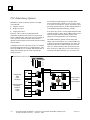
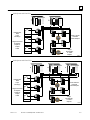
Genius I/O, with its distributed design and technology,
allows the I/O to monitor the actions of other intelligent
devices in the system and provide automatic diagnostics
without long wiring runs. Genius I/O accommodates both
local and remote installation requirements and can reduce
installation costs up to 50 percent.
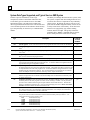
Special Features of a GMR System
In addition to the normal features of typical TMR
systems, such as fault tolerance, comprehensive
diagnostics, remote I/O, online module repair, and high
reliability and availability, GMR provides these benefits:
n
n
n
n
n
n
Application flexibility. Configurable per-point
redundancy makes it possible to customize system
hardware to specific application requirements,
thereby saving money.
Genius I/O speeds startup and eliminates long wire
runs, saving time and money.
Elimination of fuses. Temporary shorts are electronically
cleared, reducing Mean Time To Repair (MTTR)
Fault identification to point level, further reducing
MTTR. Ability to stage and debug input and output
circuitry before CPU installation using a Hand-held
Monitor.
Readily available modules through worldwide
distribution channels.
Software driven and self-documenting configuration.
System Programming and Configuration
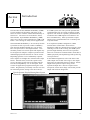
System configuration and programming are done
using software that installs on an IBM ®-PC or
1-2
compatible computer. Configuration and programming
can be done with the programming computer either online
or offline from the PLC.
The software architecture provides a structured platform
upon which to build application programs. An application
program may be built of many smaller program blocks
each related to a specific machine or process function.
This approach makes it easier to isolate and associate
control logic with machine and process functions.
GMR is shipped as a complete package providing all
safety system functions such as voting, diagnostics, and
startup control. A programmer macro allows all three
PLCs to appear as one for the purpose of downloading
and verification of the application program, saving time
and increasing accuracy.
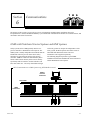
Communications
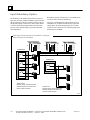
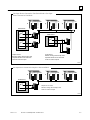
A variety of communications options make it possible to
interface the GMR system to Distributed Control Systems
(DCS), operator interfaces or workstations, host computers,
and other devices which communicate using serial
communications, either RTU MODBUS® or GE Fanuc
protocols, Ethernet TCP/IP, or GE Fanuc’s Genius LAN.
Quality is Built In
GE Fanuc has been awarded ISO 9001 certification,
assuring built-in product quality. GMR products are built
in our award-winning Charlottesville, Virginia
manufacturing facility.
GMR is based on two thoroughly field-tested product
families: the Series 90-70 PLC and the Genius I/O
system. Both have demonstrated mean time between
failure (MTBF) statistics that allow system designers to
easily achieve the safety integrity level (SIL) required in
critical applications. In addition, they are both approved
for hazardous location, Class I, Division II installation.
TÜV has certified GMR for classification to these
requirements: triplex Class 5, duplex Class 4 and 5
according to the DIN V19250/DIN V VDE 081 standards.
Field data has been accumulated and submitted for Class 6
type approval, anticipated by the end of 1997. For
information about using the GMR system in a TÜV
approved safety critical installation, refer to information in
the GMR User’s Manual (GFK-1277).
Genius® Modular Redundancy Flexible Triple Modular Redundant (TMR) System
Technical Product Overview – February 1998
GFT-177A