1
6
FEBRUARY 2, 2004 / THE ELEARNING DEVELOPERS’ JOURNAL
DESIGN /
strategies
At the same time, it must be admitted
that the best tools will not make a poor
designer produce excellent training content. Really good tools have been used
to camouflage poor design. It is certainly
easier for an incompetent instructional
designer to produce much poorer training
deliverables with an XML content reuse
system than when working alone with
MS-Word.
Assuming competent designers, some
of the most important limitations and
disadvantages of the cottage industry
approach to instructional development
are:
• Inconsistency — Since every project is
independent of every other, it is very
difficult to create and enforce standards. Even if templates are used,
designers tend to create exceptions.
• Inefficiency — There are many opportunities for reusing content that are
missed, either because designers are
unaware of legacy content that could
be adapted, or because the legacy
content is in a format that makes it
difficult to adapt to their current project.
• Inaccuracy — Because each project
recasts some of the same information
in a different way, there is no way to
globally update information and reissue training when changes occur.
• Scalability — As workloads increase
and staffing levels decline, there is no
way to maintain output and quality levels. Designers become frustrated
when they’re unable to meet the ex-
pectations of their audience.
• Tool Costs — Reliance on outmoded
tools, different versions of standard
tools, and fringe tools complicates
things, and makes people less efficient. The cost of maintaining learning
materials sourced in multiple tools is
enormous. Standardization on a few
tools and methods makes a substantial difference to the production cycle.
XML automated systems
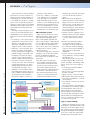
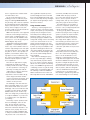
Figure 1, below, describes a content
authoring and delivery system for both
online and hard-copy training deliverables. In this example, light blue indicates tools from Adobe, orange indicates
tools from Macromedia, yellow indicates
tools from Microsoft, and purple indicates tools for open source components
or outputs. This is only one of many
equivalent solutions.
The structured approach to instructional design is seen to have the following
benefits, as William and Katherine
Horton point out in e-Learning Tools and
Technologies:
• The same courses are delivered
across multiple media and delivery
environments. Just because it happened to be developed by X using Y,
this doesn’t stand in the way of it
being reused in a completely different
environment or with different tools.
• The structured development model
supports a consistent instructional
design and development process.
Designers have many new options that
come from an efficient production
design.
• XML content can be analyzed and
repurposed much more efficiently than
legacy content. The content does not
hide in a forest of words. When needed, new and legacy content can be
efficiently blended to create educational tools to suit different needs of different student audiences.
• Learning content is organized for use.
Related content is accessible. Related
procedures and policies are obvious
— as are conflicts and inconsistencies.
• Because the relationships between
concepts and ideas are mapped
according to the taxonomy by which
the content was chunked, identifying
content for reuse and the updating of
legacy materials is significantly
streamlined.
• Content conforms to Information Technology standards to ensure portability
and long-term use.
There are three steps in the process
of implementing an XML content reuse
system: 1) Analysis, 2) Chunking, 3) Operation. The process is very simple, in
theory:
• A document type definition (DTD) is
selected and tested.
• The repository is created using tables
that mirror the DTD.
• Legacy content is converted to XML.
• XML content is placed in the repository.
• Users query the database to construct
new documents.
• Users add new content to the repository as needed.
As mentioned before, the initial analysis is perhaps the most difficult stage of
the implementation, and it is the one
stage that has the most persistent
effects. Having once decided upon the
one and only way of parsing the content,
staff members are carefully trained in
how to accomplish the chunking of legacy content into the system.
Legacy content chunking
FIGURE 1 This content authoring and delivery system produces both online and hard copy
training deliverables.
Whether this chunking process is slow
and manual or quick and automated really depends on how much legacy content
was created by properly using standardized styles and templates. If practically
none of the content was created using
standard styles and templates, then