1
CHAPTER 5. HONEYNET EXPERIMENT
37
to capture network traffic and reassemble the TCP flow. This is in the case of
unencrypted data. Encrypted data is another problem, because Sebek can only
reassemble it in its encrypted form. Instead of breaking the encryption, Sebek
circumvents it by getting the data from the Operating System’s kernel.
Sebek has a client-server architecture. On the client side, it resides entirely in
the Operating System kernel. Whenever a system call is made, Sebek hijacks
it by redirecting it to its own read() call. This way Sebek can capture the data
prior to encryption and after decryption.
After capturing the data, the client sends it to the server, which saves it in a
database or simply logs the records. The server is normally on the honeywall
machine in the case of a honeynet, and it collects data from all the honeypots
and puts it all together for analysis.
To prevent detection by intruders, Sebek employs some obfuscation methods.
On the client, it’s completely hidden from the user and therefore from an intruder on the system as well. This is however not enough because the data
captured has to be sent to the Server, thereby exposing itself. Sebek uses a
covert channel to communicate with the server. It generates packets to be sent
inside Sebek without using the TCP/IP stack and the packets are sent directly
to the driver bypassing the raw socket interface. The packets are then invisible
to the user and Sebek modifies the kernel to prevent the user from blocking
transmition of the packets.
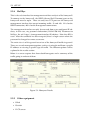
Figure 5.3: Sebek Deployment
In the case of multiple clients, there’s a risk of the clients seeing each other’s
packets. Sebek configures its own raw socket interface on the clients to ignore
all incoming Sebek packets. Only the server can receive Sebek packets. [22]
Due to its comprehensive log capabilities, it can be used as a tool for forensics
data collection. It has a web interface that can perform data analysis.