1
37
SPRECH - ASIMPLE SOFTWARE VOICE SYNTHESIZER
- by P. G. Lteschesk t III, 4510 Duval St., #203, Aust;n, Texas, 78751
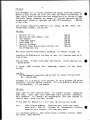
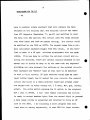
SPRECH is an output software package which can give the 1802 a voice.
It basically accepts an ASCII numeric character in RF.1 or a binary nibble (least
significant) from the accumulator D, and synthesizes the sound of that hexidigit.
It is mainly intended as a software novelty; however, it may be quite useful in
conjunction with a monitor.
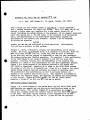
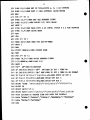
SPRECH is basically a digital voice recorder. Its algorithm is basically
similar to that used by Bobby R. Lewis in QUESTDATA (Vol. 2,#2,p. 1). The RECORD
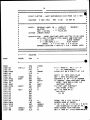
routine is used to generate the raw voice data. After manipulation and rearrangement of this data, the TEST and INTERFACE routine can be used to regenerate the
sounds of the hexidigits: 0,1,2,3 ••• F. The TALK routine is the basic subroutine
which regenerates the sound from the data in memory. TALK performs the inverse
function of RECORD.
The most difficult part of this package to implement is the voice digitalization and the voice data manipulation. After this task, SPRECH should be quite
simple to use. First, this software must be entered into the 1802 computer. It
is assumed that this package will be executed from a monitor which sets R2 as
stack pointer, R3 as program counter, and uses R4 and R5 for SCRT Call and Return
registers. Some form of audio device such as a tape recorder or an amplifier
with microphone must have its output properly connected to the EF3 line. With this
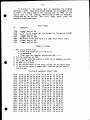
the RECORD routine is executed at location 005B. After pushing the I-key, the
numbers between 0 and F are quickly but clearly pronounced into the microphone.
The recording period should last for about twenty (20) seconds. After this, the
memory between addresses 0100 and 4000 is examined. If the amplifier is not too
noisy, the memory should be filled with primarily zeros and occasional non-zero
patches. These non-zero patches or blocks of memory are merely the digitalized
sound of each number. The first block should represent the sound for zero, while
the second block should represent the sound of one and so on. The data block
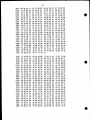
for the sound of zero is moved to memory locations 0100-02FF, while the data for
one is moved to 0300-04FF, and so on until the number F. The voice data will occupy
8K of memory since the sound for each number can be contained within two pages of
memory. After this task, the memory contents between locations 0000 and 20FF
should be saved on tape for safe keepings.
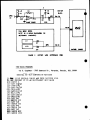
Now with this, the voice synthesieer can be used. For hardware, an amplifier
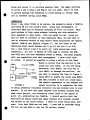
with speaker should have its input connected to the Q line (see figure 1). To
test the program and data, one should execute the TEST routine at location 0000.
With this, one can enter a number on the hexpad. After pressing the I-key, the
sound of that number will be regenerated. This routine will allow one to easily
check the sound quality of each number.
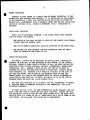
In order to use SPRECH in conjunction with a monitor, one should patch the
monitor's output routine so that the INTERFACE routine will be called at location
OOOA. The routine assumes that the output ASCII byte iR contained in RF.1~· Also