1
12_13_14_radcom_jul07
13/6/07
14:56
Page 14
PRODUCT REVIEW
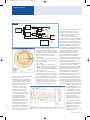
Figure 1: 2m antenna array VSWR plot
FIGURE 1
Fout
DDS
AD9859
0.1–170MHz
Low Pass
Filter
ANT
Mixer
NE612
XTAL OSC
20MHz
AMP
and stop frequency, or individual pre-stored
amateur bands, to measure across.
1KHz
Following a measurement I could store
Low Pass
DDS
Filter
AD9859
scan files as well as simply print out the
AMP
ANALOG
Mixer
scan onto a connected printer.
NE612
CPU
MSP430
Beside using my mouse to select
DIGITAL
operational modes, several one-touch ‘hot
key’ functions were available, for example
to scan, rescan, enter new limits and so on.
RS232
PC
One handy function I used the analyser for
during the review period was to make up a
© RADCOM
number of quarter-wave coax ‘stubs’.
These I’d use in line with my VHF system
term use, I stored the antenna coax
to notch out pager breakthrough on receive
parameters for each system to disc so that
as well as reducing the level of 6m
I could ‘keep an eye’ on what the ravages
transmitter 2nd harmonics. Living in a
of weather could bring; the software could
rather RF congested area as well as a
usefully superimpose either repeated
planned ‘housing estate’ village with over
scans, or a scan and a stored scan file, for
100 amateurs within a mile radius, I
me to compare.
quickly found myself popular with several
For each scan, various graph colours are
neighbouring radio colleagues in offering a
used for traces, which correspond to those
measurement service for their needs as
along the vertical axis:
well as general measurements!
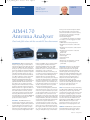
I was impressed with the AIM4170, and
•Red – SWR
checking the performance against a
•Green – Magnitude of the Impedance
•Orange – Resistive Part of the Impedance hardware-based laboratory calibrated RF
network analyser showed no discernible
•Yellow – Reactive Part of the Impedance
difference in measurements across the
•Violet – Phase Angle of the Impedance
operational range. The only difference was
•Blue – Return Loss
that the AIM4170 was rather more
As I moved my PC mouse along the
Figure 2: 80m / 40m trapped dipole Smith Chart Plot
graph scale, the actual parameter values of portable, especially when operated from an
internal battery and linked to a selfeach of these were shown on the display,
powered laptop. Also, the other (rather
eg the exact SWR figure etc, rather than
hardware, can be downloaded from the
more expensive) analyser when coupled to
having to try to visually read this from the
manufacturer’s web site at
an external HF antenna system showed
graph display. The data can even be
www.w5big.com/prog_update.htm.
plenty of ‘blips’ from off-air signals, usually
sounded out in Morse for visually-impaired
I started with a simple check of my
above around 6MHz, whereas the filtering
amateurs. I could select either an entire
existing antenna systems for VSWR,
in the AIM4170 in the same measurement
spectrum such as 1.8-30MHz, any start
although the analyser also showed me
situation completely got rid of
where the actual resonance
these and thus gave a more
occurred, which was often
accurate measurement. I was
different to the lowest SWR!
very happy indeed in using
Using this, I managed to ‘fine
the AIM4170, so much so
tune’ some of my antennas,
that I purchased it at full price
including my multi-band three
following the review for the
element HF yagi of which I had
use of myself and my
originally tuned the traps,
colleagues at my place of
several years ago, simply for
work for portable and off-site
lowest SWR on each band.
use.
Resonating this correctly should
The AIM427 is currently
of course have improved the
priced at £279 inc VAT and is
front to back ratio as well as the
distributed in the UK and Eire
forward gain and side lobe
by Vine Antennas Ltd., Tel
performance, a worthwhile time
01691 831111, who our
spent! Likewise on 2m and 6m,
where I found my antennas were Figure 3: 80m / 40m trapped dipole VSWR plot, the coax length effects can easily be thanks go to for the loan of the
analyzer for review.
each a little ‘out’. For longer
seen
Fout + 1KHz
14
RadCom ♦ July 2007