1
Technical white paper | NonStop Open System Services
MPP architecture of NonStop
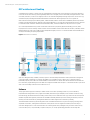
A single NonStop system is a cluster of two to 16 independent computing units, each consisting of a processor with one or
more cores and its own memory, which is generally referred to as a logical processor. Note that, throughout the rest of the
document, the terms ‘processor’ and ‘logical processor’ are used interchangeably. Each logical processor runs its own copy
of the NonStop OS, including both the Guardian and OSS environments. All the logical processors in a system are
interconnected via a high-speed switching fabric, called ServerNet, which is a forerunner of InfiniBand, which incorporated a
number of its technical innovations. All input/output (I/O) peripherals (e.g., storage and communications) are also connected
to ServerNet via I/O controllers called Cluster I/O Modules (CLIMs), and are accessible from all processors in a system.
Up to 255 independent NonStop systems can be interconnected via a proprietary layered networking protocol, called
Expand, that can run over a variety of interconnects such as ServerNet or wide-area IP networks. In effect, a NonStop-based
implementation can scale out to 4,080 (16*255) independent logical processors—a massive number that can handle most
of today’s demanding computing requirements.
Figure 2. MPP architecture of NonStop
Apart from being massively scalable, a NonStop system is also extremely fault tolerant. NonStop hardware is designed to
survive any single-point failure. For example, ServerNet is not one fabric, but two, called ‘X’ and ‘Y’. Both are used for
bandwidth purposes, but a failure of one will still allow communication to continue. All CLIMs are attached to ServerNet via
two connections, again allowing one to fail. Disks are configured as RAID1 mirrored pairs—so that there are two copies of all
data—and are actually connected to two CLIMs. And so on.
Software
The program memory layout in NonStop is similar to that of most other operating systems. A process in NonStop
represents the running instance of a program executable, called the “image.” Multiple process instances can be run using
the same image, but all those instances running on the same processor share the same copy of the code text. Each process
will have separate data segments, but these are shareable voluntarily between processes running on the same processor.
NonStop provides useful memory management utilities for runtime diagnosis and consistency checking.
The fundamentals of NonStop system design also form an excellent architecture for system security by providing a clear
separation of functions, starting at the lowest levels of the system. The code segments in NonStop are read-only (i.e.,
cannot be changed) and no code can be executed out of data segments. Non-privileged (user) processes cannot run any
code from data space, corrupt statically-compiled code space, or corrupt dynamically-generated code in a way that
3