1
Technical Newsletter
WINTER 2003
Technical Session
This Technical Session describes how EDCRASH
produces the diagnostic message “You are grossly
violating the conservation of energy.” This message
alerts the user that a difference exists between the
various methods used to calculate the energy lost
during the collision phase.
In general, EDCRASH has two available methods of
computing the damage energy. The first method uses
the results of the damage analysis, while the second
uses the loss in kinetic energy that occurs between
impact and separation.
where
= Mass of vehicle 1
m1
= Mass of vehicle 2
m2
V1,Separation = Linear velocity of vehicle 1 at separation
V2,Separation = Linear velocity of vehicle 2 at separation
= Yaw moment of inertia of vehicle 1
I1
= Yaw moment of inertia of vehicle 2
I2
1,Separation = Angular velocity of vehicle 1 at separation
ψ
2,Separation = Angular velocity of vehicle 2 at separation
ψ
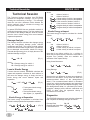
Kinetic Energy at Impact
The kinetic energy at impact is calculated in a similar
fashion:
KE Impact = 12 m1V1,2Impact + 12 m 2V22, Impact
Damage Analysis
The Damage Analysis calculates the damage energy
from the user-entered damage profile, stiffness
coefficients and PDOF. This is done for both vehicles
(unless the vehicle strikes a rigid barrier; rigid barriers
are not damaged, and therefore, absorb no energy).
The total damage energy, then, is simply the sum of the
individual damage energies:
E Damage = E 1 + E 2
(Eq. 1)
where
m1
m2
V1,Impact
V2,Impact
= Mass of vehicle 1
= Mass of vehicle 2
= Linear velocity of vehicle 1 at impact
= Linear velocity of vehicle 2 at impact
Note that for an oblique collision (i.e., a collision in
which the pre-impact velocity vectors are more that 10
degrees from parallel), there are available two
estimates of the impact velocity.
where
E1 = Damage energy for vehicle 1
E2 = Damage energy for vehicle 2
Using Linear Momentum:
Loss in Kinetic Energy
Using Damage:
VImpact = VSeparation − ∆VLinearMomentum
If scene data are entered, EDCRASH calculates the
impact and separation velocities for both vehicles. In
this case, the damage energy is simply the loss in
kinetic energy that occurs between impact and
separation:
E Damage = ∆KE = KE Impact − KE Separation
where
KEImpact
KESeparation
(Eq. 2)
= Total system kinetic energy
before impact
= Total system kinetic energy
after impact (i.e., separation)
The kinetic energy at separation is calculated from
vehicle inertial properties and separation velocities:
1
2
Iψ
2 1 1, Separation
2
2
+ 12 I 2 ψ
2, Separation
VImpact = VSeparation − ∆VDamage
(Eq. 5)
(Eq. 6)
Note that the only difference in these two estimates is
the source of the delta-V: It may come from either the
momentum-based delta-V or the damage-based
delta-V. The momentum-based delta-V is calculated
strictly from vehicle inertial properties and scene data
(path lengths, drag factors and departure angles), while
the damage-based delta-V is calculated from inertial
properties, damage profile, stiffness coefficients and
PDOF. In either case, the separation velocity is
calculated from scene data.
Diagnostics
Kinetic Energy at Separation
KE Separation = 12 m1V1,2Separation + 12 m 2V22, Separation +
(Eq. 4)
(Eq. 3)
The EDCRASH Messages report includes a diagnostic
that compares the damage energies as follows:
Damage Data:
E1 + E 2
Damage and Scene Data: KE Impact Damage − KE Separation
Linear Momentum:
KE Impact Momentum − KE Separation