1
Appendix B
Expressions and
Approximations for the
Computed Hönl–London
Factors
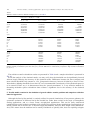
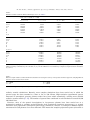
This appendix describes the approaches that have been implemented in
the SPARTAN code for the calculation of the Hönl–London Factors for bound
diatomic transitions.
Depending on the spin multiplicity of the upper and lower electronic states
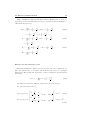
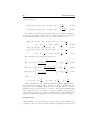
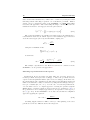
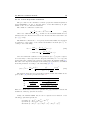
of the diatomic molecule, the number of rotational branches may go from the 3
single (P, Q, R) branches for singlet transitions, up to 12 branches for doublet
transitions (6 main branches P1 , P2 , Q1 , Q2 , R1 , R2 and 6 satellite branches
O
P12 , Q P21 , P Q12 , R Q21 , Q R12 , S R21 ), and up to 27 branches for triplet
transitions (9 main branches P1 , P2 , P3 , Q1 , Q2 , Q3 , R1 , R2 , R3 and 18
satellite branches Q P21 , R Q21 , S R21 , R P31 , S Q31 , T R31 , O P12 , P Q12 , Q R12 ,
Q
P32 , R Q32 , S R32 , N P13 , O Q13 , P R13 , O P23 , P Q23 ,Q R23 ).
Some special cases are considered in the SPARTAN code. Firstly, some
branches have very low transition probabilities and may be safely neglected, and
secondly, some branches may be indistinguishable except at very high spectral
resolution (for example, Σ states fine-structure constants have values typically
below 0.01cm−1 and appear superposed in practice. The SPARTAN code takes
advantage of this, so that only the 6 and 9 main branches for doublet and
triplet transitions are in practice calculated. This has been verified to have no
noticeable effect on the obtained results, but future versions of the code might
levy such a restriction, as improved computational power becomes available.