1
134
Part IV
Reference
ae = be * (1 + fb) * wl
Equation 4 Adjusted Earnings
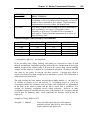
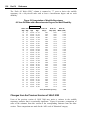
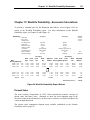
In our example, the program takes the base earnings of $23,616, adds fringe benefits of
23% (by multiplying by 1.23), then multiplies by the Probable Worklife figure of .643.
This results in the Adjusted Earnings figure of $18,678.
Past Losses
As the name implies, past losses are those losses that occurred before the date of the
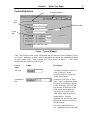
report. The program will discount past losses only if you checked the “Discount Past
Losses” box on the Defaults form (see page 49) or the “Discount Pre-Injury Earnings”
box on the Past Loss tab (see page 37). Since these losses extend backwards, the
computation of their present value is the inverse of the present value of future losses. To
document this computation, we use many of the techniques and annotations used for the
previous sections. Therefore, an understanding of those sections is necessary before
reading this one.
VALE 2000 measures present value computations of past loss from the date of injury to
the report date.
To recognize that the period is going backward in time, we must reverse the impact of the
net discount rate as shown in Equation 3 for the calculation of future loss. Equation 5
shows this calculation.
be = wb * (1 + d n ) y
Equation 5 Present Value of an Amount y Years in the Past
Future Value
Most experts prefer to present damages in terms of present value. Indeed, this is the
requirement for most courts. However, some states (i.e. New York and Michigan)
require the use of future value terms. That is, damages need to be presented in terms of
the dollar value of the year in which they will be incurred. VALE 2000 performs
computations to accommodate specifically those requirements.
As used in VALE 2000, future losses are any losses that occur after the report date. We
can state future losses in terms of present value (the value at the report date) or future
value (the value at the time the loss occurs).
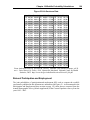
To calculate future value, the user enters a nominal growth rate and a discount rate of
zero (see page 33). The formulae described in the Present Value section of this chapter
(beginning on page 131) are then used. Use of the formulae will result in a net discount
rate (see Equation 2) that is negative; otherwise, the calculations are the same.