1
Probe Maintenance - ensuring low-noise performance
The EmD sensor sets up has a high-voltage electric field in the space behind the
diaphragm. Diaphragm movement modulates this field, such that extremely small vibrations
of the diaphragm are directly detected as field changes. For proper operation, the space in
which the field exists must be clean and dust- and lint-free, and not contain excess
moisture.
Under normal circumstances, the field will remain clean, and require no maintenance.
However, if dust, lint or moisture do enter the Probe, unexpected background of louder
noises can occur. The simple cleaning procedures below can then be used to rapidly reestablish noise-free operation, using a standard alcohol swab. These procedures are
described in great detail for clarity. However, they are simple, and take less than 2 minutes
to complete.
Noise Symptoms
Dust, lint or moisture in the field produces the following possible symptoms:
- intermittent faint white-noise.
- squealing sounds, either faint or more prominent.
- ticking sounds (static discharges).
- above artifact sounds change when the diaphragm is pressed or unscrewed slightly.
If you notice any of these symptoms, follow the cleaning procedures below. If your ds32 is
operating well, these procedures are not required for regular maintenance.
Alcohol Cleaning
- Make sure the unit is turned off.
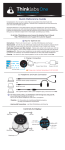
- Unscrew the diaphragm as described on
the previous page. Open the probe in a
clean, dust-free environment, and place
the open part of the probe face-up. DO
not touch the brass plate. Do not place
the open probe on a dusty surface or a
cloth surface. Lint could be attracted into
the Probe.
- Using a lint-free alcohol swab, carefully
wipe the inner surface of the diaphragm as
shown. Do not touch the inner plastic
surface of the diaphragm with anything
other than the alcohol swab.
(Continued on next page)
Rhythm :ds32
21