1
NVIDIA ® is a registered trademark of the NVIDIA Corporation
This information is the property of PathScale Inc. and cannot be used, reproduced or transmitted without authorization.
Page 1
Copyright © 2010 PathScale Inc. - DOC-ENZO08022010
Table of Contents
1 Introduction............................................................................................................................................................4
1.1 PathScale ENZO™ Overview .......................................................................................................................4
1.2 ENZO™ Runtime Overview ..........................................................................................................................4
1.3 PathScale ENZO™ Code Generation............................................................................................................5
1.4 Scope of this Document.................................................................................................................................5
2 HMPP Concept......................................................................................................................................................5
2.1 The HMPP Codelet Concept ........................................................................................................................5
2.2 HMPP Codelet Remote Procedure Call and Groups of codelets ..................................................................7
2.2.1 Execution Error with Asynchronous or Synchronous Codelet RPCs....................................................8
2.3 ENZO™ Runtime API Library Routines ........................................................................................................8
2.4 ENZO™ Memory Model ...............................................................................................................................8
3 HMPP Directives ...................................................................................................................................................8
3.1 Introduction ...................................................................................................................................................8
3.2 Concept of set of directives ........................................................................................................................10
3.3 Syntax of the HMPP directives ...................................................................................................................10
3.4 Directives for Implementing the Remote Procedure Call on an HWA .........................................................15
3.4.1 codelet Directive .................................................................................................................................15
3.4.2 group directive ....................................................................................................................................20
3.4.3 The callsite Directive ...........................................................................................................................21
3.4.4 The synchronize Directive ..................................................................................................................23
3.4.5 The allocate Directive .........................................................................................................................23
3.4.6 The release Directive ..........................................................................................................................25
3.5 Controlling Data Transfers...........................................................................................................................26
3.5.1 advancedload Directive ......................................................................................................................26
3.5.2 delegatedstore Directive .....................................................................................................................29
3.5.3 Array Sections in HMPP .....................................................................................................................31
3.5.3.1 Case of not normalized arrays ....................................................................................................32
3.5.3.2 Use of array sections in HMPP, examples...................................................................................33
3.6 HMPP data declaration ...............................................................................................................................35
3.6.1 map directive ......................................................................................................................................35
3.6.2 The mapbyname Directive...................................................................................................................37
3.6.3 The resident directive .........................................................................................................................38
3.7 Regions in HMPP........................................................................................................................................40
4 Supported Languages ........................................................................................................................................43
4.1 Input C and C++ Code.................................................................................................................................43
4.1.1 Supported C Language Constructs .....................................................................................................44
4.1.2 Parameter Passing Convention for C Codelets ..................................................................................45
4.1.3 Inlined functions ..................................................................................................................................45
4.2 Input Fortran Code ......................................................................................................................................45
4.2.1 Supported Fortran Language Constructs ............................................................................................45
4.2.1.1 Explicit declaration in codelet......................................................................................................46
4.2.1.2 Supported Data Types ................................................................................................................46
4.2.1.3 Declarations ................................................................................................................................47
4.2.1.4 Parameters .................................................................................................................................47
4.2.1.5 Inlined functions ..........................................................................................................................47
4.2.1.6 Intrinsic functions ........................................................................................................................47
4.2.1.7 Other Type Attributes and Declarations ......................................................................................47
4.2.1.8 Arrays .........................................................................................................................................47
4.2.1.9 IF statements ..............................................................................................................................48
NVIDIA ® is a registered trademark of the NVIDIA Corporation
This information is the property of PathScale Inc. and cannot be used, reproduced or transmitted without authorization.
Page 2
Copyright © 2010 PathScale Inc. - DOC-ENZO08022010
4.2.1.10 Loops ........................................................................................................................................49
4.2.1.11 Modules ....................................................................................................................................49
4.2.1.12 Operations ................................................................................................................................51
4.2.1.13 Function Calls ...........................................................................................................................51
4.2.2 Unsupported statements in codelet ....................................................................................................52
4.2.3 Parameter Passing Convention for Fortran codelets ..........................................................................52
4.2.4 Knowns limitations...............................................................................................................................52
5 Compiling HMPP Applications ............................................................................................................................52
5.1 Overview......................................................................................................................................................53
5.2 Common Command Line Parameters ........................................................................................................53
6 Running HMPP Applications................................................................................................................................53
6.1 Launching the Application............................................................................................................................53
7 HMPP Codelet Generators..................................................................................................................................53
8 Improved code generation and performance.......................................................................................................53
8.1 HMPPCG Directives Syntax .......................................................................................................................54
8.2 Interpretation order of the HMPPCG directives............................................................................................55
8.3 HMPPCG: Loop Properties .........................................................................................................................57
8.3.1 HMPPCG parallel Directive ................................................................................................................57
8.3.1.1 HMPPCG parallel: the reduce clause .........................................................................................57
8.3.2 Inhibiting Vectorization or Parallelization ............................................................................................59
8.3.3 HMPPCG Grid blocksize directive ......................................................................................................59
8.3.4 HMPPCG accelerated context queries ...............................................................................................61
8.3.4.1 The GridSupport() query .............................................................................................................63
8.3.4.2 The gridification queries ..............................................................................................................64
8.3.5 HMPPCG gridification support ............................................................................................................65
8.3.6 HMPPCG constantmemory directive...................................................................................................66
8.4 HMPPCG: loop transformations ..................................................................................................................67
8.4.1 Permute transformation.......................................................................................................................67
8.4.2 Distribute transformation .....................................................................................................................67
8.4.3 Fuse transformation ............................................................................................................................69
8.4.4 Unroll directive transformation ............................................................................................................71
8.4.4.1 Dealing with the unroll strategy ...................................................................................................72
8.4.4.2 Dealing with the remainder loop: ................................................................................................74
8.4.4.3 Dealing with scalar variables ......................................................................................................74
8.4.4.4 Jam clause .................................................................................................................................75
8.4.5 Full unroll transformation ....................................................................................................................78
8.4.6 Tile transformation ..............................................................................................................................79
9 Going further: factorization of the HMPP directives ............................................................................................81
9.1 General Rules for Preprocessor Commands ..............................................................................................81
9.1.1 Display Commands .............................................................................................................................82
9.1.2 #PRINT Command .............................................................................................................................82
9.1.3 #DEFINE Command without Argument ..............................................................................................82
9.1.4 #DEFINE Command with Arguments .................................................................................................83
9.1.5 #BLOCK and #INSERT without Arguments ........................................................................................84
9.1.6 #BLOCK and #INSERT with Arguments .............................................................................................85
10 ENZO™ Supported HWA..................................................................................................................................86
10.1.1 Hardware Accelerators .....................................................................................................................86
NVIDIA ® is a registered trademark of the NVIDIA Corporation
This information is the property of PathScale Inc. and cannot be used, reproduced or transmitted without authorization.
Page 3
Copyright © 2010 PathScale Inc. - DOC-ENZO08022010
1 Introduction
The PathScale ENZO™ Suite combines the HMPP (Hybrid Multicore Parallel Programming) open standard with
direct code generation for NVIDIA® Tesla GPUs. This approach uses the strength of the GPU as a hardware
accelerator (HWA) to replace traditional SIMD computing units.
Using HMPP directives with PathScale ENZO™ allows the programmer to write hardware independent
applications where hardware-specific code is dissociated from the legacy code. Applications do not have to be
explicitly rewritten for a target architecture.
Special thanks to CAPS Enterprise for giving us permission to reuse portions of their HMPP Workbench User
Guide [R1] for the related notes, examples and HMPP directive syntax.
1.1 PathScale ENZO™ Overview PathScale ENZO™ currently supports HMPP Fortran which, combined with the ENZO™ runtime, allows
seamless execution of ENZO™ GPGPU applications. Future versions of ENZO™ will include support for HMPP
C, C++ and ENZO™ C++ Templates.
To improve how quickly your application runs, ENZO™first identifies the regions of the application's source code
that are suitable for the HWA target. Those regions then become regions or functions called “HMPP codelets”
(see Section 2.1) using the HMPP directives. The hardware-accelerated versions of the regions or codelets are
defined in the same source language as the rest of the program, such as Fortran, using the HMPP programming
model.
The HMPP annotated source code is parsed by the PathScale Fortran frontend to translate the HMPP directives
into calls to the ENZO™ runtime API (see Section 2.3). The ENZO™ runtime API is in charge of managing the
concurrent execution of the codelets and regions.
HMPP directives also allow you to group codelets. Based on the codelet approach, these groups allow the
programmer to use data already available on a hardware accelerator so that these data can be shared between
different codelets executing at different times, without any additional data transfer between the host memory and
the HWA.
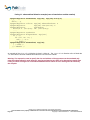
Figure 1 shows how an ENZO™ application generates and compiles code. The native code and HWA code take
the same path until the final stage when the compiler optimizes down to native heterogeneous assembly.
Figure 1 - PathScale ENZO™ Compilation Process
<insert image>
1.2 ENZO™ Runtime Overview The ENZO™ runtime API controls the remote procedure calls to the HWA. Linked to the application, this library
allocates memory and initializes the HWA to allow the execution of the codelets and regions. It relays
communications between the host and the HWA and manages the asynchronous execution of regions and
codelets.
NVIDIA ® is a registered trademark of the NVIDIA Corporation
This information is the property of PathScale Inc. and cannot be used, reproduced or transmitted without authorization.
Page 4
Copyright © 2010 PathScale Inc. - DOC-ENZO08022010
1.3 PathScale ENZO™ Code Generation
PathScale ENZO™ generates direct-to-native HWA instruction code to maximize performance . The entire
process is a unified solution, which does not rely on source-to-source conversion, and takes advantage of the
PathScale HPC compute-focused NVIDIA® Tesla drivers.
Currently, ENZO™ only supports NVIDIA® Tesla C1060 and C1070 systems, but we intend to support Tesla 20xx
by Q3 2010.
1.4 Scope of this Document
This manual covers the PathScale ENZO™ runtime, code generator and HMPP directives.
For documentation on the compiler CLI interface and installation instructions, please refer to the PathScale
ENZO™ CLI User Guide and PathScale ENZO™ Installation notes.
2 HMPP Concept
HMPP is based on the concept of codelets, functions that can be remotely executed, and regions, which are
areas of code meant to be executed on the target HWA. The ENZO™ runtime API library is in charge of remote
procedure calls (RPCs) to the HWA, as well as managing the HWA's resources. HMPP directives can define a
group of codelets, allowing the programmer to share data between different codelets that may run at different
times on the HWA. We will refer to individual codelets as "stand-alone codelets" in the rest of the document to
distinguish them from groups of codelets.
Please note that while PathScale ENZO™ does semantic checking on the directives, this does not
guarantee that all errors of incorrect usage will be reported. Misuse of the HMPP directives may lead to
erroneous results.
2.1 The HMPP Codelet Concept A codelet is a computational part of a program located inside a function. It takes several scalars and array
parameters, performs a computation on these data and returns the data. The result is passed by some
parameters given by reference (INTENT(inout) in Fortran). The function does not support any return code (it is
like a subroutine procedure in Fortran). The execution of a codelet is considered as atomic in that it does not have
an identified intermediate state or data. The execution has no side effects.
Codelet parameters are classified into two types:
•
•
Non-scalar parameters, which are restricted to array data types
Scalar parameters, which are transferred by value
The transfer of non-scalar parameters is performed via the ENZO™ Runtime protocol. The size of all parameters
must be known before the transfer of any parameter and before the codelet is executed.
A codelet has the following properties:
1.
It is a pure function.
• It does not contain static or volatile variable declarations nor refer to any global variables, unless
these have been declared by an HMPP directive “resident” (see chapter 3.6.3 for more details).
NVIDIA ® is a registered trademark of the NVIDIA Corporation
This information is the property of PathScale Inc. and cannot be used, reproduced or transmitted without authorization.
Page 5
Copyright © 2010 PathScale Inc. - DOC-ENZO08022010
It does not contain any function calls with an invisible body (that cannot be inlined). This includes
the use of libraries and system functions such as malloc, printf etc.
• Every function call must refer to a static pure function (no function pointers).
It does not return any value (void function in C or a subroutine in Fortran).
The number of arguments should be fixed (no variable number of arguments like vararg in C).
It is not recursive.
Its parameters are assumed to be non-aliased.
It does not contain callsite directives (RPC to another codelet) or other HMPP directives.
•
2.
3.
4.
5.
6.
These properties ensure that a codelet RPC can be remotely executed by an HWA. This RPC and its associated
data transfers can be asynchronous.
By default, all the parameters are uploaded to the HWA just before the RPC and downloaded just after it has
finished executing.
The examples of code below will demonstrate the correct and incorrect ways to use and define codelets.
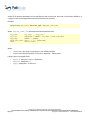
This is an example in C of a correctly-written codelet:
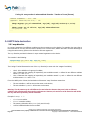
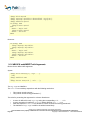
Listing 1 — Correct codelet definition
#pragma hmpp testlabel1 codelet, target=TESLA1, args[v1].io=out
static void codeletOk(int n, float v1[n], float v2[n], float v3[n]) {
int i;
for (i = 0 ; i < n ; i++) {
v1[i] = v2[i] + v3[i];
}
}
NVIDIA ® is a registered trademark of the NVIDIA Corporation
This information is the property of PathScale Inc. and cannot be used, reproduced or transmitted without authorization.
Page 6
Copyright © 2010 PathScale Inc. - DOC-ENZO08022010
You cannot use global variables in the body of a codelet because the memory is not shared between the HWA
and the CPU.
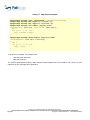
Listing 2 - Incorrect codelet definition due to use of a global variable
......
float globalVar[SIZE];
......
#pragma hmpp testlabel1 codelet, target=TESLA1, args[v1].io=out
static void codeletNotOk(int n, float v1[n], float v2[n], float v3[n]) {
int i;
for (i = 0 ; i < n ; i++) {
v1[i] = v2[i] + v3[i]*globalVar[i];
}
}
To fix the error, the global variable needs to be passed as a parameter to the codelet or be declared as a
resident variable (see chapter 3.6.3).
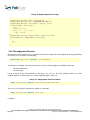
You cannot use aliasing between parameters in a codelet. The following code produces an erroneous result due
to the aliasing between v1 and v2 which point to the same caller parameters (see line 18, at the “callsite” level).
On the device, the parameters are in independent data structures.
NVIDIA ® is a registered trademark of the NVIDIA Corporation
This information is the property of PathScale Inc. and cannot be used, reproduced or transmitted without authorization.
Page 7
Copyright © 2010 PathScale Inc. - DOC-ENZO08022010
Listing 3 — Incorrect codelet definition due to aliasing between parameters
/* Legal codelet declaration */
#pragma hmpp testlabel1 codelet, target=TESLA1, args[v1].io=inout
static void codeletNotOk(int n,
float v1[n],
float v2[n],
float v3[n]) {
int i;
for (i = 1 ; i < n ; i++) {
v1[i] = v2[i-1] + v3[i];
}
}
int main(int argc, char **argv) {
............
/* wrong codelet use: the first two vectors are the same array */
#pragma hmpp testlabel1 callsite
codeletNotOk(n, t1, t1, t3);
............
}
2.2 HMPP Codelet Remote Procedure Call and groups of codelets The HMPP 1.5 directives standard specifies that the execution of a codelet should be atomic. By default, all input
parameters were uploaded to the HWA before the RPC. The size of the parameters had to be known at runtime to
initiate the memory transfers. They were provided either in the codelet's declaration (as explicit size of arrays in
the prototype) or as parameters in the HMPP directives. The output parameters were downloaded back to the
host memory once the codelet had successfully finished executing.
These rules still appear in the HMPP 2.0 directives standard, however the introduction of groups of codelets
allows the programmer to execute several codelets as a sequence, sharing the same hardware, memory, and
data. This approach reduces the overhead due to successive allocation and release of memory and hardware. It
also reduces the data transfer overhead between the host memory and the HWA memory.
The management of the hardware accelerator is the same, except that it now remains allocated for the execution
of the whole group ( not just during the execution of each individual codelet as in version 1.5). This ensures that,
once the data has been uploaded to the HWA accelerator, it's accessible to all the codelets in the same group.
Data management differs from 1.5 since it is necessary to manage the data throughout the application for different
codelets in the same group.
Before loading and executing a codelet or a group of codelets on an HWA, the ENZO™ runtime ensures thatThe
HWA is present and available (i.e. not busy) in the platform and an HWA implementation of the codelet or the
group of codelets is available.
Unless all those conditions are satisfied, ENZO™ will either wait for the HWA to be available or not run.
NVIDIA ® is a registered trademark of the NVIDIA Corporation
This information is the property of PathScale Inc. and cannot be used, reproduced or transmitted without authorization.
Page 8
Copyright © 2010 PathScale Inc. - DOC-ENZO08022010
2.2.1 Execution Error with Asynchronous or Synchronous Codelet RPCs
In the case of a synchronous (default) or asynchronous codelet RPC, when an error occurs ENZO™ will call
abort(), report the error and exit.
Asynchronous data transfer and asynchronous codelet execution are hardware accelerator-dependent.
2.3 ENZO™ Runtime API Library Routines The ENZO™ runtime API manages the concurrent execution of HWA implementations of the codelets and
regions, in combination with native code.
2.4 ENZO™ Memory Model In the current version of ENZO™, the memory addresses managed at the host level and at the HWA level are
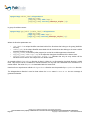
different (see Figure 3). The “application” and the ENZO™ runtime API have their own private memory. ENZO™
deals with this in a way transparent to the user. ENZO™ is the programming "glue" between target-specific
programming environments and general-purpose programming.
Figure 3 - ENZO™ memory model
<insert image>
3 HMPP Directives 3.1 Introduction The HMPP 2.0 directives are metadata added in the application's source code. They are safe as they do not
change the original code. They address the remote execution (RPC) of a function as well as the transfers of data
to/from the HWA memory.
The simplest use of HMPP directives is two directives made of a codelet declaration and a callsite marker. They
are identified by a unique label given in each directive. The scope of the label is the compilation unit but the label
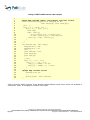
must be unique for the whole application. For instance, in the listing below the directive at line 2, testlabel
declares a TESLA1 codelet implementation to be run on an NVIDIA® GPU. The call to this codelet is on line 31.
It should be noted that the HWA implementation of a codelet is specific to a call site. This is because the use of an
HWA is specific to both a computation and its context.
NVIDIA ® is a registered trademark of the NVIDIA Corporation
This information is the property of PathScale Inc. and cannot be used, reproduced or transmitted without authorization.
Page 9
Copyright © 2010 PathScale Inc. - DOC-ENZO08022010
Listing 4- HMPP codelet source code example
1
2
3
4
5
6
7
8
9
10
11
12
13
14
15
16
17
18
19
20
21
22
23
24
25
26
27
28
29
30
31
32
33
34
35
....
#pragma hmpp testlabel codelet, target=TESLA1, args[vout].io=inout
static void kernel(unsigned int N, unsigned int M,
float vout[N][M], float vin[N][M]){
int i, j;
for(i = 2; i < (N-2); i++) {
for(j = 2; j < (M-2); j++) {
float temp;
temp = vin[i][j]
+ 0.3f *(vin[i-1][j-1] + vin[i+1][j+1])
- 0.506f *(vin[i-2][j-2] + vin[i+2][j+2]);
vout[i][j] = temp * (vout[i][j]);
}
}
}
int main(int argc, char **argv){
unsigned int n = 100;
unsigned int m = 20;
int i, j;
float resultat = 0.0f;
float out[n][m];
float in[n][m];
...
// init
for(i = 0 ; i < n ; i++){
for(j = 0 ; j < m ; j++){
in[i][j] = (COEFF) * (-1.0f);
out[i][j] = (COEFF) + (j * 0.01f) ;
}
}
#pragma hmpp testlabel callsite
kernel(n,m,out,in);
....
printf("result : %f\n",resultat);
}
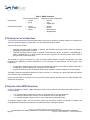
Table 1 shows the HMPP directives. These directives address different needs: some of them are dedicated to
declarations, others to managing the execution of the codelet.
NVIDIA ® is a registered trademark of the NVIDIA Corporation
This information is the property of PathScale Inc. and cannot be used, reproduced or transmitted without authorization.
Page 10
Copyright © 2010 PathScale Inc. - DOC-ENZO08022010
Table 1- HMPP Directives
Control flow instructions
Directives for data management
Declarations
• codelet
• resident
• group
• map
• mapbyname
Operational Directives
• callsite
• allocate
• synchronize
• release
• region
• advancedload
• delegatedstore
3.2 Concept of set of directives The concept of directives and their associated labels allow you to recreate a coherent structure on a whole set of
directives spread throughout an application. This is a fundamental part of HMPP.
There are two kinds of labels:
•
•
Directives associated with a codelet. In general, the directives carrying this kind of label are limited to
managing only stand-alone codelets.
Directives associated with a group of codelets. These labels are written as follows: “<LabelOfGroup>“,
where “LabelOfGroup” is a name specified by the user. In general, the directives which have a label of
this type relate to the whole group.
The concept of a group is reserved to a class of problems which requires a specific management of the data
throughout the application to obtain performance. In the following, for each directive, we will present both
notations for:
•
•
A stand-alone codelet context: only one set of directives associated to one codelet is defined. Note that in
an application, several separate set of directives can be defined.
A group of codelets: the set of directives deals with the definition of several codelets in the same group.
The HMPP directives with different labels do not see each other, i.e. a directive of a given label does not interfere
with a directive using a different label.
Please note that inside a set, directives can only interact by sharing data and data cannot be shared between two
distinct sets of directives.
3.3 Syntax of the HMPP directives In order to simplify the notation, regular expressions will be used to describe the syntax of the HMPP directives. A
summary follows.
•
•
•
“?” A question mark indicates there is either no preceding item or one preceding item.
“*” An asterisk indicates there are zero or more instances of the preceding items.
“+” A plus sign indicates there are one or more instances of the preceding items.
To keep the notation simple , we use the same notation for stand-alone codelets and groups of codelets. The
main difference between the two syntaxes is an additional label to manage the groups.
NVIDIA ® is a registered trademark of the NVIDIA Corporation
This information is the property of PathScale Inc. and cannot be used, reproduced or transmitted without authorization.
Page 11
Copyright © 2010 PathScale Inc. - DOC-ENZO08022010
We also have a color key for describing syntax directives:
•
•
•
•
Reserved HMPP keywords are in blue
Elements of grammar which can be declared as HMPP keywords are in red
Code which is meant to be empahsized is in bold black
Highlighted code is in magenta
In stand-alone codelet context, the general syntax of the HMPP directives is (for C and C++):
#pragma hmpp codelet_label directive_type [, directive_parameters]* [&]
•
The syntax for Fortran 95, 2003 and 2008 is:
!$hmpp codelet_label directive_type [, directive_parameters]* [&]
Where:
• "<grp_label>" is a unique identifier naming a group of codelets. In cases where no groups are defined
in the application, this label should be left out. A legal label name must follow this grammar: [a-z,A-Z,_][az,A-Z,0-9,_]*. Note that the “< >” characters belong to the syntax and are mandatory for this kind of label.
• "codelet_label" is a unique identifier naming a stand-alone codelet. A legal label name must follow this
grammar: [a-z,A-Z,_][a-z,A-Z,0-9,_]*.
• "directive_type" is the directive's type.
• "directive_parameters" designates some parameters associated with the directive_type. These
parameters may be of different kinds and specify either arguments given to the directive or a mode of
execution (asynchronous versus synchronous for example).
• & and \ are used to continue the directive on the next line (same for C, C++ and Fortran).
NVIDIA ® is a registered trademark of the NVIDIA Corporation
This information is the property of PathScale Inc. and cannot be used, reproduced or transmitted without authorization.
Page 12
Copyright © 2010 PathScale Inc. - DOC-ENZO08022010
Example of a simple codelet declaration with no group definition
#pragma hmpp codelet_label codelet, &
#pragma hmpp codelet_label directive_parameter &
#pragma hmpp codelet_label [, directive_parameter]*
Example of a codelet declaration inside a group
#pragma hmpp <grp_label> codelet_label codelet, &
#pragma hmpp <grp_label>
directive_parameter &
#pragma hmpp <grp_label>
[, directive_parameter]*
Furthermore, the directive's parameters may accept arguments.
We will define these two notions as follows:
•
•
Parameters.These are parameters of directives,
Arguments. These are arguments belonging to parameters.
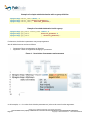
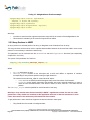
Figure 4 - Description of parameters and arguments
In this example, outv is a value of the directive parameter and points to the user's function arguments.
NVIDIA ® is a registered trademark of the NVIDIA Corporation
This information is the property of PathScale Inc. and cannot be used, reproduced or transmitted without authorization.
Page 13
Copyright © 2010 PathScale Inc. - DOC-ENZO08022010
Values of the directive parameters can be specified by: their formal name, their order in the function definition, or
a range (in case several arguments need to be provided to the directive).
Example:
#pragma hmpp <grp_label> directive_type, args[arg_items].xxx
Where args[arg_items].xxx represents the directive parameter with
arg_items:
arg_item:
arg_range:
param_with_ident:
ident:
arg_item [ „;‟ arg_item ]*
IDENTIFIER | NUMBER | arg_range | param_with_ident
NUMBER „-„ NUMBER
ident „::‟ [* | IDENTIFIER]
codelet_label | *
Where
•
•
IDENTIFIER is the name of a parameter in the codelet prototype;
NUMBER is the numerical position of a function's argument - starting from 0.
Listing 5 gives an example where
•
•
•
args[0-1] point out sn and sm, respectively
args[inv] designates inv
args[3] designates inm and so on
NVIDIA ® is a registered trademark of the NVIDIA Corporation
This information is the property of PathScale Inc. and cannot be used, reproduced or transmitted without authorization.
Page 14
Copyright © 2010 PathScale Inc. - DOC-ENZO08022010
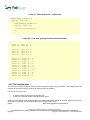
Listing 5 - Directive parameters and arguments (stand-alone codelet notation)
#pragma hmpp simple1 codelet, args[0-1;inv].io=in, &
#pragma hmpp simple1
args[3].io=in,
&
#pragma hmpp simple1
args[outv].io=inout, &
#pragma hmpp simple1
target=TESLA1
static void matvec(int sn, int sm,
float inv[sm], float inm[sn][sm],
float *outv){
........
}
The following construction is also legal:
#pragma hmpp <MyGroup> delegatedstore, args[*::var_b]
The delegatedstore directive is applied on all the variables var_b defined in the group MyGroup (codelet
parameters and resident variables if any).
Example:
#pragma hmpp <MyGroup> delegatedstore, args[::MyResVarData;cod1::var_a;*::var_b]
The delegatedstore directive is applied on the group MyGroup on the following variables:
•
•
•
the resident data MyResidentVarData;
the var_a argument of the codelet cod1;
all the arguments called var_b defined in the group MyGroup
Please note that when many parameters of the same codelet are referenced, the following notation is also
supported:
#pragma hmpp <MyGroup> delegatedstore, args[cod1::var_a;cod1::var_b]
This is equivalent to:
#pragma hmpp <MyGroup> cod1 delegatedstore, args[var_a;var_b]
The codelet label cod1 has been moved to the beginning of the directive and
declarations to shorten the directive.
removed from the variable
NVIDIA ® is a registered trademark of the NVIDIA Corporation
This information is the property of PathScale Inc. and cannot be used, reproduced or transmitted without authorization.
Page 15
Copyright © 2010 PathScale Inc. - DOC-ENZO08022010
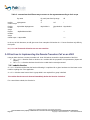
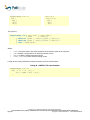
Table 2 - summarizes the different way to access to the argumentsaccording to their scope
By name
Implicit
current scope
Explicit
codelet
scope
Explicit
resident
scope
Global scope
MyArgument
By rank (start from By range
0)
3
0-5
MyCodelet::MyArgument
MyCodelet::3
All
*
MyCodelet::0- MyCodelet::*
7
::MyResidentVariable
::*
*::MyVariable
*::*
In the rest of this document, we will give most of our examples of directives in C. Fortran directives only differ by
their prefix.
In C, C++ and Fortran the directives are not case sensitive.
3.4 Directives for Implementing the Remote Procedure Call on an HWA Using an HWA involves a remote procedure call. A set of directives controls the implementation of the RPC:
1. The codelet directive marks a function as a codelet with the properties of its parameters (inputs and
outputs).
2. The callsite directive declares the call to the codelet that is remotely executed.
3.4.1 codelet directive A codelet directive requires that the function following it is optimized for a given hardware. Its label must not be
used for anything else in the application.
A codelet directive must have a label. A group label is not required if no group is defined.
The codelet directive must be inserted immediately before the function is declared.
For a stand-alone codelet, the directive is:
NVIDIA ® is a registered trademark of the NVIDIA Corporation
This information is the property of PathScale Inc. and cannot be used, reproduced or transmitted without authorization.
Page 16
Copyright © 2010 PathScale Inc. - DOC-ENZO08022010
#pragma hmpp codelet_label codelet [, version = major.minor[.micro]?]?
[, args[arg_items].io=[in|out|inout]]*
[, args[arg_items].size={dimsize[,dimsize]*}]*
[, args[arg_items].const=true]*
[, cond = "expr"]
[, target=target_name[:target_name]*]
For a group of codelets, the directive is:
#pragma hmpp <grp_label> codelet_label codelet [,version = major.minor[.micro]?]?
[, args[arg_items].io=[in|out|inout]]*
[, args[arg_items].size={dimsize[,dimsize]*}]*
[, args[arg_items].const=true]*
[, cond = "expr"]
[, target=target_name[:target_name]*]
Where:
• <grp_label> is a unique identifier associated with all the directives that belong to the group (definition
and use).
• codelet_label is a unique identifier associated with all the directives that belong to the same codelet
execution (definition and use).
• version = major.minor[.micro]? specifies the version of the HMPP directives to be considered by the
preprocessor (for each of them, value may be positive or null).
• args[arg_items].size={dimsize[,dimsize]*} specifies the size of a non-scalar parameter (an array).
Each dimsize provides the size for one dimension. dimsize must be a simple expression depending only
on the scalar arguments of the codelets.
• args[arg_items].const=true indicates that the argument is to be uploaded only once. Note that even if
there is only one codelet callsite associated with a codelet declaration, there can be several calls to the
codelet, for example if the callsite is inside a loop.
• args[arg_items1].io=[in|out|inout] indicates that the specified function arguments are either
input, output or both. By default, for codelets and resident, unqualified arguments are inputs. For HMPP
regions, arguments are INOUT. The specification for this parameter drives the data transfers between the
host and the HWA. Furthermore, it allows additional checks about how the data is used in HMPP
applications.
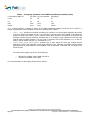
Table 3 - Intent in Fortran versus HMPP Input/Output parameter policy
Default IN
OUT INOUT
IN
IN
OUT INOUT
IN
IN
Error Warning
OUT
Error OUT Warning
INOUT Error Error INOUT
INTENT HMPP IO
Unset
IN
OUT
INOUT
In Fortran, the “.io” parameter can be omitted when an "INTENT‟ attribute is explicitly specified in the
source code.
NVIDIA ® is a registered trademark of the NVIDIA Corporation
This information is the property of PathScale Inc. and cannot be used, reproduced or transmitted without authorization.
Page 17
Copyright © 2010 PathScale Inc. - DOC-ENZO08022010
Table 4 – C language parameter versus HMPP Input/Output parameter policy
By Value By Const address By address
IN
IN
IN
IN
IN
IN
Error
Error
OUT
Error
Error
INOUT
C Parameters HMPP IO
Unset
IN
OUT
INOUT
In C, a scalar argument is passed by value, so its HMPP input/output property cannot be OUT or INOUT. A
pointer argument with a const attribute has the same restriction (see Table 4).
•
•
cond = "expr" specifies an execution condition as a boolean C or Fortran logical expression that needs
to be true before the codelet will run. The expression must be correct and evaluate in all operational
directive contexts (see Table 1). cond is useful to control when directives are executed. All directives are
executed normally but they will still be executed even if, for example, a goto statement in the host code
implicitly skips an HMPP directive. The host code is required to set up the expression expr so that if it
wants to skip an HMPP directive expr evaluates to FALSE.
target=target_name[:target_name]* specifies one or more targets for which the codelet must be
generated. It means that according to the target specified, if the hardware is available and the codelet
implementation for that hardware is also available, it will be executed. Otherwise, the next target in the
list will be tried.
The values of the targets can be one of the following:
•
•
TESLA1 for NVIDIA® Tesla C1060 and C1070
TESLA2 for NVIDIA® Tesla C20xx
For more information on the targets, please refer to section 7.
NVIDIA ® is a registered trademark of the NVIDIA Corporation
This information is the property of PathScale Inc. and cannot be used, reproduced or transmitted without authorization.
Page 18
Copyright © 2010 PathScale Inc. - DOC-ENZO08022010
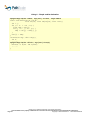
Listing 6 – Simple codelet declaration
#pragma hmpp simple1 codelet, args[outv].io=inout, target=TESLA1
static void matvec(int sn, int sm,
float inv[sm], float inm[sn][sm], float *outv){
int i, j;
for (i = 0 ; i < sm ; i++) {
float temp = outv[i];
for (j = 0 ; j < sn ; j++) {
temp += inv[j] * inm[i][ j];
}
outv[i] = temp;
}
int main(int argc, char **argv) {
int n;
........
#pragma hmpp simple1 callsite, args[outv].size={n}
matvec(n, m, myinc, inm, myoutv);
........
}
NVIDIA ® is a registered trademark of the NVIDIA Corporation
This information is the property of PathScale Inc. and cannot be used, reproduced or transmitted without authorization.
Page 19
Copyright © 2010 PathScale Inc. - DOC-ENZO08022010
Listing 7– codelet declaration inside a group
#pragma hmpp <myGroup> simple1 codelet, args[outv].io=inout, target=TESLA1
static void matvec(int sn, int sm,
float inv[sm], float inm[sn][sm], float *outv){
int i, j;
for (i = 0 ; i < sm ; i++) {
float temp = outv[i];
for (j = 0 ; j < sn ; j++) {
temp += inv[j] * inm[i][ j];
}
outv[i] = temp;
}
int main(int argc, char **argv) {
int n;
........
#pragma hmpp <myGroup> simple1 callsite, args[outv].size={n}
matvec(n, m, myinc, inm, myoutv);
........
}
More than one codelet directive can be added to a function to specify different uses or execution contexts.
However, there can be only one codelet directive for a given callsite label. An example appears below:
NVIDIA ® is a registered trademark of the NVIDIA Corporation
This information is the property of PathScale Inc. and cannot be used, reproduced or transmitted without authorization.
Page 20
Copyright © 2010 PathScale Inc. - DOC-ENZO08022010
Listing 8 – Multiple codelet declarations (for stand-alone codelets)
#pragma hmpp simple1 codelet, args[outv].io=inout, &
#pragma hmpp simple1
cond ="n==1024", target=TESLA1
#pragma hmpp simple2 codelet, args[outv].io=inout, &
#pragma hmpp simple2
cond ="n==1024", target=TESLA1
static void matvec(int sn, int sm,
float inv[sm], float inm[sn][sm], float *outv){
int i, j;
for (i = 0 ; i < sm ; i++) {
float temp = outv[i];
for (j = 0 ; j < sn ; j++) {
temp += inv[j] * inm[i][ j];
}
outv[i] = temp;
}
}
int main(int argc, char **argv) {
int n;
........
#pragma hmpp simple1 callsite, args[outv].size={n}
matvec(n, m, myinc0, inm, myoutv0);
#pragma hmpp simple2 callsite, args[outv].size={n}
matvec(n, m, myinc1, inm, myoutv1);
........
#pragma hmpp simple1 release
#pragma hmpp simple2 release
}
Note that if more than one callsite directive precedes a function call, only one of them can initiate an RPC call.
The execution policy is based on the order of the callsite directives: the directives are evaluated one after the
other. Thus, a callsite can only be launched if the condition of all previous callsite directives has failed and the
condition of the current directive is true and the HWA is available. Subsequent directives will be ignored once one
has been executed.
3.4.2 group directive The group directive allows the declaration of a group of codelets. The parameters defined in this directive are
applied to all codelets belonging to the group.
The syntax of the directive is:
NVIDIA ® is a registered trademark of the NVIDIA Corporation
This information is the property of PathScale Inc. and cannot be used, reproduced or transmitted without authorization.
Page 21
Copyright © 2010 PathScale Inc. - DOC-ENZO08022010
#pragma hmpp <grp_label> group, [version = <major>.<minor>[.<micro>]?]? &
,[target= target_name[:target_name]*]]? &
,[cond = “expr”]?
Where the directive parameters are:
•
•
•
•
<grp_label> a unique identifier associated with all the directives that belong to the group (definition and
use). This label will have to be reused to run any codelet within a group.
version = major.minor[.micro]? specifies the version of the HMPP directives to be considered by the
preprocessor.
cond = "expr" specifies an execution condition as a boolean C or Fortran logical expression that must
be true to start the execution of the group of codelets. If a condition for a group is specified at this level, it
will overwrite the existing codelet conditions. See the comments under the codelet directive for alternate
applications of this cond parameter.
target=target_name[:target_name]* specifies which targets to use and their order. MIf the
corresponding hardware and codelet implementations for the specified target are available it will be
executed. Otherwise, the next target specified in the list will be checked. For more information on targets,
please refer to section 7 .
3.4.3 The callsite directive The callsite directive specifies the use of a codelet at a given point in the program. Related data transfers and
synchronization points that are inserted elsewhere in the application have to use the same label.
A codelet label is mandatory for the callsite directive. A group label is also required if the codelet belongs to a
group.
The callsite directive must be inserted immediately before the function call.
The syntax of the directive for stand-alone codelets is:
NVIDIA ® is a registered trademark of the NVIDIA Corporation
This information is the property of PathScale Inc. and cannot be used, reproduced or transmitted without authorization.
Page 22
Copyright © 2010 PathScale Inc. - DOC-ENZO08022010
#pragma hmpp codelet_label callsite
[, asynchronous]?
[, args[arg_items].size={dimsize[,dimsize]*}]*
[, args[arg_items].advancedload=[true|false]]*
[, args[arg_items].addr="expr"]*
[, args[arg_items].noupdate=true]*
For a group of codelets, the syntax is:
#pragma hmpp <grp_label> codelet_label callsite
[, asynchronous]?
[, args[arg_items].size={dimsize[,dimsize]*}]*
[, args[arg_items].advancedload=[true|false]]*
[, args[arg_items].addr="expr"]*
[, args[arg_items].noupdate=true]*
Where the directive parameters are:
•
<grp_label> is a unique identifier associated with all the directives belonging to the group (definition and
use).
•
•
codelet_label is a unique identifier associated with all the directives belonging to the same codelet
execution (definition and use).
asynchronous specifies that the codelet execution is not blocking (default is synchronous). In
asynchronous mode, all the output parameters have to be downloaded using the delegatedstore directive
(see Section 3.5.2). A synchronize directive is mandatory before the first delegatedstore directive to
insure that the codelet executes properly.
When an asynchronous codelet is declared, a release directive is also mandatory (see section 3.4.5).
•
•
•
•
args[arg_items].size={dimsize[,dimsize]*} specifies the size of a non-scalar parameter (i.e. an
array) if it is not provided by the codelet prototype. Each dimsize provides the size for one dimension. The
set is evaluated at runtime by an allocate directive, or by all callsite and advancedload directives within
the group.
args[arg_items].advancedload=true indicates that the specified parameters are preloaded (see
Section 3.5.1). In this case, at the callsite directive level, HMPP will not load the specified data. Only in or
inout parameters can be preloaded.
args[arg_items].addr="expr" gives the address of the data to load, store or both.
args[arg_items].noupdate=true this property specifies that the data is already available on the HWA
so no transfer is needed. The user is responsible for making sure these data are actually on the HWA.
You can see examples of the callsite directive in Listing 8. If the condition of the directive is not true, or if no
resources are available on the HWA, the native codelet code is used instead.
It should be noted that if there are no allocate and release directives (see chapters 3.4.5 and 3.4.5
respectively) in the directive set, the callsite directive will perform device acquisition as well as allocate the
parameters then free them and release the device.
NVIDIA ® is a registered trademark of the NVIDIA Corporation
This information is the property of PathScale Inc. and cannot be used, reproduced or transmitted without authorization.
Page 23
Copyright © 2010 PathScale Inc. - DOC-ENZO08022010
3.4.4 The synchronize directive The synchronize directive specifies to wait until the completion of an asynchronous callsite execution.
As with the callsite directive, a label for the codelet is mandatory, as is a group label, if it belongs to a group.
The syntax of the synchronize directive for stand-alone codelets is:
:
#pragma hmpp codelet_label synchronize
For a group of codelets, the syntax is:
#pragma hmpp <grp_label> codelet_label synchronize
Where the directive's parameters are:
•
•
<grp_label>: a unique identifier associated with all the directives belonging to the group (definition and
use).
codelet_label: a unique identifier associated with all the directives belonging to the same codelet
execution (definition and use).
When the synchronize directive is used, the corresponding callsite directive must be set as asynchronous. If not,
the directive will be ignored and a warning message will appear during compilation. If a synchronization point is
encountered before the codelet is called, an execution error will occur.
Note that the synchronize directive is only a synchronization barrier. delegatedstore directives should
follow if output data need to be downloaded from the HWA to the host.
3.4.5 The allocate directive An HWA may need some time to be allocated or initialized before being used by a set of directives. Pre-allocating
the hardware, before the RPC is called or any data uploaded, may improve execution time ,. This pre-allocation
should be done via the allocate directive.
When an allocate directive is used, it must be executed before all other i directives.
To allocate memory in the HWA, ENZO™ evaluates the sizes of the non-scalar parameters during the execution
either from the codelet or directly from an expression given by the user in the call site (see parameter size of the
HMPP callsite directive, chapter 3.4.2 ). Note that once the size has been evaluated, it cannot be changed during
any execution of the codelet up to the next release directive.
The syntax for stand-alone codelets is:
#pragma hmpp codelet_label allocate [,args[arg_items].size={dimsize[,dimsize]*}]*
IFor a group of codelets, the syntax is:
NVIDIA ® is a registered trademark of the NVIDIA Corporation
This information is the property of PathScale Inc. and cannot be used, reproduced or transmitted without authorization.
Page 24
Copyright © 2010 PathScale Inc. - DOC-ENZO08022010
#pragma hmpp allocate [,args[arg_items].size={dimsize[,dimsize]*}]*
Where the directive parameters are:
•
<grp_label> a unique identifier associated with all the directives belonging to the group (definition and
use).
•
codelet_label a unique identifier associated with all the directives belonging to the same codelet
execution (definition and use).
•
args[arg_items2].size={dimsize[,dimsize]*} gives an alternate way to evaluate the size of nonscalar codelet arguments. Each dimsize provides the size for one dimension. dimsize is an expression
evaluable at the location of the directive (can be a variable, a value, an expression to evaluate etc.)
This directive is used when the callsite specifies an unknown size in the advancedload directive. The size must
be specified for each dimension of the argument. Listing 9 illustrates the size declaration for two n-by-m matrices
inm and outv.
Please, note that once a “.size” parameter is specified for an argument in an allocate directive, this value
cannot be changed in an advancedload or delegatedstore directive.
The allocate directive is used for both asynchronous and synchronous RPCs. When used, the allocation step is
not performed by other directives. This directive must therefore override the default in all other directives
belonging to the same codelet.
NVIDIA ® is a registered trademark of the NVIDIA Corporation
This information is the property of PathScale Inc. and cannot be used, reproduced or transmitted without authorization.
Page 25
Copyright © 2010 PathScale Inc. - DOC-ENZO08022010
Listing 9 - allocate directive example (for stand-alone codelets)
#pragma hmpp matvec allocate, args[inm;outv].size={n,m}
....
while (...){
#pragma hmpp matvec callsite, asynchronous
matvec(n, m, (inc+(k*n)), inm, (outv+(k*m)));
....
#pragma hmpp matvec synchronize
#pragma hmpp matvec delegatedstore, args[outv]
}/* endwhile */
#pragma hmpp matvec release
3.4.6 The release Directive The release directive specifies when to release the HWA for a group or a stand-alone codelet (this directive is
generally used in association with the allocate directive (see the last chapter) The release directive does not
physically free the HWA but marks it for reallocation.
If a release directive is used, this one must be executed last after all other instructions of the directive
set.
If no group is defined, this directive is optional when the callsite is synchronous but is mandatory otherwise (like
delegatedstore). The syntax of the directive is the following:
In stand-alone codelet context:
#pragma hmpp codelet_label release
In group of codelets context:
#pragma hmpp <grp_label> release
Where the directive parameters are:
•
<grp_label> a unique identifier associated to all the directives that belong to the group (definition and
use).
•
codelet_labela unique identifier associated to all the directives that belong to the same codelet
execution (definition and use).
Warning: Note that by default, if no group is defined, in case where a callsite is not associated to a
release directive, the HWA is instantly released after the codelet execution has completed.
NVIDIA ® is a registered trademark of the NVIDIA Corporation
This information is the property of PathScale Inc. and cannot be used, reproduced or transmitted without authorization.
Page 26
Copyright © 2010 PathScale Inc. - DOC-ENZO08022010
Listing 10 – release directive example (case of stand-alone codelet notation)
......
while (j){
for (k = 0 ; k < iter ; k++) {
#pragma hmpp testlabel1 callsite
simplefunc1(n, &(t1[k*n]), &(t2[k*n]), &(t3[k*n]));
}
j--;
}
#pragma hmpp testlabel1 release
......
Listing 10 shows a usage of the release directive. The allocated HWA of the testlabel1 call site is released after
the while loop.
3.5 Controlling Data Transfers
When using an HWA, an important bottleneck is often the data transfer between the HWA memory and the host
memory. To limit the communication overhead, the programmer can try to overlap data transfers with successive
executions of the same codelets by using the asynchronous property of the HWA. Two directives can be used for
that purpose:
•
•
The advancedload directive loads data before the remote execution of the codelet.
The delegatedstore directive delays the fetching of the result.
These directives are detailed in the next sections.
3.5.1 advancedload Directive Data can be uploaded before the execution of the codelet by using the advancedload directive.
The syntax is:
In stand-alone codelet context:
NVIDIA ® is a registered trademark of the NVIDIA Corporation
This information is the property of PathScale Inc. and cannot be used, reproduced or transmitted without authorization.
Page 27
Copyright © 2010 PathScale Inc. - DOC-ENZO08022010
#pragma hmpp codelet_label advancedload
,args[arg_items]
[,args[arg_items].size={dimsize[,dimsize]*}]*
[,args[arg_items].addr="expr"]*
[,args[arg_items].section={[subscript_triplet,]+}]*
[,asynchronous]
In group of codelets context:
#pragma hmpp <grp_label> [codelet_label]? advancedload
,args[arg_items]
[,args[arg_items].size={dimsize[,dimsize]*}]*
[,args[arg_items].addr="expr"]*
[,args[arg_items].section={[subscript_triplet,]+}]*
[,asynchronous]
Where the directive parameters are:
•
<grp_label> a unique identifier associated with all the directives that belong to the group (definition and
use).
•
•
•
•
•
•
codelet_label a unique identifier associated with all the directives that belong to the same codelet
execution (definition and use).
args[arg_items] the name or rank (caller program) of the argument to be loaded.
args[arg_items].size={dimsize[,dimsize]*} gives an alternate way to evaluate the size of nonscalar codelet arguments. Each dimsize provides the size for one dimension. This parameter may be
used when the callsite specifies a size that is not known in the advancedload directive used.
args[arg_items].addr="expr" expr is an expression that gives the address of the data to upload.
args[arg_items].section={[subscript_triplet,]+]* indicates that only an array section will be
transferred to the device. See chapter 3.5.3 for further details.
asynchronous indicates that the transfer can be performed asynchronously, meaning that it is a nonblocking transfer.
The advancedload directive is used on data whose the intent status is in or inout. An error message is
generated otherwise.
NVIDIA ® is a registered trademark of the NVIDIA Corporation
This information is the property of PathScale Inc. and cannot be used, reproduced or transmitted without authorization.
Page 28
Copyright © 2010 PathScale Inc. - DOC-ENZO08022010
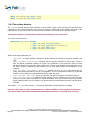
Listing 11 - advancedload directive example (case of stand-alone codelet notation)
#pragma hmpp matvec advancedload, args[inm], args[inm].size={n,m}
....
while (...){
#pragma hmpp matvec callsite, args[inm].advancedload=true, &
#pragma hmpp matvec
args[inm].size={n+1,m+1}, &
#pragma hmpp matvec
asynchronous
matvec(n, m, (inc+(k*n)), inm, (outv+(k*m)));
....
#pragma hmpp matvec synchronize
#pragma hmpp matvec delegatedstore, args[outv]
if (...) {
for (i=0; i<m; i++) {
inm[...] = 0.1;
} /* endfor */
#pragma hmpp matvec advancedload, args[inm]
} /* endif */
} /* endwhile */
An example of the advancedload directive is given in Listing 11 . The advancedload directive at line 15 loads the
inm matrix after it has been modified and before the next call to the codelet.
Warning: The expression used to specify the size and address of the arguments can be evaluated only
when the advancedload is used. However, most inconsistencies are likely to be detected at compile time.
Listing 12 shows an illegal use of the advancedload directive where an error message will be issued by
the compiler.
NVIDIA ® is a registered trademark of the NVIDIA Corporation
This information is the property of PathScale Inc. and cannot be used, reproduced or transmitted without authorization.
Page 29
Copyright © 2010 PathScale Inc. - DOC-ENZO08022010
Listing 12 - Illegal use of the advancedload directive (the actual arguments of the codelet is not in
the scope of the advancedload directive).
void foo_xxx(int* N, float* CA, float* CX, float* CY) {
...
/* Illegal preloading of the "table" input data because
table is declared below (“table” designated here as args [0]) */
#pragma hmpp callfoo advancedload, args[0], &
#pragma hmpp callfoo
asynchronous
...
/* Call the codelet */
{
float table[2];
table[0] = 3.14159265357;
table[1] = 2.718281;
#pragma hmpp callfoo callsite, args[0].advancedload=true, &
#pragma hmpp callfoo
asynchronous
foo_hmpp(table, CX, CY, SY_out);
}
...
#pragma hmpp callfoo synchronize
/* Starting from there, the codelet execution has complete */
...
#pragma hmpp callfoo delegatedstore, args[SY_out]
/* Starting from there, the value of SY_out has been updated */
...
#pragma hmpp callfoo release
/* Starting from there, the hardware can be reallocated
to another codelet */
}
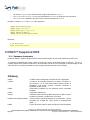
When the execution reaches an advancedload program point, the HWA, if available, is locked by the ENZO™
runtime. When an asynchronous advancedload directive is used, the argument must not be modified between
that directive and the call of the codelet.
3.5.2 delegatedstore Directive The delegatedstore directive is the opposite of the advancedload directive in the sense that it downloads output
data from the HWA to the host. The program execution is pause until all transfers are completed. The syntax is:
In stand-alone codelet context:
NVIDIA ® is a registered trademark of the NVIDIA Corporation
This information is the property of PathScale Inc. and cannot be used, reproduced or transmitted without authorization.
Page 30
Copyright © 2010 PathScale Inc. - DOC-ENZO08022010
#pragma hmpp codelet_label delegatedstore
,args[arg_items]
[,args[arg_items].addr="expr"]*
[,args[arg_items].section={[subscript_triplet,]+}]*
In group of codelets context:
#pragma hmpp <grp_label> [codelet_label]? delegatedstore
,args[arg_items]
[,args[arg_items].addr="expr"]*
[,args[arg_items].section={[subscript_triplet,]+}]*
Where the directive parameters are:
•
<grp_label> is a unique identifier associated with all the directives that belong to the group (definition
and use).
•
•
•
•
codelet_label is the unique identifier associated with all the directives that belong to the same codelet
execution (definition and use);
args[arg_items4] is the name (caller program) or rank of the codelet arguments to download.
args[arg_items].addr="expr": expr is an expression that gives the address of the data to store.
args[arg_items].section={[subscript_triplet,]+]* indicates that only an array section will be
transferred to the device. See chapter 3.5.3 for further details.
An example of the delegatedstore directive is given in Listing 13 . In this example, the simple function is called
twice. Only the first call is a candidate for remote execution, so only that call is offloaded to an accelerator or a
worker thread. The value of myoutv1 is downloaded after the second call.
Note that for an asynchronous callsite a delegatedstore directive must be preceded by a synchronize directive.
The delegatedstore directive is used on data whose the intent status is inout or out. An error message is
generated otherwise.
NVIDIA ® is a registered trademark of the NVIDIA Corporation
This information is the property of PathScale Inc. and cannot be used, reproduced or transmitted without authorization.
Page 31
Copyright © 2010 PathScale Inc. - DOC-ENZO08022010
Listing 13 - delegatedstore directive example
#pragma hmpp simple callsite, asynchronous
simple(n, m, myinc1,inm, myoutv1);
simple(n, m, myinc2,inm, myoutv2);
#pragma hmpp simple synchronize
#pragma hmpp simple delegatedstore, args[outv]
#pragma hmpp simple release
Warnings:
•
•
You have to ensure that the argument expression stays valid in the context of the delegatedstore use.
This directive is mandatory in the context of asynchronous callsite.
3.5.3 Array Sections in HMPP An array section is a selected portion of an array. It designates a set of elements from an array.
The array sections can be used in order to optimize data transfers between the host and the HWA in some cases
where it is not necessary to transfer the whole array..
This parameter can be used with both the advancedload and the delegatedstore directives (see respectively
chapter 3.5.1 and 3.5.2 ).
The syntax of this parameter is of the form:
args[arg_item].section={[subscript_triplet,]+}*
Where
•
•
arg_item designates an array;
subscript_triplet consists of two subscripts and a stride and defines a sequence of numbers
corresponding to array element positions along a single dimension.
The notation for the subscript_triplet is: “start:end:stride” where:
• start and end are subscripts which designate the first and last values of a dimension.
• stride is a scalar integer expression that specifies how many subscript positions to count to
reach the next selected element. If the stride is omitted, it has a value of 1. The stride must be
positive.
The subscript_triplet must be specified for each dimension of the array.
Warnings: Array sections must be used carefully in ENZO™ applications. Indeed, the use of a stride
greater than 1 may results to a slowdown of the application when lots of data are transferred. In such
cases, the transfer of the whole array still remains the best solution.
To get performance, users should not forget the constraints inherent in data layout:
•
They should favor the transfer of contiguous data;
NVIDIA ® is a registered trademark of the NVIDIA Corporation
This information is the property of PathScale Inc. and cannot be used, reproduced or transmitted without authorization.
Page 32
Copyright © 2010 PathScale Inc. - DOC-ENZO08022010
•
They should favor data locality in array section (this means, for example, to transfer data by column for
Fortran and by row for C and C++ instead of the opposite).
3.5.3.1 Case of not normalized arrays By default the HMPP standard makes the assumption that the arrays are normalized, meaning that all the
dimensions of the arrays:
•
•
Start from 0, in C and C++;
Start from 1, in Fortran;
In cases where at least one of an array's dimensions is not normalized, the shape must be specified using the
following notation:
args[arg_item].section={[subscript_triplet,]+}* of {[shape_couple,]+}
Where shape_couple: designates the first and the last values in the sequence of indices for a dimension.
Listing 14 illustrates the approach. In the delegatedstore directive, the array section requests the transfer of the
contiguous data u[0:1024] of a one dimension array u declared with the (-1024:1024) array shape.
NVIDIA ® is a registered trademark of the NVIDIA Corporation
This information is the property of PathScale Inc. and cannot be used, reproduced or transmitted without authorization.
Page 33
Copyright © 2010 PathScale Inc. - DOC-ENZO08022010
Listing 14- array section specified with a shape (extract) (Fortran)
...
INTEGER, PARAMETER :: M=4
INTEGER, PARAMETER :: Ns=-1024
INTEGER, PARAMETER :: Ne=+1024
REAL :: u(Ns:Ne) , v(Ns:Ne)
...
!- Transfer of the whole array
!$HMPP <conv> advancedload, args[f1::A]
!- callsite
!$HMPP <conv> f1 callsite
call doubleconv1d(Ne-Ns,M,u,v,coef)
...
!- callsite
!$HMPP <conv> f2 callsite
call conv1d(Ne-Ns,M,u,coef)
...
!- get only the modified data on the host
!$HMPP <conv> delegatedstore, args[f1::A],args[f1::A].section={0:Ne} of { Ns:Ne }
.
.
.
!-----------! Codelet declaration
!-------------!$HMPP <conv> f1 codelet
SUBROUTINE doubleconv1d(n,iter,A,B,C)
.
.
.
3.5.3.2 Use of array sections in HMPP, examples
Below are a few examples provided to illustrate the use of the .section parameter.
NVIDIA ® is a registered trademark of the NVIDIA Corporation
This information is the property of PathScale Inc. and cannot be used, reproduced or transmitted without authorization.
Page 34
Copyright © 2010 PathScale Inc. - DOC-ENZO08022010
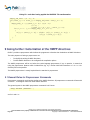
Listing 15 - array section in advancedload directive - Transfer of 1 column (Fortran)
INTEGER, PARAMETER :: size = 3661
INTEGER*4, dimension(size,size) :: tab
...
!$hmpp <Mygroup> get_col advancedload, args[tab], args[tab].section={1:size,1:1}
...
!$hmpp <group> get_col callsite, args[tab].advancedload=true
call put(size, tab)
...
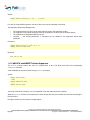
On Listing 15, the user transfers the first column through the use of an advancedload directive, and on Listing 16
transfers the first row of the array tab. The advancedload parameter is set to true at the callsite level to notify that
the transfer of the data has already been done.
NVIDIA ® is a registered trademark of the NVIDIA Corporation
This information is the property of PathScale Inc. and cannot be used, reproduced or transmitted without authorization.
Page 35
Copyright © 2010 PathScale Inc. - DOC-ENZO08022010
Listing 16 - array section in advancedload directive - Transfer of 1 row (Fortran)
INTEGER, PARAMETER :: size = 3661
INTEGER*4, dimension(size,size) :: tab
...
!$hmpp <Mygroup> get_col advancedload, args[tab], args[tab].section={1:1,1:size}
...
!$hmpp <group> get_col callsite, args[tab].advancedload=true
call put(size, tab)
...
3.6 HMPP data declaration 3.6.1 map directive In a group, arguments from different codelets may share resources on the device. For example, they may refer to
the same table or one may use the result of another one. In these cases, HMPP directives can take advantage of
using the same memory space on the device for all these arguments.
The map directive provides this feature: it maps several arguments on the device.
The notation is the following:
#pragma hmpp <grp_label> map, args[arg_items]
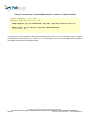
The Listing 17 below illustrates the use of the map directive (in same color the “mapped” variables):
•
•
•
Line 2: is the definition of a group of codelets;
Line 3: illustrates the mapping of respectively two variables named v1 defined in two different codelets
names init and dotSum.
Line 4: illustrates the mapping of respectively two variables named lxp and v2 defined in two different
codelets names init and dotSum.
From the HMPP point of view, the introduction of these two “map” directives means that:
•
•
The two variables v1 will be seen as the same on the device;
The two variables lxp and v2 will be seen as the same;
Warning: The IO status may be still different for each directive because they each refer to different
callsites: this will determine the transfer requirements. However, the union set of IO directives will define
the way that the map memory will be allocated!
Example: in a map: a, b
•
•
•
•
a is in in one codelet.
b is out in another codelet.
The memory allocation will be inout (only one for both).
a will be initialized before the first codelet.
NVIDIA ® is a registered trademark of the NVIDIA Corporation
This information is the property of PathScale Inc. and cannot be used, reproduced or transmitted without authorization.
Page 36
Copyright © 2010 PathScale Inc. - DOC-ENZO08022010
•
b will be downloaded after the second codelet.
NVIDIA ® is a registered trademark of the NVIDIA Corporation
This information is the property of PathScale Inc. and cannot be used, reproduced or transmitted without authorization.
Page 37
Copyright © 2010 PathScale Inc. - DOC-ENZO08022010
Listing 17 - map directive example
...
#pragma hmpp <myGroup> group, target=TESLA1 // definition of the group
#pragma hmpp <myGroup> map, args[init::v1;dotSum::v1]
#pragma hmpp <myGroup> map, args[init::lxp;dotSum::v2]
#pragma hmpp <myGroup> init codelet, args[v1].io=out
void init(int n, float v1[n], float initval, float lxp[n]) {
int j;
for (j = 0 ; j < n ; j++)
v1[j] = initval + lxp[j];
...
}
#pragma hmpp <myGroup> dotSum codelet, args[v1].io=inout
void dotSum(int n, float v1[n], float v2[n])
{
int j;
for (j = 0 ; j < n ; j++)
v1[j] += v2[j];
}
To be able to be mapped, the variables must:
•
•
Have the same dimensions
Have the same type
The example given below shows an illegal map association between two array variables and a scalar. In such
situations an error message will be generated.
NVIDIA ® is a registered trademark of the NVIDIA Corporation
This information is the property of PathScale Inc. and cannot be used, reproduced or transmitted without authorization.
Page 38
Copyright © 2010 PathScale Inc. - DOC-ENZO08022010
Listing 18-Illegal map directive usage
...
#pragma hmpp <myGroup> group, target=TESLA1
#pragma hmpp <myGroup> map, args[dotSum::v1;init::n]
#pragma hmpp <myGroup> init codelet, args[v1].io=out
void init(int n, float v1[n]) {
int j;
float val = 0.0;
for (j = 0 ; j < n ; j++)
v1[j] = val++;
}
#pragma hmpp <myGroup> dotSum codelet, args[v1].io=inout
void dotSum(int n, float v1[n], float v2[n])
{
int j;
...
}
3.6.2 The mapbyname Directive
This directive is quite similar to the map directive except that the arguments to be mapped are directly specified by
their name. So, the notation is the following:
#pragma hmpp <grp_label> mapbyname [,variableName]+
To be able to be mapped, the same constraints as for the map directive apply, the variables must have:
•
•
The same dimensions
The same type
Listing 19 shows a use of this directive. In the group <fxx_myGroup> all of the variables called xmin will be
mapped together, all of the named xmax will be mapped together, and so on.
Listing 19 - mapbyname directive example
!$hmpp <fxx_myGroup> mapbyname, xmin,xmax,ymin,ymax,zmin,zmax
The mapbyname directive is equivalent to multiple map directives.
!$hmpp <fxx_myGroup> mapbyname, xmin, xmax
Is equal to:
NVIDIA ® is a registered trademark of the NVIDIA Corporation
This information is the property of PathScale Inc. and cannot be used, reproduced or transmitted without authorization.
Page 39
Copyright © 2010 PathScale Inc. - DOC-ENZO08022010
!$hmpp <fxx_myGroup> map, args[*::xmin]
!$hmpp <fxx_myGroup> map, args[*::xmax]
3.6.3 The resident directive The resident directive declares some variables as global within a group. Those variables can then be directly
accessed from any codelet belonging to the group. In practice, it means that those variables will reside in the
HWA memory. So they can be seen as memory-resident variables on the HWA for the considered group.
This directive applies to the declaration statement just following it in the source code.
The syntax of this directive is:
#pragma hmpp <grp_label> resident
[, args[::var_name].io=[in|out|inout]]*
[, args[::var_name].size={dimsize[,dimsize]*}]*
[, args[::var_name].addr="expr"]*
[, args[::var_name].const=true]*
Where the directive parameters are:
•
<grp_label> : a unique identifier associated to all the directives that belong to the group (definition and
use).
•
•
•
•
args[::var_name].io=in|out|inout indicates that the specified variables are either input, output or
both. By default, unqualified variables are inputs. The specification of this parameter drives the data
transfers between the host and the HWA. Furthermore, it allows some additional checks about the use of
the data in ENZO™ applications (see chapter 3.4.1 for more details about the management of this
property)..
args[::var_name].size={dimsize[,dimsize]*} specifies the size of a non scalar parameter (an
array). Each dimsize provides the size for one dimension. The set is evaluated at runtime by an allocate
directive, or by all callsite and advancedload directives within the group.
args[::var_name].addr="expr" expr is an expression that gives the address of the data to upload.
args[::var_name].const=true indicates that the argument is to be uploaded only once. Note that even
if there is only one callsite associated to a codelet declaration, there can be several calls to the codelet
(when inserted inside a loop for instance). If a release directive is used between the calls, the data will be
reloaded.
The notation ::var_name with the prefix ::, indicates an application's variable declared as resident.
Note that, unlike input or output codelet arguments, resident variables are never implicitly transferred to
and from the HWA. Explicit advancedload and delegatedstore directives are required when necessary.
NVIDIA ® is a registered trademark of the NVIDIA Corporation
This information is the property of PathScale Inc. and cannot be used, reproduced or transmitted without authorization.
Page 40
Copyright © 2010 PathScale Inc. - DOC-ENZO08022010
Listing 20 - resident directive example
#include <stdio.h>
#define SIZE 10240
// group declaration. The group label is “myGroup”
#pragma hmpp <myGroup> group, target=TESLA1
// resident data declaration inside the group "MyGroup"
#pragma hmpp <myGroup> resident, args[::tab_init_on_hwa].io=out &
#pragma hmpp <myGroup>
, args[::tab_init_on_host].io=in
float tab_init_on_hwa [SIZE], tab_init_on_host[SIZE];
// declaration of the codelet "init" inside the group "MyGroup"
#pragma hmpp <myGroup> init codelet
void init(int n) {
int j;
float val = 0.0;
for (j = 0 ; j < n ; j++) tab_init_on_hwa[j] = val++ ;
}
// declaration of the codelet "dotSum" inside the group "MyGroup"
#pragma hmpp <myGroup> dotSum codelet
void dotSum(int n)
{
int j;
for (j = 0 ; j < n ; j++) tab_init_on_hwa[j] += tab_init_on_host[j];
}
int main(int argc, char **argv)
{
int i, m=SIZE;
float val = 0.0;
for (i = 0 ; i < m ; i++)
tab_init_on_host[i] = val++*2;
#pragma hmpp <myGroup> allocate // allocation of the group on the HWA
// transfer onto the HWA of the variable tab_init_on_host
#pragma hmpp <myGroup> advancedload, args[::tab_init_on_host]
#pragma hmpp <myGroup> init callsite
// call to the "init" codelet
init(m);
#pragma hmpp <myGroup> dotSum callsite
// call to the "dotSum" codelet
dotSum(m);
//transfer of the data from the HWA to the CPU
#pragma hmpp <myGroup> delegatedstore, args[::tab_init_on_hwa]
#pragma hmpp <myGroup> release // release of the HWA
// short display of the results
for (i = 0 ; i < m ; i=i+2) {
if ((i <= 5) || (i >= m-5))
printf ("tab_init_on_hwa[%d]= %4.2f \t\t tab_init_on_hwa[%d]= %4.2f \n",
i, tab_init_on_hwa[i], i+1, tab_init_on_hwa[i+1]);
}
return 0;}
The Listing 20 illustrates the use of this directive. The corresponding results are presented on Listing 21
NVIDIA ® is a registered trademark of the NVIDIA Corporation
This information is the property of PathScale Inc. and cannot be used, reproduced or transmitted without authorization.
Page 41
Copyright © 2010 PathScale Inc. - DOC-ENZO08022010
Listing 21 - Results of the application described Listing 10 (with hmpp and usual compiler like gcc)
$ pathcc MyProgramWithResident.c -o MyProgramWithResident
$ ./MyProgramWithResident
tab_init_on_hwa[0]= 0.00
tab_init_on_hwa[1]= 3.00
tab_init_on_hwa[2]= 6.00
tab_init_on_hwa[3]= 9.00
tab_init_on_hwa[4]= 12.00
tab_init_on_hwa[5]= 15.00
tab_init_on_hwa[10236]= 30708.00 tab_init_on_hwa[10237]= 30711.00
tab_init_on_hwa[10238]= 30714.00 tab_init_on_hwa[10239]= 30717.00
3.7 Regions in HMPP
This section presents a new set of HMPP directives to allow expressing computations to be performed on the
HWA as regions of code. The goal is to avoid requiring code restructuring to build codelets.
A region is a merging of the codelet/callsite directives. Therefore, all of the attributes available for codelet or
callsite directives can be used on regions directives.
In C, the region directive must be inserted immediately before a block.
In Fortran, the region and the corresponding endregion directives must be inserted around a part of
executable code.
The constraints for writing regions are the same as for codelets (see chapter 2.1 for more details). In addition, the
control flow must remain inside the region; that is, there must not be any:
•
•
•
return (in C) and stop (in Fortran);
no break and continue (in C), cycle and exit (in Fortran) to a loop enclosing the region;
goto to jump inside or outside the region.
We distinguish two parts in the declaration of a region: one dedicated to the codelet parameters, the other
dedicated to the callsite parameters. So, the syntax for the definition of a region is the following:
Be careful: Do not confuse an HMPP section, which refers to an array section (see chapter 3.5.3, Array sections
in HMPP) with HMPP regions, which refer to a block of statements.
In C and C++
NVIDIA ® is a registered trademark of the NVIDIA Corporation
This information is the property of PathScale Inc. and cannot be used, reproduced or transmitted without authorization.
Page 42
Copyright © 2010 PathScale Inc. - DOC-ENZO08022010
#pragma hmpp [<MyGroup>] [label] region
Codelet parameters
Callsite parameters
[,
[,
[,
[,
args[arg_items].io=[in|out|inout]]*
cond = "expr"]
args[arg_items].const=true]*
target=target_name[:target_name]*]
[,
[,
[,
[,
[,
args[arg_items].size={dimsize[,dimsize]*}]*
args[arg_items].advancedload=[true|false]]*
args[arg_items].addr="expr"]*
args[arg_items].noupdate=true]*
asynchronous]?
[, private=[arg_items]]*
{
C BLOCK STATEMENTS
}
In Fortran
NVIDIA ® is a registered trademark of the NVIDIA Corporation
This information is the property of PathScale Inc. and cannot be used, reproduced or transmitted without authorization.
Page 43
Copyright © 2010 PathScale Inc. - DOC-ENZO08022010
!$hmpp [<MyGroup>] [label] region
Codelet parameters
Callsite parameters
[,
[,
[,
[,
args[arg_items].io=[in|out|inout]]*
cond = "expr"]
args[arg_items].const=true]*
target=target_name[:target_name]*]
[,
[,
[,
[,
[,
args[arg_items].size={dimsize[,dimsize]*}]*
args[arg_items].advancedload=[true|false]]*
args[arg_items].addr="expr"]*
args[arg_items].noupdate=true]*
asynchronous]?
[, private=[arg_items]]*
FORTRAN STATEMENTS
!$hmpp [<MyGroup>] [label] endregion
Where the directive parameters are:
•
•
•
All the codelet parameters refer to parameters available for the codelet directive (see chapter 3.4.1 ,
codelet Directive )
All the callsite parameters refer to parameters available for the callsite directive (see chapter 3.4.3 ,
callsite Directive );
private: specifies the variables that should be re-declared to be only used in the region. Typically, this
parameter applies for loop induction variables. The HMPP private keyword usage is identical to the
OpenMP private keyword.
Warning: The HMPP standard assumes all variables used in a region must be explicitly mentioned
through one of the region parameters. See examples below. By default, arguments of HMPP region have
an INOUT status.
Listing 22 and Listing 23 show the use of the region directives for C language. Note that all the variables
referenced in the C block statements are declared either through the use of their INPUT/OUTPUT status (“io”
clause) or through the private keyword for the temporary variables.
NVIDIA ® is a registered trademark of the NVIDIA Corporation
This information is the property of PathScale Inc. and cannot be used, reproduced or transmitted without authorization.
Page 44
Copyright © 2010 PathScale Inc. - DOC-ENZO08022010
Listing 22 - region in HMPP (C example)
.
.
.
#pragma hmpp <MyGroup> MyRegionLabel region, args[a;n].io=in, &
#pragma hmpp <MyGroup>
args[r].io=out, args[r;a].size={n}, &
#pragma hmpp <MyGroup>
private=[s,c,i]
{ /* start HMPP region */
for( i = 0; i < n; ++i ){
s = sinf(a[i]);
c = cosf(a[i]);
r[i] = s*s + c*c;
}
} /* end HMPP region */
.
.
.
Listing 23 - region in HMPP (Fortran example)
NVIDIA ® is a registered trademark of the NVIDIA Corporation
This information is the property of PathScale Inc. and cannot be used, reproduced or transmitted without authorization.
Page 45
Copyright © 2010 PathScale Inc. - DOC-ENZO08022010
!$hmpp <MyGroup> allocate
.
.
.
!$hmpp <MyGroup> MyRegionLabel region, args[n;a].io=in,&
!$hmpp <MyGroup>
args[r].io=out, private=[i,sin_sq,cos_sq]
do i = 1,n
sin_sq = sin(a(i)) ** 2
cos_sq = cos(a(i)) ** 2
r(i) = sin_sq + cos_sq
enddo
!$hmpp <MyGroup> MyRegionLabel endregion
.
.
.
!$hmpp <MyGroup> release
.
.
.
The following restrictions apply:
•
•
•
Regions cannot be nested;
Asynchronous regions must have at least a label;
Only hmppcg directives are allowed inside the region.
Warning: In Fortran, all variables accessed in a region must have their declarations in the same
compilation unit. That is, at the present time, you can not create a region where a variable is defined in an
external module.
4 Supported Languages The HMPP codelet generators do not handle the full language for C, C++, or Fortran. This restrictions aim at
ensuring portability of the code on most HWAs (for example, allowing pointer arithmetic in C language would
forbid generation of code for many hardware platforms) and also performance.
Moreover, it should be noted that in addition to the restrictions brought by the HMPP standard, HWAs may impose
additional limitations. End-users should pay attention to the current limitations of the hardware accelerators that
they want to use by consulting hardware manufacturer's website.
4.1 Input C and C++ Code
As mentioned above, the HMPP codelet generators do not handle the full C language. The HMPP codelet
generators take C99 input code so the array size can be specified in the parameter declaration. The remainder of
this section is organized as follows:
•
•
Section 4.1.1 describes the valid C constructs for HMPP;
Section 4.1.2 shows how codelet parameter data sizes are addressed by the HMPP codelet generator.
NVIDIA ® is a registered trademark of the NVIDIA Corporation
This information is the property of PathScale Inc. and cannot be used, reproduced or transmitted without authorization.
Page 46
Copyright © 2010 PathScale Inc. - DOC-ENZO08022010
4.1.1 Supported C Language Constructs In this section we describe the language constructs which are supported by the HMPP codelet generators. The
codelet prototype is preferably in C99 style in which all array sizes are specified in the declaration (see Section
4.1.2 ). Typically a codelet code looks like:
Listing 24 – C codelet code example
void simplefunc(int n, float s1[1], float v2[n], float v3[n]){
int i;
float r = s1[0];
for (i = 0 ; i < n ; i++) {
r += v2[i] * v3[i];
}
s1[0] = r;
}
Below are the language constructs supported by the HMPP codelet generators. If a construct is not supported, the
HMPP codelet generator issues an error message and no codelet implementation is produced.
•
•
•
Atomic data types
• char, unsigned char, short, unsigned short, integer, long, long long, unsigned integer,
unsigned long, unsigned long long;
• float, double, complex
Data structures
• Structure containing only scalar atomic fields.
• Multidimensional arrays of structures.
Language constructs
• All arithmetic, shift and comparison operations.
• for loops with simple induction variables. The following styles of for loops are supported:
for (i=lowbound ; i<highbound ; i++){...}
for (i=lowbound ; i<=highbound ; i++){...}
for (i=lowbound ; i<=highbound ; i = i+s){...}
•
•
•
Where lowbound and highbound are invariant in the loop. The step value s is an integer constant.
Furthermore, the induction variable i cannot be modified in the loop body.
Conditional statements if() ... else …
Array accesses with affine A[a*i+b] index expressions.
Calls to intrinsic (see Section 4.2.1.13 for the list of supported intrinsic) and functions.
The following constructs are not supported in a codelet:
•
•
•
•
Pointer data accesses and pointer arithmetic.
switch and case statements.
Data structures containing arrays or structures of arrays
Function pointers
Warning: Initialization of structure using C99 style is not supported
NVIDIA ® is a registered trademark of the NVIDIA Corporation
This information is the property of PathScale Inc. and cannot be used, reproduced or transmitted without authorization.
Page 47
Copyright © 2010 PathScale Inc. - DOC-ENZO08022010
4.1.2 Parameter Passing Convention for C Codelets To implement the communications between the host and HWAs, it is necessary to provide the HMPP API runtime
with the size of the data to be transfered to/from the HWAs. Thus, this size must be explicitly specified in the
codelet parameters. Listing 25 illustrates this.
Warning: By default, no aliasing is allowed between codelet parameters.
Listing 25 - Parameter data size passing using C99 for codelets
/* C99 syntax */
#pragma hmpp csmain codelet, args[a].io=in, &
#pragma hmpp csmain
args[b].io=in, &
#pragma hmpp csmain
args[r].io=out
void csmain(unsigned int S, float r[S], float a[S], float b[S]) {
unsigned i;
for (i=0 ; i<S ; i++){
r[i] = b[i] / sqrt(a[i]);
}
}
4.1.3 Inlined functions HMPP supports the inlining of functions with the following restrictions:
• The definition of the inlined function must be available in the compilation scope of the codelet;
• The inlined function must not have any HMPP directives;
• The inlined function must not be recursive;
• The inlined function must not access global variables
4.2 Input Fortran Code The HMPP codelet generators do not support the full Fortran language. The subset taken into account is similar to
the C subset described in Chapter 4.1 . The remainder of this section is organized as follow:
•
•
Section 4.2.1 describes the supported Fortran language constructs.
Section 4.2.2 indicates how codelet parameter data sizes are addressed by the HMPP codelet
generators.
4.2.1 Supported Fortran Language Constructs In this section we describe the language constructs that are supported by the HMPP codelet generators. Typically
a codelet code looks like:
Listing 26 – Fortran codelet code example
NVIDIA ® is a registered trademark of the NVIDIA Corporation
This information is the property of PathScale Inc. and cannot be used, reproduced or transmitted without authorization.
Page 48
Copyright © 2010 PathScale Inc. - DOC-ENZO08022010
!$hmpp simple codelet, target=TESLA1
SUBROUTINE simple(n,m,inv,inm,outv)
IMPLICIT NONE
INTEGER, INTENT(IN) :: n,m
REAL, INTENT(IN) :: inv(n)
REAL, INTENT(IN) :: inm(m,n)
REAL, INTENT(OUT) :: outv(m,n)
INTEGER :: i,j
DO j = 1,n
DO i = 1,m
outv(i,j) = inv(j) * inm(i,j)
ENDDO
ENDDO
END SUBROUTINE simple
The language constructs presented below are the ones supported by the Fortran HMPP codelet generators. If a
construct is not supported, the code generator issues an error and no codelet is produced.
4.2.1.1 Explicit declaration in codelet
The “IMPLICIT NONE” statement is required in Fortran codelet. All variables must be explicitly declared in Fortran
codelets.
4.2.1.2 Supported Data Types The table below summarizes the scalar data types that are supported within the codelets and shows how they are
interpreted.
Table 5- Supported Fortran data types
F77
INTEGER*1
INTEGER*2
INTEGER*4
INTEGER*8
REAL*4
REAL*8
LOGICAL*1
LOGICAL*2
LOGICAL*4
CHARACTER*1
F90
INTEGER(1)
INTEGER(2)
INTEGER(4)
INTEGER(8)
REAL(4)
REAL(8)
LOGICAL(1)
LOGICAL(2)
LOGICAL(4)
CHARACTER(1)
Default
INTEGER
REAL
DOUBLE PRECISION
LOGICAL
CHARACTER
Implementation
8bit signed
16bit signed
32bit signed
64bit signed
IEEE754 32bit float
IEEE754 64bit float
8bit
16bit
32bit
8bit
Current restrictions:
•
•
•
The KIND of all types is hard-coded to the values used by most Fortran compilers. In the future, they will
be configurable for each Fortran compiler,
User defined types via the TYPE statements are not allowed,
The CHARACTER type and the character constants are only allowed for LEN=1. Virtually no operation except
comparison is allowed on characters so they are of limited usage except when passed as arguments to
the codelet.
NVIDIA ® is a registered trademark of the NVIDIA Corporation
This information is the property of PathScale Inc. and cannot be used, reproduced or transmitted without authorization.
Page 49
Copyright © 2010 PathScale Inc. - DOC-ENZO08022010
4.2.1.3 Declarations Declarations can be provided using the old F77 or the new F90 form:
INTEGER
a,b ! F77 form
INTEGER :: c,d ! F90 form
The attribute DIMENSION can also be used to specify array shapes:
INTEGER :: A(10)
INTEGER,DIMENSION(10) :: B
4.2.1.4 Parameters PARAMETER statements and attributes are supported for scalar objects only.
INTEGER, PARAMETER :: N=42
INTEGER M
PARAMETER ( M = 42 )
4.2.1.5 Inlined functions The HMPP standard supports the inlining of functions with the same restrictions as for C language (see chapter
4.1.3 ).
4.2.1.6 Intrinsic functions Intrinsic functions used in codelets must have been declared through the use of the INTRINSIC Fortran
statement. The example below illustrates the use of intrinsic functions in Fortran codelets.
...
REAL(8),DIMENSION(N) :: V
real(8),dimension(N,N) :: Loc
INTEGER :: J
INTRINSIC :: LOG, COS, SIN
...
4.2.1.7 Other Type Attributes and Declarations Most type attributes introduced by Fortran90 are currently not supported in codelets (POINTER, VOLATILE, TARGET,
...). A noticeable exception is INTENT which is in fact recommended for all codelet arguments.
COMMON, EQUIVALENCE, BLOCKDATA and all declaration statements that may create aliasing between variables are
not allowed in codelets.
4.2.1.8 Arrays Array bounds should be fully specified using constants or scalar integer arguments of the codelet.
Current restrictions:
NVIDIA ® is a registered trademark of the NVIDIA Corporation
This information is the property of PathScale Inc. and cannot be used, reproduced or transmitted without authorization.
Page 50
Copyright © 2010 PathScale Inc. - DOC-ENZO08022010
•
•
•
Scalar integer arguments used to specify an array bound shall not be modified within the codelet. Ideally,
they should have the INTENT(IN) attribute,
Scalar integer arguments used to specify an array bound must appear before that array in the argument
list,
For better performance, it is recommended to use a constant or a single variable for the lower bound.
Below is a typical example:
Listing 27 – Fortran array declaration in codelet
SUBROUTINE codelet(m,n,A,B,C)
INTEGER, INTENT(IN)
:: m,n
INTEGER, INTENT(INOUT) :: A(100), B(m,n), C(0:m*n-1)
...
END SUBROUTINE
The following forms of arrays are not allowed:
•
•
Assumed-size arrays as in A(*) or B(100,*)
Assumed-shape and deferred-shape arrays as in A(:) or B(3:)
Remark: an array of the form A(:m) is allowed since its lower bound is by default equal to one.
4.2.1.9 IF statements The following forms of IF statements are supported:
•
IF…ENDIF constructs optionally with ELSE IF and ELSE:
IF (A>B) THEN
C = 1
ELSE IF (A<B) THEN
C = -1
ELSE
C = 0
ENDIF
•
Logical IF statements:
IF (A==B) C=0
Current restrictions:
•
•
SELECT CASE constructs are currently not supported.
GOTOs are not supported as well as arithmetic IF statements that are in fact disguised GOTOs.
NVIDIA ® is a registered trademark of the NVIDIA Corporation
This information is the property of PathScale Inc. and cannot be used, reproduced or transmitted without authorization.
Page 51
Copyright © 2010 PathScale Inc. - DOC-ENZO08022010
4.2.1.10 Loops The following forms of loops are supported:
•
DO statements with index, start, end and an optional step. The index and all 3 expressions shall be of type
integer.
•
•
DO WHILE statements;
Standalone DO - so a potentially infinite loop.
A DO construct must be terminated by an ENDDO statement. The old F77 form using a termination label is not
allowed. EXIT and CYCLE statements are allowed within DO constructs.
Current restrictions:
•
•
•
The step, if any, must be a simple constant (such as 1 or -2).
No loop name shall be specified to an EXIT or CYCLE statement. They are applied to the first outer loop.
The computation of the number of iterations in a loop of the form (a) is assumed not to overflow when
computed using the type of the index. In practice, e.g. for INTEGER*4, the number of iterations shall not be
greater than 231-1 (2147483647).
4.2.1.11 Modules The current HMPP standard brings a preliminary support of Fortran modules. The objective is to provide users
with the most frequently used constructions used in Fortran applications. Thus, scalar PARAMETER variables of
types INTEGER, LOGICAL, REAL and COMPLEX defined in modules can be directly used in HMPP codelets.
However, this first implementation mainly focuses on INTEGER parameters. Thus, the following operations are
supported on INTEGER type only:
•
Constant definitions. Evaluation of expressions is supported for the usual INTEGER arithmetic operators +,
-, *, /.
MODULE foo
INTEGER, PARAMETER :: N=24, M=5
INTEGER, PARAMETER :: P= ((N+1)*(M-5))/(M+N)
END MODULE foo
•
INTEGER comparison and LOGICAL operators (.OR., .AND., .EQ., …)
MODULE foo
INTEGER,
INTEGER,
LOGICAL,
LOGICAL,
LOGICAL,
LOGICAL,
END MODULE
•
PARAMETER
PARAMETER
PARAMETER
PARAMETER
PARAMETER
PARAMETER
foo
Intrinsic functions to query type kind information (SELECTED_INT_KIND, SELECTED_REAL_KIND and KIND)
NVIDIA ® is a registered trademark of the NVIDIA Corporation
This information is the property of PathScale Inc. and cannot be used, reproduced or transmitted without authorization.
Page 52
Copyright © 2010 PathScale Inc. - DOC-ENZO08022010
MODULE foo
INTEGER,
INTEGER,
INTEGER,
INTEGER,
INTEGER,
INTEGER,
INTEGER,
INTEGER,
END MODULE
PARAMETER
PARAMETER
PARAMETER
PARAMETER
PARAMETER
PARAMETER
PARAMETER
PARAMETER
foo
::
::
::
::
::
::
::
::
INT4 = SELECTED_INT_KIND(4)
INT10 = SELECTED_INT_KIND(10)
INT14 = SELECTED_INT_KIND(14)
FLOAT_4_7 = SELECTED_REAL_KIND(4,7)
FLOAT_P10 = SELECTED_REAL_KIND(P=10)
FLOAT_R20 = SELECTED_REAL_KIND(R=40)
FLOAT = KIND(1.0E0)
DOUBLE = KIND(1.0D0)
Because of the difficulty to ensure consistent rounding in floating point arithmetic, operations on REAL or COMPLEX
data types are not yet supported. It is however possible to define parameters of REAL or COMPLEX types as long as
their expressions only contain:
•
•
•
•
•
REAL constant (e.g. 1.2, 1.2D0, 1.2_4, 1.2_INT4)
COMPLEX constant
Unary operator -
Parentheses
References to other parameters of the same type
REAL conversions whether they are implicit or explicit are not supported. In practice that means that the
expression must be of the exact same type as the parameter. For instance, the example below is correct if we
assume that the default REAL kind is 4:
REAL(4), PARAMETER :: X1 = 3.1415
REAL , PARAMETER :: X2 = 3.1415_4
However, the following equivalent declarations containing an implicit and an explicit cast to REAL(8) will not be
able to be evaluated:
REAL(8), PARAMETER :: Y1 = 3.1415
REAL(8), PARAMETER :: Y2 = REAL(3.1415,kind=8)
In practice, one could write the declaration which is similar even though it is not semantically equivalent:
REAL(8), PARAMETER :: Y =3.1415_8
Note: Fortran module support will be improved in future releases, so some of these limitations will be
removed in the future.
NVIDIA ® is a registered trademark of the NVIDIA Corporation
This information is the property of PathScale Inc. and cannot be used, reproduced or transmitted without authorization.
Page 53
Copyright © 2010 PathScale Inc. - DOC-ENZO08022010
4.2.1.12 Operations Arithmetic operations are currently limited to scalars. Support for arrays should be available in future releases. All
native operators are supported:
•
•
•
Arithmetic: + - / * **;
Comparison: > < >= < == /= (and their 'dotted' forms: .GT. .LT. and so on);
Logical: .NOT. .AND. .OR. .EQV. .NEQV.
4.2.1.13 Function Calls Name
ABS(x)
LOG(n)
LOG10(n)
SQRT(n)
MIN(a,b,...)
MAX(a,b,...)
MOD(a,b)
EXP(a)
COS(a)
SIN(a)
TAN(a)
ACOS(a)
ASIN(a)
ATAN(a)
COSH(a)
SINH(a)
TANH(a)
ACOSH(a)
ASINH(a)
ATANH(a)
IAND(a,b)
IOR(a,b)
IEOR(a,b)
NOT(a)
REAL(a)
DBLE(a)
INT(a)
INT1(a)
INT2(a)
INT4(a)
INT8(a)
Table 6 – Supported Intrinsic functions
Semantic
Absolute value
Natural logarithmic
Base-10 logarithmic function
Square root
Minimum
Maximum
a modulo b
Base-E exponential
Cosine
Sine
Tangent
Arc-Cosine
Arc-Sine
Arc-Tangent
Hyperbolic Cosine
Hyperbolic Sine
Hyperbolic Tangent
Inverse Hyperbolic Cosine
Inverse Hyperbolic Sine
Inverse Hyperbolic Tangent
Bitwise AND
Bitwise OR
Bitwise Exclusive-OR
Bitwise NOT
Convert a to REAL
Convert a to DOUBLE PRECISION (i.e. REAL(8))
Convert a to INTEGER
Convert a to INTEGER(1)
Convert a to INTEGER(2)
Convert a to INTEGER(4)
Convert a to INTEGER(8)
Type
REAL*n or INTEGER*n
REAL*n
REAL*n
REAL*n
REAL*n or INTEGER*n
REAL*n or INTEGER*n
INTEGER*n
REAL*n
REAL*n
REAL*n
REAL*n
REAL*n
REAL*n
REAL*n
REAL*n
REAL*n
REAL*n
REAL*n
REAL*n
REAL*n
INTEGER*n
INTEGER*n
INTEGER*n
INTEGER*n
Only calls to intrinsic functions listed below are supported. All arguments should be of scalar type.
NVIDIA ® is a registered trademark of the NVIDIA Corporation
This information is the property of PathScale Inc. and cannot be used, reproduced or transmitted without authorization.
Page 54
Copyright © 2010 PathScale Inc. - DOC-ENZO08022010
Warning: In Fortran, local variables can be stored in global memory and be initialized at startup. Then
they keep their value between function calls. This is not the case in codelets where variable declared
locally are assumed to be strictly local (as in C).
4.2.2 Unsupported statements in codelet The following statements are not supported in HMPP Fortran codelets:
•
•
•
•
WHERE, SELECT, CALL, FORALL, GOTO, USE, CONTAINS, INCLUDE;
I/O statements: OPEN, CLOSE, …
Memory statements: ==>, ALLOCATE
Arithmetic if
4.2.3 Parameter Passing Convention for Fortran codelets To implement the communication between the host and the HWAs, it is necessary to provide the ENZO™ runtime
API with the size of the data to be transfered to/from the HWAs. This is performed using the Fortran syntax with
the array bound specified as an expression of the codelet parameters as shown in the example presented in
Section 4.2.1 . In other words, a parameter declaration such as A(*) is not supported. The INTENT(IN|INOUT|
OUT) clause is mandatory.
4.2.4 Knowns limitations
•
•
•
The HMPP size=, addr=, cond=, and section= parameters are not yet supported.
A codelet procedure and its callsite must lie within the same module or external program unit. Thus, a
codelet procedure may be a module procedure or an internal subroutine, but not an external subroutine.
For a particular group or standalone codelet, the advancedload and delegatedstore directives must be
able to access the same actual arguments as the callsite directive. Thus, these directives must all be in
the same procedure, or the arguments must be available to all of them by host association or use
association.
5 Compiling HMPP Applications PathScale ENZO™ provides developers with HMPP standards compliant compilers in order to easily build
ENZO™ applications. PathScale ENZO™ currently comes with HMPP Fortran compilers and in Q3 will include
support for HMPP C and C++.
5.1 Overview
In terms of use, PathScale ENZO™ works the same as the EKOPath compilers. However, the paths diverge at
the final code generation phase.
Compiling an ENZO™ program is as simple as using the traditional EKOPath pathf90, pathcc or pathCC compiler
drivers.
5.2 Common Command Line Parameters We strive to make the ENZO™ compiler as easy to use as possible, but for more details on compiler options
please reference ENZO_cli_guide.pdf
NVIDIA ® is a registered trademark of the NVIDIA Corporation
This information is the property of PathScale Inc. and cannot be used, reproduced or transmitted without authorization.
Page 55
Copyright © 2010 PathScale Inc. - DOC-ENZO08022010
6 Running HMPP Applications
ENZO™ applications using the ENZO™ runtime library work just as regular applications. No extra steps are
required at run time, as long as the runtime library is available on the target system.
6.1 Launching the Application
HMPP programs using the ENZO™ runtime are launched just like regular programs
$ ./program
7 HMPP Codelet Generators
HMPP codelet generator directives are converted by PathScale ENZO™ compiler to an intermediate
representation, which is lowered down the same compilation path as regular HMPP directives.
8 Improved code generation and performance
HMPPCG (HMPP Codelet Generator) extends the base set of directives to provide optimized code generation
and mapping of input codelets into the target code.
Most of the transformations described in this part apply on loops. A loop is a syntactic language construction
expressing the repetition of some statements.
In HMPP, a transformation can be applied on a loop if:
•
•
It has a unique induction variable;
The number of iterations must be computable at run-time before entering the loop.
for loops in the C language and DO loops in Fortran are supported.
To optimize the code generated by ENZO™, two main types of directives are used:
•
•
Some specifying loop properties;
Others mentioning transformations to be applied on the loops.
More directives will be provided in future versions of the HMPP standard.
Please note that ENZO™ does not check for the incorrect usage of the directives. Be aware that misuse
of the HMPPCG directives may lead to undefined behaviour.
8.1 HMPPCG Directives Syntax The general syntax of the directives is (respectively for C, C++ and Fortran) the following:
C and C++:
NVIDIA ® is a registered trademark of the NVIDIA Corporation
This information is the property of PathScale Inc. and cannot be used, reproduced or transmitted without authorization.
Page 56
Copyright © 2010 PathScale Inc. - DOC-ENZO08022010
#pragma hmppcg [(target)]? directive_type [clause] [, clause]*
Fortran:
!$hmppcg[(target)]? directive_type [clause] [, clause]*
Where:
•
target: allows to restrict the execution of the directive to a specific target.
For example, on Listing 30 the hmppcg permute transformation will be applied regardless of the considered
hardware accelerator.
Listing 30 - hmppcg directive (basic example)
#pragma hmppcg permute j, i
for (i = 1; i < M - 1; ++i) // 0
{
for (j = 1; j < N - 1; ++j) // 1
{
B[i][j] = c11 * A[i - 1][j - 1] + c12 * A[i][j] ;
}
}
Warning: Note that all the directives described in this part are introduced by using the hmppcg keyword
and do not contain any labels. They are dedicated to codelet generation and apply only on the codelet
source code that they just precede. They can only be used in codelets or regions.
8.2 Interpretation order of the HMPPCG directives
With the HMPP standard, several transformations can be applied, one after the other, on a loop nest. Two modes
or directives scheduling are provided:
•
•
One based on lexical order in the source code (default mode);
One base on the evaluation of an order clause.
In the first case, the order in which the transformations are executed follows these steps:
•
•
•
Step 1: search the first HMPPCG directive;
Step 2: apply the source code transformation given by the directive (or ignore it if the target does not
match);
Step 3: go back to step 1 with the resulting code until no transformation remain to be applied.
Users must be careful about the order in which the directives are applied. The directives are successively
evaluated and their execution is performed on the code resulting from the previous transformation.
NVIDIA ® is a registered trademark of the NVIDIA Corporation
This information is the property of PathScale Inc. and cannot be used, reproduced or transmitted without authorization.
Page 57
Copyright © 2010 PathScale Inc. - DOC-ENZO08022010
Table 7 below illustrates this mode of operation with the following assumptions:
•
•
“dN” means which directives to apply;
A symbolic notation is used.
Table 7 – interpretation order of hmppcg directive: lexical order
d1 permute k, i, j
loop i
// i index
d2 unroll 2 i index
loop j
// j index
d3 unroll 3
loop k
// k index
s1
s2
1 – Initial code. First the directive d1 is applied
loop k
// loop k is unrolled
loop i
// i index
d2
unroll 2
loop j
// j index
s1
s2
d3 unroll 3
loop k
// k index
loop i
// i index
d2 unroll 2
loop j // j index
s1
s2
2 - The execution of d1 leads
now to have d3 in first position.
So, the directive d3 will be the
next directive applied.
loop k
// loop k is
unrolled
loop i
// i index
loop j // loop j is
unrolled
s1
s2
3 - Then d3 is applied. The execution of d3 does not change 4 - d2 is now applied. There is no
the order of the directive. Loop k is unrolled. The directive d2 more directives to be applied
will then be the next directive applied.
Otherwise, another mode is possible through the use of the “order” clause available in certain directives. In this
mode, the “order” clause forces the execution of the directives in the increasing order of “order” attributes.
If several directives have the same order value, then they are executed in lexical order. Table 8 illustrates the use
of this clause (with the same assumptions as previously indicated).
Table 8 - interpretation order of hmppcg directive: use of the order clause
d1 permute j,i
loop i
d2 unroll 2,order=1
loop j
d1 permute j,i
loop i
d2 unroll 2,order=1
loop j
NVIDIA ® is a registered trademark of the NVIDIA Corporation
This information is the property of PathScale Inc. and cannot be used, reproduced or transmitted without authorization.
Page 58
Copyright © 2010 PathScale Inc. - DOC-ENZO08022010
d3 unroll 3,order=0
loop k
s1
s2
loop k // loop k is
unrolled
s1
s2
...
1 – Initial code. Directive d3 is first applied since the 2 - The directive d3 has been applied.
order directive has the smallest value.
The directive d2 will be the next
directive applied
d1 permute j,i
loop i
loop j
// loop j is unrolled
loop k // loop k is unrolled
s1
s2
...
loop j
// loop j is
unrolled
loop i
loop k // loop k is
unrolled
s1
s2
...
The directive d2 has been applied. Then the last 4 – Loops I and J have been permuted.
directive to execute is d1
All the directives have been applied.
Currently, ENZO™ does not apply more than 5 transformations consecutively on a same loop nest.
8.3 HMPPCG: Loop Properties The directives described in this part allow specifying some properties on loops. These properties are then used by
the HMPP generator in order to optimize the generated code.
8.3.1 HMPPCG parallel Directive This directive has to be used when the codelet generator is not able to compute the parallel properties of
complicated loops.
According to the nature of the considered target accelerator (vectorial or parallel), the use of this directive will lead
to different schemes of codelet generation A parallel loop is declared using the following directive:
#pragma hmppcg parallel
[, reduce (operator:var [, operator:var]* ) ]*
[, private (var [, var]* ) ]*
Where:
•
reduce specifies that in the considered loop, a reduction operation is performed (see chapter 8.3.1.1
below);
•
private specifies that each loop iteration should have its own instance of the variable. A private
variable is not initialized and the value is not maintained for use outside of the loop.
NVIDIA ® is a registered trademark of the NVIDIA Corporation
This information is the property of PathScale Inc. and cannot be used, reproduced or transmitted without authorization.
Page 59
Copyright © 2010 PathScale Inc. - DOC-ENZO08022010
This directive applies on the loop it precedes.
8.3.1.1 HMPPCG parallel: the reduce clause The reduce clause allows the user to indicate that one or several reductions are done in the loop. Indeed, without
this clause, the parallel execution of a loop with such an operation could lead to a wrong result.
•
•
operator specifies a reduction operator (see Table 9 )
var is the name of a scalar variable referenced in the loop;
The table below presents the list of allowed reduction operators in the reduce clause.
Table 9 - List of reduction operators defined in HMPP
Operators
+
*
min
max
and .and. &&
or .or. ||
ixor ieor ^
ior |
iand &
Meaning
Addition
Multiplication
Minimum
Maximum
Logical and
Logical or
bitwise exclusive or
bitwise inclusive or
bitwise and
Listing 31 - hmppcg parallel clause with reduction operations
#pragma hmppcg parallel, reduce (+:ssx,+:ssy)
for ( i = 0; i < NK; i++)
{
if (qqprim2[i])
{
qq[qqprim[i]] += 1.0;
ssx = ssx + qqprim3[i];
ssy = ssy + qqprim4[i];
}
}
Listing 31 illustrates the use of the hmppcg parallel directive with two addition (i.e. +) reduction operations.
Note that the use of this directive forces ENZO™ to consider the loop parallel independently of any
analysis carried out and in some cases may create conflicts between the directive specified and the loop
analysis. The table below summarizes such situations:
Results of ENZO™ HMPPCG
loop-kinds analysis pragma
used
Results
NVIDIA ® is a registered trademark of the NVIDIA Corporation
This information is the property of PathScale Inc. and cannot be used, reproduced or transmitted without authorization.
Page 60
Copyright © 2010 PathScale Inc. - DOC-ENZO08022010
Parallel
Sequential
Parallel
reduction
None
Parallel
Noparallel
Parallel,
reduce
None
Parallel
Loop is computed on hardware accelerator
Loop is computed on hardware accelerator
Loop is computed on the CPU
Loop is computed on hardware accelerator
Loop is computed on the CPU
Loop is computed on the hardware accelerator. A warning
message mentions that this execution could lead to erroneous
result
Noparallel Loop is computed on the CPU
Parallel,
Loop is computed on hardware accelerator
reduce
with None
Loop is computed on the CPU
Parallel
Loop is computed on the hardware accelerator. A warning
message mentions that this execution could lead to erroneous
result
Noparallel Loop is computed on the CPU
Parallel,
Loop is computed on hardware accelerator (with a warning
reduce
message if a reduction variable is not mentioned in the reduce
clause)
8.3.2 Inhibiting Vectorization or Parallelization A non-parallel loop (i.e. sequential) is declared using the following directive:
#pragma hmppcg noParallel
The following example shows a loop nest where the use of the HMPP directives allows guiding the code
generation.
Listing 32 – noParallel and parallel directives
#pragma hmppcg noParallel
for (i=0; i < n; i++) {
A[i][n] = B[i+1];
#pragma hmppcg parallel
for (j=0; j < n; j++) {
D[i][j] = A[i][j] * E[3][j];
}
}
This directive proves to be useful to control the gridification process of loops on targets such as Tesla.
Note that this directive forces ENZO™ to consider the loop as sequential independently of any
optimization analysis. Such a loop will be executed on the CPU.
NVIDIA ® is a registered trademark of the NVIDIA Corporation
This information is the property of PathScale Inc. and cannot be used, reproduced or transmitted without authorization.
Page 61
Copyright © 2010 PathScale Inc. - DOC-ENZO08022010
This directive applies on the loop it precedes.
8.3.3 HMPPCG Grid blocksize directive This directive controls the number of threads in a block for the “gridification” of a loop nest..
This pragma can be put anywhere inside a codelet and it applies to every loop nest following the pragma in lexical
order. If no pragma is supplied, the default value is used (“32x4”).
The syntax is:
#pragma hmppcg grid blocksize “nxm”
Where:
•
n and m are the new dimensions of blocks sizes within the grid.
For example, for NVIDIA® architecture, typical values are: 16x16, 32x8, 64x2, 32x4.
Note that the optimal value of the block size is dependent on the loop nest and on the targeted hardware.
Listing 33 - hmppcg grid blocksize directive. Example of use
//Loops will be gridified with the default value
for (i=0; i < n; i++) {
for (j=0; j < n; j++) {
...
}
}
...
#pragma hmppcg grid blocksize 8x8
//Loops will be gridified with 8x8 threads in a block
for (i=0; i < n; i++) {
for (j=0; j < n; j++) {
...
}
}
...
// still gridified with 8x8 threads in a block
for (i=0; i < n; i++) {
for (j=0; j < n; j++) {
...
}
}
After having been set, if the value of the block size needs to be change in a codelet, a new hmppcg grid
blocksize directive can be added in the codelet (see example below).
NVIDIA ® is a registered trademark of the NVIDIA Corporation
This information is the property of PathScale Inc. and cannot be used, reproduced or transmitted without authorization.
Page 62
Copyright © 2010 PathScale Inc. - DOC-ENZO08022010
8.3.4 HMPPCG accelerated context queries Within as HMPP codelet or region, the hmppcg set directive provides a way to obtain information about the
current accelerated context.
The general syntax of the directive is: C and C++ syntax:
#pragma hmppcg set <varname> = <query>(<arguments>)
Fortran syntax:
!$hmppcg set <varname> = <query>(<arguments>)
Where:
• <varname> is a scalar integer variable
• is one of the supported HMPPCG query intrinsics
• is a comma separated list of arguments (if the query intrinsic needs any).
Alternatively, the query intrinsic can be replaced by a single default integer constant
#pragma hmppcg set <varname> = <constant>
The semantic of the hmppcg set directive is that of a standard assignment of the specified variable for all the
specified HMPP targets.
Listing 34 - Illustration of the hmppcg set directive
PROGRAM test
integer :: x
!$hmpp foo callsite
CALL foo(x)
IF (x==0) THEN
PRINT *, "The fallback was executed"
ELSE
PRINT *, "The NVIDIA target was executed"
END IF
CONTAINS
!$hmpp foo codelet, target=TESLA1
SUBROUTINE foo(status)
IMPLICIT NONE
INTEGER, INTENT(OUT) :: status
status = 0
!$hmppcg set status = 1
END SUBROUTINE foo
END PROGRAM test
This behavior allows detecting dynamically whether the fallback is executed or not as shown by Listing 34
NVIDIA ® is a registered trademark of the NVIDIA Corporation
This information is the property of PathScale Inc. and cannot be used, reproduced or transmitted without authorization.
Page 63
Copyright © 2010 PathScale Inc. - DOC-ENZO08022010
Listing 35 - Example of the hmppcg set directive used to detect which target is executed
PROGRAM test
integer :: x
!$hmpp foo callsite
CALL foo(x)
IF (x==0) THEN
PRINT *, "The fallback was executed"
ELSE IF (x==1) THEN
PRINT *, "The Tesla target was executed"
END IF
CONTAINS
!$hmpp foo codelet, target=TESLA1
SUBROUTINE foo(status)
IMPLICIT NONE
INTEGER, INTENT(OUT) :: status
status = 0
!$hmppcg(CUDA) set status = 1
END SUBROUTINE foo
END PROGRAM test
Combined with the ability to restrict any HMPPCG directive to a specific target, the set directive allows detecting
dynamically which target is currently executed (see Listing 35).
8.3.4.1 The GridSupport() query The GridSupport() intrinsic returns 1 if the current HMPP target supports the concept of loop gridification
(targets TESLA1,TESLA2,...) and 0 otherwise.
C and C++ syntax:
#pragma hmppcg set <varname> = GridSupport()
Fortran syntax:
!hmppcg set <varname> = GridSupport()
This query is typically used to detect whether an implementation using shared memory is possible in a codelet.
NVIDIA ® is a registered trademark of the NVIDIA Corporation
This information is the property of PathScale Inc. and cannot be used, reproduced or transmitted without authorization.
Page 64
Copyright © 2010 PathScale Inc. - DOC-ENZO08022010
Listing 36 - GridSupport query example
!$hmpp jacobi codelet, target=TESLA1
SUBROUTINE jacobi(n,A,B)
IMPLICIT NONE
INTEGER, INTENT(IN) :: n
INTEGER, INTENT(INOUT) :: A(n,n), B(n,n)
INTEGER :: i,j
INTEGER :: grid_support
grid_support = 0
!$hmppcg set grid_support = GridSupport()
IF (grid_support==1) THEN
! Implement here a version using shared memory
...
ELSE
! Implement here a version without shared memory
...
ENDIF
END SUBROUTINE jacobi
8.3.4.2 The gridification queries A set of query intrinsics is provided so information about the current gridified loop nest is available. Due to their
nature, these queries should only be used within a gridified loop nest. They are not strictly forbidden outside such
loops but their result would then be inconsistent.
Each of the gridification query intrinsics exists in 3 forms:
•
•
•
The X and Y forms respectively refer to the internal and external gridified loop.
The XY refers to a linearized view of the gridification.
The last form takes reference to the gridified loop through their index variable which is given as argument.
The following gridification queries are currently supported:
•
•
•
•
•
BlockSizeX(), BlockSizeY(), BlockSizeXY() and BlockSize(index) provide the block size as
specified by the hmppcg grid blocksize directive.
RankInBlockX(), RankInBlockY(), RankInBlockXY() and RankInBlock(index) provide the ranks of
the current thread within the current block. Numbering starts from 0.
RankInGridX(), RankInGridY(), RankInGridXY() and RankInGrid(index) provide the rank of the
current thread in the complete gridification. Numbering also starts from 0.
BlockIdX(), BlockIdY(), BlockIdXY() and BlockId(index) provide the rank of the block in the
gridification. Numbering also starts from 0.
BlockCountX(), BlockCountY(), BlockCountXY() and BlockCount(index) provide the number of
blocks in the gridification.
NVIDIA ® is a registered trademark of the NVIDIA Corporation
This information is the property of PathScale Inc. and cannot be used, reproduced or transmitted without authorization.
Page 65
Copyright © 2010 PathScale Inc. - DOC-ENZO08022010
Listing 37 - The XY linearization formulas
BlockSizeXY()
RankInBlockXY()
BlockIdXY()
BlockCountXY()
RankInGridXY()
=
=
=
=
=
BlockSizeX() * BlockSizeY()
BlockSizeX() * RankInBlockY() + RankInBlockX()
BlockCountX() * BlockIdY()
+ BlockIdX()
BlockCountX() * BlockCountY()
BlockIdXY() * BlockSizeXY() + RankInBlockXY()
Remark: Those intrinsics are all computed using 32bits integers. This is sufficient given the limitations of the
current GPUs architectures. The only exception is RankInGridXY() which may overflow in 32bit integers for large
problem sizes (e.g. a typical CUDA GPU may accept up to 64K*64K blocks of up to 1024 threads).
8.3.5 HMPPCG gridification support The “hmppcg grid” directive provides a set of functionalities related to the gridification process:
•
•
•
hmppcg grid shared declares that a local scalar or array variable must be allocated in shared memory
(i.e. all threads in the current gridified block have access to it). For arrays, their dimensions must be
constant and known at compile time. The directive must be located within the gridified loop while the
shared object must be declared outside that loop.
hmppcg grid barrier introduces a synchronization barrier between all threads of the current gridified
block. This is typically needed to avoid race conditions when accessing objects placed in shared memory.
It is important to notice that most targets require ALL threads in the current block to honour the barrier. As
a consequence, barriers should never be placed inside divergent conditional statements (i.e. not executed
identically by all threads) and use of the hmppcg grid unguarded directive may be necessary to ensure
that all threads of the block are alive.
hmppcg grid unguarded removes the guard normaly used to 'kill' the unneeded threads in the last
blocks of each dimension of gridification. Consider for example a 1D gridified loop of 1000 iterations and a
block size of 64. Without an hmppcg grid unguarded directive, the last blocks should only execute the
loop body for (1000 modulo 64 =) 40 out of its 64 threads. The remaining 24 threads must do nothing and
so are considered as dead. For an unguarded gridification those dead threads would be executed thus
increasing the effective number of iterations from 1000 to 1024. Using an unguarded gridification is like
increasing manually the loop upper bound such that the number of iterations becomes a multiple of the
block size. Unguarded gridification is usually needed when using the hmppcg grid barrier directive that
requires all threads of the block to be alive. It should be noted that in most cases some guards must be
manually reinserted to insure that the loop indexes remains in the expected ranges.
A typical gridified loop using barriers and shared memory looks like this:
NVIDIA ® is a registered trademark of the NVIDIA Corporation
This information is the property of PathScale Inc. and cannot be used, reproduced or transmitted without authorization.
Page 66
Copyright © 2010 PathScale Inc. - DOC-ENZO08022010
!$hmppcg grid blocksize 64x1
!$hmppcg grid unguarded
!$hmppcg parallel
DO i=1,n
IF (i<=n) THEN
... write to shared memory
ENDIF
!$hmppcg grid barrier
IF (i<=n) THEN
... read from shared memory
ENDIF
!$hmppcg grid barrier
ENDDO
To get further details or examples about the used of the shared memory, see document [R9] , section 4.6
"Exploiting the Shared Memory".
8.3.6 HMPPCG constantmemory directive
NVIDIA® devices use several memory spaces, which have different characteristics that reflect their distinct
usages in CUDA applications. These memory spaces include global, local, shared, texture, and registers (see
[R4] and [R5] for more details).
The directive described here helps to improve the performance by allowing the use of the constant memory
available on NVIDIA® architecture.
Access to this memory space from an ENZO™ application is possible by the introduction of the following directive
in the codelet definition:
C and C++ syntax:
#pragma hmppcg constantmemory <param> [, <size>]?
Fortran syntax:
!$hmppcg constantmemory <param> [, <size>]?
With:
•
•
<param> the codelet‟s parameter (array or scalar)
<size> the size of the array (number of elements). When scalar variables are defined, the size is optional
or must be equal to 1.
It should be noted that by default, scalar variables are automatically placed in constant memory.
When specifying a TESLA target ENZO™ allows using up to 2KB of constant memory.
NVIDIA ® is a registered trademark of the NVIDIA Corporation
This information is the property of PathScale Inc. and cannot be used, reproduced or transmitted without authorization.
Page 67
Copyright © 2010 PathScale Inc. - DOC-ENZO08022010
This directive applies on codelet parameters. In Fortran application, it must be introduced before
executable statements.
8.4 HMPPCG: loop transformations Unlike the directives described earlier, those described in this part specify some transformation to apply on a loop.
These transformations are applied before the final code generation. Their application can provide better
performance by improving computation scheduling or data locality.
8.4.1 Permute transformation
The loop permutation is a common transformation which is usually used to improve data accesses locality but can
also be used to create coarse-grain or fine-grain parallization.
This directive provides a way to permute nested loops. It may be very useful to reorder the loops according to the
code that will be executed on CPU or on hardware accelerator. The order of loops may impact the coalescing of
memory accesses.
The syntax is:
#pragma hmppcg permute <var>, <var> [, <var>]*
[, order = <order_value> ]?
Where:
• <var> identifies one of the loops, based on the name of its induction variable
• <order_value> is a positive number (starting at zero)
The application of this transformation reorganizes the loop control structures according to the new order specified
by the directive.
Example:
Before
!$hmppcg permute k, i, j
DO I = 1, 8
DO J = 1, 8
DO K = 1, 8
A(I, J, K) = B(I, J, K)*1.2
ENDDO
ENDDO
ENDDO
After
DO K = 1, N
DO I = 1, N
DO J = 1, N
A(I, J, K) = B(I, J, K)*1.2
ENDDO
ENDDO
ENDDO
The loops now follow the order k, I, j, as specified in
the directive.
8.4.2 Distribute transformation In some situations, loops may be too complex to be automatically parallelized:
•
It may contain statements which prevent the parallelization
NVIDIA ® is a registered trademark of the NVIDIA Corporation
This information is the property of PathScale Inc. and cannot be used, reproduced or transmitted without authorization.
Page 68
Copyright © 2010 PathScale Inc. - DOC-ENZO08022010
•
The generated loop can use too many registers, which prevents effective execution
The distribute transformation splits the initial loop into several separate loops. This directive has two parts:
•
•
The first part identifies the loop on which the transformation will be applied
The second part identifies where the loop shall be cut off.
The syntax is:
#pragma hmppcg distribute
#pragma hmppcg cut
[, addtoall {<dir> [; <dir>]*} ]*
[, order = <order_value> ]?
[, add
{<dir> [; <dir>]*} ]*
Where:
•
<dir> is a HMPP Codelet Generator directive. In this context, the hmppcg directive is written without the
“language directive prefix”.
For example:
!$hmppcg distribute, addtoall {unroll 2, jam}
Add an hmppcg unroll directive to the loops resulting from the application of the distribute clause.
•
•
<order_value> is a positive number (starting at zero).
The addtoall clause allows user to add new directives to the resulting loops created by the
transformation.
The distribute directive is attached to the loop to be divided. This loop must contain at least one cut directive.
Listing 38 and Listing 39 illustrate the use of this transformation.
NVIDIA ® is a registered trademark of the NVIDIA Corporation
This information is the property of PathScale Inc. and cannot be used, reproduced or transmitted without authorization.
Page 69
Copyright © 2010 PathScale Inc. - DOC-ENZO08022010
Listing 38 - Original code
DO I = 1, SIZE_1
!$hmppcg distribute
DO J = 1, SIZE_2
! original loop
T(I, J) = 0
!$hmppcg cut
DO K = 1, SIZE_2
T(I, J) = A(I, K) * B(I, J)
ENDDO
!$hmppcg cut
C(I, J) = C(I, J) + T(I, J)
ENDDO
ENDDO
Listing 39 - Code after having applied the distribute transformation1
for (i_2 = 0, hmppcg_end = (*size_1) - 1; i_2 <= hmppcg_end; i_2 += 1)
{
for (j_21 = 0, hmppcg_end = (*size_2) - 1; j_21 <= hmppcg_end; j_21 += 1)
{
t[j_21][i_2] = 0;
} // end loop j_21
for (j_2 = 0, hmppcg_end = (*size_2) - 1; j_2 <= hmppcg_end; j_2 += 1)
{
for (k_2 = 0, hmppcg_end = (*size_2) - 1; k_2 <= hmppcg_end; k_2 += 1)
{
t[j_2][i_2] = (a[k_2][i_2]) * (b[j_2][i_2]);
} // end loop k_2
} // end loop j_2
for (j_22 = 0, hmppcg_end = (*size_2) - 1; j_22 <= hmppcg_end; j_22 += 1)
{
c[j_22][i_2] = (c[j_22][i_2]) + (t[j_22][i_2]);
} // end loop j_22
} // end loop i_2
8.4.3 Fuse transformation This transformation is the opposite of the previous one. If the granularity of a loop, or the work performed by a
loop, is small, then the performance gain from its parrallization may be insignificant. This is because the overhead
of parallel loop start-up is too high compared to the loop workload. In such situations, the hmppcg fuse
transformation can be used to combine several loops into a single one, and thus increase the granularity of the
loop.
To apply this transformation, the loops must have the same iteration space and must not be separated by any
non-loops statements.
1 This is for educational purposes only since the real result differs from this presentation given here.
NVIDIA ® is a registered trademark of the NVIDIA Corporation
This information is the property of PathScale Inc. and cannot be used, reproduced or transmitted without authorization.
Page 70
Copyright © 2010 PathScale Inc. - DOC-ENZO08022010
The syntax is:
#pragma hmppcg fuse <offset>
[, add {<dir> [; <dir>]*} ]*
[, order = <order_value> ]
Where:
•
•
•
•
<offset> identifies the loops to consider. Value 0 designates the current loop (where the directive is set).
So -1 designates the first previous, +1 the first next, +2 the two next loops and so on
<dir> is a HMPP Codelet Generator directive
<order_value> is a positive number starting at zero.
The add clause allows user to add new directives to the resulting loop created by the transformation.
Listing 40 to Listing 43 illustrate the use of this transformation.
NVIDIA ® is a registered trademark of the NVIDIA Corporation
This information is the property of PathScale Inc. and cannot be used, reproduced or transmitted without authorization.
Page 71
Copyright © 2010 PathScale Inc. - DOC-ENZO08022010
Listing 40 - Original code
!$hmppcg fuse 1
DO I = 1, N
A(I) = B(I) - C(I)
ENDDO
DO J = 1, N
IF(A(J) .LT. 0) A(J) = B(J)*B(J)
ENDDO
Listing 41 - Code after having applied the fuse transformation1
for (i_2 = 0, __hmppcg_end = (*n) - 1; i_2 <= __hmppcg_end; i_2 += 1)
{
a[i_2] = b[i_2] - c[i_2];
if (a[i_2] < 0)
{
a[i_2] = b[i_2] * b[i_2];
}
} // end loop i_2
Listing 42 - Original code –with negative fuse index
DO I = 1, N
A(I) = B(I) - C(I)
ENDDO
!$hmppcg fuse -1
DO J = 1, N
IF(A(J) .LT. 0) A(J) = B(J)*B(J)
ENDDO
Listing 43 - Original code –with negative fuse index
for (i_2 = 0, hmppcg_end = (*n) - 1; i_2 <= hmppcg_end; i_2 += 1)
{
a[i_2] = b[i_2] - c[i_2];
if (a[i_2] < 0)
{
a[i_2] = b[i_2] * b[i_2];
}
} // end loop i_2
8.4.4 Unroll directive transformation 1 This is for educational purposes only since the real result differs from this presentation given here
NVIDIA ® is a registered trademark of the NVIDIA Corporation
This information is the property of PathScale Inc. and cannot be used, reproduced or transmitted without authorization.
Page 72
Copyright © 2010 PathScale Inc. - DOC-ENZO08022010
The loop unroll transformation is intended to increase register exploitation and decrease memory loads and stores
per operation within an iteration of a nested loop. Improved register usage decreases the need for main memory
accesses and allows better exploitation of some machine instructions.
This transformation can be applied by using the following directive:
#pragma hmppcg unroll { <var>:<factor> [, <var>:<factor>]* | <factor> [, <factor>]* }
[, remainder|noremainder|guarded [(<var> [, <var>]*)] ]*
[, contiguous|split|changestep
[(<var> [, <var>]*)] ]*
[, scalartemp|arraytemp]?
[, jam
[(<var> [, <var>]*)] ]*
[, addtounrolled [(<var> [, <var>]*)] {<dir> [; <dir>]*} ]*
[, addtoremainder [(<var> [, <var>]*)] {<dir> [; <dir>]*} ]*
[, order = <order_value> ]
Where:
•
•
<var> identify one of the loops, based on the name of its induction variable;
<factor> is an unroll factor, strictly greater than zero (1 means no unroll performed, but the associated
•
clauses are still executed.).
The addtounrolled and addtoremainder clauses allow users to add new directives to the resulting
loops created by the transformation.
Then the other clauses drive the loop unroll algorithm.
8.4.4.1 Dealing with the unroll strategy Different schemas of unrolling can be used in the HMPP standard. These ones are controlled thanks to the
following options:
•
contiguous, which is the default behavior: the end bound is divided and arrays are accessed by a
sequence of contiguous indexes.
Table 10 - unroll directive with contiguous option
Initial code
#pragma hmppcg unroll i:4, contiguous
for( i = 0 ; i < n ; i++ ) {
v1[i] = alpha * v2[i] + v1[i];
}
Extract of generated code (the remainder loop is not represented)
for (i_1 = 0, __hmppcg_end = (n / 4) - 1;
{
v1[4 * i_1] = (alpha * (v2[4 * i_1]))
v1[(4 * i_1) + 1] = (alpha * (v2[(4 *
v1[(4 * i_1) + 2] = (alpha * (v2[(4 *
i_1 <= __hmppcg_end;
+ (v1[4 * i_1]);
i_1) + 1])) + (v1[(4 *
i_1) + 2])) + (v1[(4 *
NVIDIA ® is a registered trademark of the NVIDIA Corporation
This information is the property of PathScale Inc. and cannot be used, reproduced or transmitted without authorization.
Page 73
Copyright © 2010 PathScale Inc. - DOC-ENZO08022010
v1[(4 * i_1) + 3] = (alpha * (v2[(4 * i_1) + 3])) + (v1[(4 *
}
•
split: array accesses are distributed along the iteration space.
Table 11 - unroll directive with split option
Initial code
#pragma hmppcg unroll i:4, split
for( i = 0 ; i < n ; i++ ) {
v1[i] = alpha * v2[i] + v1[i];
}
Extract of generated code (the remainder loop is not represented)
for (i_1 = 0, __hmppcg_end = (n / 4) - 1; i_1 <= __hmppcg_end; i_1 += 1)
{
v1[i_1] = (alpha * (v2[i_1])) + (v1[i_1]);
v1[i_1 + (n / 4)] = (alpha * (v2[i_1 + (n / 4)])) +
(v1[i_1 + (n / 4)]);
v1[i_1 + ((n / 4) * 2)] = (alpha * (v2[i_1 + ((n / 4) * 2)])) +
(v1[i_1 + ((n / 4) * 2)]);
v1[i_1 + ((n / 4) * 3)] = (alpha * (v2[i_1 + ((n / 4) * 3)])) +
(v1[i_1 + ((n / 4) * 3)]);
}
•
changestep: similar to contiguous, but the stride of the loop is multiplied by instead of recomputing
accesses from the body of the loop. This strategy requires that the loop has no inter-iteration
dependencies.
Table 12- unroll directive with changestep option
Initial code
#pragma hmppcg unroll i:4, changestep
for( i = 0 ; i < n ; i++ ) {
v1[i] = alpha * v2[i] + v1[i];
}
Extract of generated code (the remainder loop is not represented)
NVIDIA ® is a registered trademark of the NVIDIA Corporation
This information is the property of PathScale Inc. and cannot be used, reproduced or transmitted without authorization.
Page 74
Copyright © 2010 PathScale Inc. - DOC-ENZO08022010
for (i_1 = 0, __hmppcg_end = ((n / 4) * 4) - 1; i_1
+= 4)
{
v1[i_1] = (alpha * (v2[i_1])) + (v1[i_1]);
v1[i_1 + 1] = (alpha * (v2[i_1 + 1])) + (v1[i_1
v1[i_1 + 2] = (alpha * (v2[i_1 + 2])) + (v1[i_1
v1[i_1 + 3] = (alpha * (v2[i_1 + 3])) + (v1[i_1
}
<= __hmppcg_end; i_1
+ 1]);
+ 2]);
+ 3]);
8.4.4.2 Dealing with the remainder loop: Like the unroll strategy, there are different ways to handle the remainder loop. The following keywords are
provided:
•
•
•
remainder is the default behavior. A remainder loop is generated when the number of iterations is
unknown or if it is not modulo of the unrolling .
noremainder can be used to prevent the generation of a remainder loop. This option must be used
carefully. It forces ENZO™ not to generate a remainder loop (even when the number of iterations is not
modulo of the unrolling factor).
guarded is an alternate way to avoid the execution of a remainder loop by inserting guards inside the
body of the loop unrolled.
8.4.4.3 Dealing with scalar variables When applying a loop unroll and jam transformation, scalar variables can be handled in two ways:
•
scalartemp, which is the default, temporary variables remain untouched. For example, for the loop nest
containing the following statements and unrolled with a factor of two:
tmp += 1;
out[i1][i2] = in[i1][i2] + 1;
It will be transformed into:
tmp__0 = tmp__0 + 1;
tmp__1 = tmp__1 + 1;
out[2 * i1_1][i2_1__0] = (in[2 * i1_1][i2_1__0]) + 1;
out[(2 * i1_1) + 1][i2_1__0] = (in[(2 * i1_1) + 1][i2_1__0]) + 1;
•
arraytemp: private variables accesses are transformed into an array. So in this context, a loop nest
containing the following statements and unrolled on the first index with a factor of two and a jam:
NVIDIA ® is a registered trademark of the NVIDIA Corporation
This information is the property of PathScale Inc. and cannot be used, reproduced or transmitted without authorization.
Page 75
Copyright © 2010 PathScale Inc. - DOC-ENZO08022010
tmp+=1;
out[i1][i2]=in[i1][i2]+1;
will be transformed into:
tmp[0] = (tmp[0]) + 1;
tmp[1] = (tmp[1]) + 1;
out[2 * i1_1][i2_11] = (in[2 * i1_1][i2_11]) + 1;
out[(2 * i1_1) + 1][i2_11] = (in[(2 * i1_1) + 1][i2_11]) + 1;
8.4.4.4 Jam clause Finally, you can control the way duplicated statements are fused together:
•
jam [(<var> [, <var>]*)] ]* enable the merge of duplicated child statements inside the specified
loop
The jam argument designates a loop induction variable. The jam argument is optional.
By default, without any arguments, the jam clause applies to the most internal loop of the loop nest. If an
argument is specified, this one specifies the loop in which the jam is applied.
The following examples given under the form of a pseudo-code to preserve the readability - illustrate the behavior
of the jam clause:
•
•
Table 13 : illustrates the default behavior of the jam clause. The loop is unrolled according to the loop
induction variable, and then the structure of the loop nest is jammed.
Table 14 : illustrates the use of the jam clause with an argument. The loop nest is not completely jammed
according to the jam argument which specified that the jam must only be applied at the i_loop level (so
only on the j_loop).
Table 13 - Illustration of the jam clause with no argument
After transformation
Before
#unroll i:2, jam
loop i
loop j
loop k
a(i,j,k)
EndLoop k
EndLoop j
EndLoop i
Before
loop i
loop j
loop k
a(i,j,k)
a(i+1,j,k)
EndLoop k
EndLoop j
EndLoop i
Table 14 - Illustration of the jam clause with argument (the k_loop is not jammed)
Intermediate state
After transformation
NVIDIA ® is a registered trademark of the NVIDIA Corporation
This information is the property of PathScale Inc. and cannot be used, reproduced or transmitted without authorization.
Page 76
Copyright © 2010 PathScale Inc. - DOC-ENZO08022010
#unroll i:2, jam(i)
loop i
loop j
loop k
a(i,j,k)
EndLoop k
EndLoop j
EndLoop i
loop i
loop j
loop k
a(i,j,k)
EndLoop k
EndLoop j
loop j‟
loop k‟
a(i+1,j,k)
EndLoop k‟
EndLoop j‟
EndLoop i
loop i
loop j
loop k
a(i,j,k)
EndLoop k
loop k
a(i+1,j,k)
EndLoop k
EndLoop j
EndLoop i
Thus, on the original code below:
Listing 44 - Unroll and Jam transformation - Original code
#pragma hmppcg unroll i1:2, scalartemp, jam
for(i1=0; i1<n1; i1++)
{
int tmp = 0;
for(i2=0; i2<n2; i2++)
{
tmp+=1;
out[i1][i2]=in[i1][i2]+1;
}
}
Listing 45 shows the results of the unroll transformation without the jam clause. The structure of the loop is
duplicated two times
From the same initial code, Listing 46 shows the result obtained with the jam clause. Both loop control structures
have been merged into a single one and the statements have been grouped together.
NVIDIA ® is a registered trademark of the NVIDIA Corporation
This information is the property of PathScale Inc. and cannot be used, reproduced or transmitted without authorization.
Page 77
Copyright © 2010 PathScale Inc. - DOC-ENZO08022010
Listing 45 - Unroll transformation with no jam clause12
for (i1_1 = 0, _hmppcg_end = (n1 / 2) - 1; i1_1 <= _hmppcg_end; i1_1 += 1)
{
tmp_0 = 0;
{
for (i2_1_0 = 0, _hmppcg_end = n2 - 1; i2_1_0 <= _hmppcg_end; i2_1_0 += 1)
{
tmp_0 = tmp_0 + 1;
out[2 * i1_1][i2_1_0] = (in[2 * i1_1][i2_1_0]) + 1;
}
}
tmp_1 = 0;
{
for (i2_1_1 = 0, _hmppcg_end = n2 - 1; i2_1_1 <= _hmppcg_end; i2_1_1 += 1)
{
tmp_1 = tmp_1 + 1;
out[(2 * i1_1) + 1][i2_1_1] = (in[(2 * i1_1) + 1][i2_1_1]) + 1;
}
}
}
...
Listing 46 - Unroll transformation with jam clause applied
for (i1_1 = 0, _hmppcg_end = (n1 / 2) - 1; i1_1 <= _hmppcg_end; i1_1 += 1)
{
int32_t tmp_0;
int32_t tmp_1;
tmp_0 = 0;
tmp_1 = 0;
{
int32_t _hmppcg_end, i2_1_0;
for (i2_1_0 = 0, _hmppcg_end = n2 - 1; i2_1_0 <= _hmppcg_end; i2_1_0 += 1)
{
tmp_0 = tmp_0 + 1;
tmp_1 = tmp_1 + 1;
out[2 * i1_1][i2_1_0] = (in[2 * i1_1][i2_1_0]) + 1;
out[(2 * i1_1) + 1][i2_1_0] = (in[(2 * i1_1) + 1][i2_1_0]) + 1;
}
}
}
1 This is for educational purposes only since the real result differs from this presentation given here
2 The remainder loop is not presented on this example
NVIDIA ® is a registered trademark of the NVIDIA Corporation
This information is the property of PathScale Inc. and cannot be used, reproduced or transmitted without authorization.
Page 78
Copyright © 2010 PathScale Inc. - DOC-ENZO08022010
8.4.5 Full unroll transformation This directive is used to fully unroll a loop and its nested loops. Fully unrolling a loop means that the loop is
unrolled by its number of iterations and finally replaced by its body.
Of course, this directive can be applied provided that the number of iterations of all loops can be determined at
compile-time (otherwise a transformation failure is issued).
The syntax is:
#pragma hmppcg fullunroll [<var>]
[, order = <order_value> ]
Where:
•
•
<var> is the induction variable of the deepest nested loop which will be fully unrolled.
<order> is a positive number starting at zero.
NVIDIA ® is a registered trademark of the NVIDIA Corporation
This information is the property of PathScale Inc. and cannot be used, reproduced or transmitted without authorization.
Page 79
Copyright © 2010 PathScale Inc. - DOC-ENZO08022010
Listing 47 - fullunroll directive - original code
#pragma hmppcg fullunroll i1
for(i1=0; i1<13; i1++)
{
#pragma hmppcg fullunroll i2
for(i2=0; i2<10; i2++)
{
out[i1][i2]=in[i1][i2]+1;
}
}
Listing 48 – Code after applying the fullunroll transformation
{
out(0, 0) = in(0, 0) +
out(0, 1) = in(0, 1) +
...
out(0, 9) = in(0, 9) +
out(1, 0) = in(1, 0) +
out(1, 1) = in(1, 1) +
out(1, 2) = in(1, 2) +
...
out(11, 9) = in(11, 9)
out(12, 0) = in(12, 0)
out(12, 1) = in(12, 1)
out(12, 2) = in(12, 2)
out(12, 3) = in(12, 3)
out(12, 4) = in(12, 4)
out(12, 5) = in(12, 5)
out(12, 6) = in(12, 6)
out(12, 7) = in(12, 7)
out(12, 8) = in(12, 8)
out(12, 9) = in(12, 9)
1;
1;
1;
1;
1;
1;
+
+
+
+
+
+
+
+
+
+
+
1;
1;
1;
1;
1;
1;
1;
1;
1;
1;
1;
}
8.4.6 Tile transformation This directive is used to divide the iteration space of perfectly nested loops into blocks. This transformation can
improve the use of the memory hierarchy through the reuse of variables.
For each of the loops to tile:
•
•
its iteration space is reduced to the wanted size;
a new loop is created around to iterate between blocks
Applied to a set of loops, each newly created loop is placed outside the original set of loops. Original loops are not
destroyed nor replaced. The table below sums up the transformation done:
Before
After having applied the transformation
NVIDIA ® is a registered trademark of the NVIDIA Corporation
This information is the property of PathScale Inc. and cannot be used, reproduced or transmitted without authorization.
Page 80
Copyright © 2010 PathScale Inc. - DOC-ENZO08022010
#pragma hmppcg tile i:2
loop i
loop j
s1[i]
s2[i]
loop i by 2
loop i [1:2]
loop j
s1[i]
s2[i]
The syntax is:
#pragma hmppcg tile { <var>:<size> [, <var>:<size>]*
| <size>
[, <size>]* }
[, addtoouter [(<var> [, <var>]*)] {<dir> [; <dir>]*} ]*
[, addtotiled [(<var> [, <var>]*)] {<dir> [; <dir>]*} ]*
[, order = <order_value> ]
Where:
•
•
•
•
<size> is the new value of one of the dimension of the iteration space of the loop nest
<var> identifies a loop (based on its induction variable name.)
<dir> is a HMPP Codelet Generator directive
<order_value> is a positive number starting at zero.
Listing 49 and Listing 50 illustrate a simple example use of this transformation
Listing 49 - HMPPCG Tile transformation
#pragma hmppcg tile i:8
for( i = 0 ; i < n ; i++ ) {
v1[i] = alpha * v2[i] + v1[i];
}
NVIDIA ® is a registered trademark of the NVIDIA Corporation
This information is the property of PathScale Inc. and cannot be used, reproduced or transmitted without authorization.
Page 81
Copyright © 2010 PathScale Inc. - DOC-ENZO08022010
Listing 50 - code after having applied the HMPPCG Tile transformation
hmppcg_end_outer = (n - 1) / 8;
for (outer_i_2 = 0; outer_i_2 <= hmppcg_end_outer; outer_i_2 += 1)
{
hmppcg_end_i_2 = ((((outer_i_2 * 8) + 7)>(n - 1)?
(n - 1) :
((outer_i_2 * 8) + 7))) - (outer_i_2 * 8);
for (i_2 = 0 ; i_2 <= hmppcg_end_i_2; i_2 += 1)
{
v1[i_2 + (outer_i_2 * 8)] = (alpha * (v2[i_2 + (outer_i_2 * 8)])) +
(v1[i_2 + (outer_i_2 * 8)]);
}
}
}
9 Going further: factorization of the HMPP directives ENZO™ provides a preprocessor which allows the programmer to factorize the declarations of HMPP directives.
The main purposes of having a preprocessor are:
•
•
To simplify the writing of HMPP directives;
To allow HMPP directives to be configured via compilation options.
The HMPP preprocessor will be run before the native language preprocessor, if any. In practice, it means that
using the preprocessor features within included files (e.g. by a Fortran INCLUDE statement or a C #include
directive) will not be possible.
The HMPP preprocessor is mostly inspired from the standard C preprocessor
9.1 General Rules for Preprocessor Commands Preprocessor commands are directives similar to the HMPP directives. All preprocessor commands will start with
character #, to distinguish them from other HMPP directives.
The general syntax for the HMPP preprocessor commands is in Fortran:
!$hmpp #KEYWORD [ARGUMENTS...]
and in C and C++:
NVIDIA ® is a registered trademark of the NVIDIA Corporation
This information is the property of PathScale Inc. and cannot be used, reproduced or transmitted without authorization.
Page 82
Copyright © 2010 PathScale Inc. - DOC-ENZO08022010
#pragma hmpp #KEYWORD [ARGUMENTS...]
9.1.1 Display Commands The display commands simply print their arguments.
Syntax:
!$hmpp #echo args
!$hmpp #error args
!$hmpp #warning args
Potential macros in arguments are expanded.
Arguments of #echo are printed to the standard output stream. Arguments of #error and #warning are printed to
the standard error stream, prefixed with the location of the command.
An #error immediately stops the preprocessing and produces an error code, a #warning does not.
Note that the #echo command is mostly intented for debug and should not appear in release code.
9.1.2 #PRINT Command The #print command allows printing the arguments into the output source file.
Syntax:
!$hmpp #print args
Potential macros in arguments are expanded.
9.1.3 #DEFINE Command without Argument The #define command associates an arbitrary value to a symbolic name.
Syntax:
NVIDIA ® is a registered trademark of the NVIDIA Corporation
This information is the property of PathScale Inc. and cannot be used, reproduced or transmitted without authorization.
Page 83
Copyright © 2010 PathScale Inc. - DOC-ENZO08022010
!$hmpp #define name value
The name can be any valid identifier. In the resulting code, the #define command is expanded to a single empty
line.
After a #define command, each occurrence of \name or \{name} in a HMPP or HMPPCG directive is replaced by
the specified value.
The following rules are applied during the definition of a macro:
•
•
•
•
•
The first blank character (space or TAB) after “name” is not part of the value.
The trailing newline character is not part of the value.
In all directives, the characters \ can be escaped by doubling them as in \\.
No expansion is performed on the value before affecting the macro.
A ## sequence indicates that the tokens on the left and right must be concatenated, ignoring all
neighboring spaces (same semantic as in CPP).
Example 1: A simple macro usage
!$hmpp #define NB 4
!$hmppcg unroll(\NB), noremainder
Becomes:
!$hmppcg unroll(4), noremainder
Example 2: In this example, the \X1 and \X2 are both extended to B because the \ARG in their value is expanded
during the callsite and not during the #define statements.
!$hmpp
!$hmpp
!$hmpp
!$hmpp
...
!$hmpp
#define
#define
#define
#define
ARG A
X1 \ARG
ARG B
X2 \ARG
Foo callsite , args[\X1;\X2].noupdate
Becomes:
…
!$hmppc Foo callsite , args[B;B].noupdate
9.1.4 #DEFINE Command with Arguments A macro can be specified with a list of arguments as follows:
NVIDIA ® is a registered trademark of the NVIDIA Corporation
This information is the property of PathScale Inc. and cannot be used, reproduced or transmitted without authorization.
Page 84
Copyright © 2010 PathScale Inc. - DOC-ENZO08022010
Syntax:
!$hmpp #define name(arg [, arg ,...]) value
For each of the specified arguments, macros of that name can be expanded in the value.
The expansion follows the following rules:
•
•
•
•
The argument hides any macro of the same that may exist in the expansion context.
The argument is only visible during the first level of expansion of value (see the example below)
The arguments are expanded before the macro;
Commas ',' and closing parenthesis ')' characters are not allowed in the arguments before their
expansion.
Example 1:
!$hmpp #define FOO(a,b) From \a to \b
!$hmpp #echo FOO(100,200)
Becomes:
From 100 to 200
9.1.5 #BLOCK and #INSERT without Arguments The #block command marks the start of a named block of text. The block ends with the corresponding
#endblock command.
A block defined can be later inserted using a #insert command
Syntax:
!$hmpp #block name
body
!$hmpp #endblock name
...
!$hmpp #insert name
The body of the block is arbitrary. It is not interpreted in any way when the block is defined.
When the #insert directive is encountered, the lines forming the body are inserted and processed according to
the usual rules.
Example: A block can be inserted in multiple places
NVIDIA ® is a registered trademark of the NVIDIA Corporation
This information is the property of PathScale Inc. and cannot be used, reproduced or transmitted without authorization.
Page 85
Copyright © 2010 PathScale Inc. - DOC-ENZO08022010
!$hmpp #block MyLoad
!$hmpp <MyGroup> MyCodelet1 advancedload, args[A;B;C]
!$hmpp <MyGroup> MyCodelet2 advancedload, args[A;B;C]
!$hmpp #endblock MyLoad
IF (debug) THEN
!$hmpp #insert MyLoad
ELSE
PRINT *,'Begin Load'
!$hmpp #insert MyLoad
PRINT *,'End Load'
ENDIF
Becomes:
IF (debug) THEN
!$hmpp <MyGroup> MyCodelet1
!$hmpp <MyGroup> MyCodelet2
ELSE
PRINT *,'Begin Load'
!$hmpp <MyGroup> MyCodelet1
!$hmpp <MyGroup> MyCodelet2
PRINT *,'End Load'
ENDIF
9.1.6 #BLOCK and #INSERT with Arguments Blocks can be defined with arguments.
Syntax:
!$hmpp #block name(arg1 [, arg2 ,...])
body
!$hmpp #endblock name
...
!$hmpp #insert name(val1 [, val2 ,...])
The arg…argN are identifiers.
The val1…valN are arbitrary expressions with the following restrictions:
•
•
They cannot contain commas ','
They cannot contain closing parenthesis ')‟
The rules for processing the arguments in a #insert directive are:
•
•
•
•
A macro is defined for each arg1…argN using the corresponding val1, …, valn.
A macro expansion is applied to val1…valn before affecting arg1, …, argN.
After that expansion val1…valn are allowed to contain commas and closing parenthesis.
The definition of arg1…argN is valid for the whole inserted body.
NVIDIA ® is a registered trademark of the NVIDIA Corporation
This information is the property of PathScale Inc. and cannot be used, reproduced or transmitted without authorization.
Page 86
Copyright © 2010 PathScale Inc. - DOC-ENZO08022010
•
•
•
The macros arg1…argN are restored to their original value after the #insert.
#define or #undef to arg1…argN are only valid within the #insert (according to rule just before)
#define or #undef applied to any other macros remain valid after the #insert
Example: A simple #block and #insert with arguments
!$hmpp
!$hmpp
!$hmpp
!$hmpp
!$hmpp
#block myBlock(A,B)
#echo I say \B \A
#echo Oops! I say \A \B
#endblock myBlock
#insert myBlock(Hello,World)
Becomes:
I say World Hello
Oops! I say Hello World
10 ENZO™ Supported HWA
10.1.1 Hardware Accelerators PathScale ENZO™ supports target=TESLA1 which provides support for the Tesla C1060 and C1070 cards.
To maintain compatibility with CAPS' HMPP compiler we currently alias target=CUDA to TESLA1. There is a
compiler switch which allows this behavior to be overridden and users are encouraged to take advantage of this
since this alias is considered unstable and may change with future versions of the compiler.
Glossary
callsite
Codelet
CUDA
Device
Guards
Hardware Accelerators (HWA)
HMPP
In HMPP context, designates a codelet call in the application
A routine to be remotely executed in an HWA. A codelet is a
pure function. It is a small self-contained subset section of
executable code whose dynamic execution consumes a
significant amount of time
Programming language for the NVIDIA® CUDA compatible
hardware
A particular HWA device
Predicates expressed using HMPP directives to define runtime
conditions to execute a codelet RPC in an HWA
A device used to speedup segments of an application. Typical
examples of a an HWA are : GPU, FPGA, or streaming units
(SSE, ...).
A set of directives made an open standard by CAPS Entreprise
NVIDIA ® is a registered trademark of the NVIDIA Corporation
This information is the property of PathScale Inc. and cannot be used, reproduced or transmitted without authorization.
Page 87
Copyright © 2010 PathScale Inc. - DOC-ENZO08022010
HMPP codelet
HMPP Group of codelets
HMPP directives
HMPP native codelet
HMPP preprocessor
ENZO™ program
HMPP region
ENZO™ runtime API
ENZO™ runtime callbacks
HMPP target codelet
Label
main thread
Remote Procedure Call (RPC)
Resident variable
and PathScale
Contains a pure function that can be executed in an HWA using
HMPP. The HMPP codelet also contains the ENZO™ runtime
callbacks
A group of codelets designates the execution of several
codelets based on a same hardware allocation and with the
possibility to share data.
Set of directives to program the use of HWAs in application
source
HMPP native codelet is the original function that is annotated
using the HMPP directives
The HMPP preprocessor translates the HMPP directives into
calls to the HMPP runtime library
A C, C++ or Fortran program that contains HMPP directives
A set of contiguous statements to be executed on the HWA.
Runtime library linked with the ENZO™ program to manage the
execution of the HMPP codelet.
API that provides the ENZO™ runtime with all the necessary
services to execute a target codelet
HMPP target codelet is the hardware dedicated implementation
of the codelet
A label identifying a group of directives defining the declaration
and execution of a codelet.
Process that executes the original code
In HMPP, an RPC denotes the remote execution of a codelet in
an HWA
A resident variable points out a data of the program which can
explicitly be declared at HMPP level as:
•
•
“global” for a group: means that this variable will be
accessible from any codelets belonging to the
considered group;
“local” on the HWA: means that once this variable has
been loaded on the HWA, it stay available up to the
release of the device.
This kind of variable is introduced by the directive keyword
“resident” (see chapter 3.6.3 for more details on this directive).
The management of this kind of data (load to the HWA or write
to the host) must be explicitly done at user level by using the
“advancedload” and “delegatedstore” directives.
Bibliography
R1: , HMPP Workbench User Guide, 2010
R9: , HMPP – NVIDIA GPU FORTRAN and C Cookbook, Version 2.0, 2010
R4: , NVIDIA_CUDA_Programming_Guide_[2.1;2.2;2.3].pdf,
R5: , NVIDIA_CUDA_BestPracticesGuide_[2.3].pdf,
NVIDIA ® is a registered trademark of the NVIDIA Corporation
This information is the property of PathScale Inc. and cannot be used, reproduced or transmitted without authorization.
Page 88
Copyright © 2010 PathScale Inc. - DOC-ENZO08022010