1
User’s Manual
C166S V1 SubSystem
System Overview
2.1.4
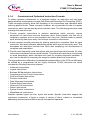
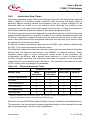
Consistent and Optimized Instruction Formats
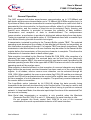
To obtain optimum performance in a pipelined design, an instruction set has been
designed which incorporates concepts from Reduced Instruction Set Computing (RISC).
These concepts primarily allow fast decoding of the instructions and operands while
reducing pipeline holds. These concepts, however, do not preclude the use of complex
instructions, which are required by microcontroller users. The following goals were used
to design the instruction set:
1. Provide powerful instructions to perform operations which currently require
sequences of instructions and are frequently used. Avoid transfer into and out of
temporary registers such as accumulators and carry bits. Perform tasks in parallel
such as saving state upon entry into interrupt routines or subroutines.
2. Avoid complex encoding schemes by placing operands in consistent fields for each
instruction. Also avoid complex addressing modes which are not frequently used. This
decreases the instruction decode time while also simplifying the development of
compilers and assemblers.
3. Provide most frequently used instructions with one-word instruction formats. All other
instructions are placed into two-word formats. This allows all instructions to be placed
on word boundaries, which alleviates the need for complex alignment hardware. It
also has the benefit of increasing the range for relative branching instructions.
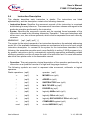
The high performance offered by the hardware implementation of the CPU can efficiently
be utilized by a programmer via the highly functional C166S instruction set which
includes the following instruction classes:
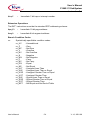
•
•
•
•
•
•
•
•
•
•
•
•
Arithmetic Instructions
Logical Instructions
Boolean Bit Manipulation Instructions
Compare and Loop Control Instructions
Shift and Rotate Instructions
Prioritize Instruction
Data Movement Instructions
System Stack Instructions
Jump and Call Instructions
Return Instructions
System Control Instructions
Miscellaneous Instructions
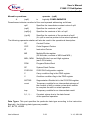
Possible operand types are bits, bytes and words. Specific instruction support the
conversion (extension) of bytes to words. A variety of direct, indirect or immediate
addressing modes are provided to specify the required operands.
User’s Manual
2-5
V 1.6, 2001-08