1
F-Link Supervised Transceiver System
Introduction
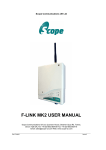
The Scope F-Link system is a four input (dry contact) transceiver which forms
part of a linked radio network for remote alerting and status monitoring, typically
of fire or security panels. The unit has 4 dry contact input zones, each with a
corresponding relay output and a further relay to indicate a radio link failure.
The unit can be configured as either a "master" or a "node" in a supervised
private radio network, employing polling, acknowledge-back and "listen-beforetalk" (LBT) techniques to ensure robustness and reliability of the radio system.
The front panel indicates when any zones are active, the unit's configuration
status (master/node), the presence of a radio signal jam or radio link fail and
received signal strength of incoming transmissions.
The F-Link™ Wireless Networking Protocol is a simple protocol designed for low
data rate, short distance communication. Fundamentally based on IEEE
802.15.4™, the F-Link protocol provides an easy-to-use plug-and-play wireless
network of up to 3 "nodes" + a "master" unit in it's standard configuration.
Expanded systems of up to 15 nodes are possible for specialist applications.
Please refer to Scope Technical Sales for further details.
User-configurable options include Normally Open/Closed default condition for
each input zone and relays set as either Latching, Change of State or Self Reset
(momentary), all selectable via a bank of switches within the unit (no PC
programming required).
The input power requirement is 10-30V dc (500 mA minimum supply), allowing
the unit to be powered from a typical 12V or 24V dc panel supply.
The transmitter is a 0.5W synthesized unit, factory programmable between
458.500 MHz and 458.650 MHz in 12.5KHz channels.
Ref: FLNK1
Page 6 of 15
Issue 1