1
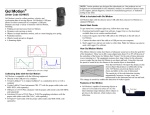
How the Sound Level Meter Works The Sound Level Meter uses an electric condenser microphone mounted on the end of a shaft. The output of this microphone is fed into a series of filters, amplifiers, integrators, and adder circuits to produce a single sound pressure level measurement. The Sound Level Meter uses a directional microphone, which requires the instrument be pointed in the direction of the noise source unless ambient noise levels are being monitored. Acoustical engineers organize the audio spectrum into sound octave bands.3 The weighting switch on your Sound Level Meter is used to add or subtract different values to the octave band components. The “A” weighted sound level discriminates against low frequencies, in a manner similar to the response of the ear. In this setting the meter primarily measures in the 500 to 10,000 Hz range. It is the weighting scale most commonly used for OSHA and DEQ regulatory measurements. The “C” weighted sound level does not discriminate against low frequencies and measures uniformly over the frequency range of 30 to 10,000 Hz. This weighting scale is useful for monitoring sources such as engines, explosions and machinery. The sound levels measured with these two weightings have units of “dBA” and “dBC”, respectively. Calibration Information You should not need to calibrate the Sound Level Meter for classroom use. Calibration is possible, but it will require access to a special calibrator, not commonly available in the classroom. This sensor is equipped with circuitry that supports auto-ID. When used with LabQuest 2, LabQuest, LabQuest Mini, LabPro, Go! Link, SensorDAQ, TI-Nspire™ Lab Cradle, EasyLink, or CBL 2™, the data-collection software identifies the sensor and uses pre-defined parameters to configure an experiment appropriate to the recognized sensor. Suggested Experiments Sound Level Studies You can collect sound level data in many real-world situations; for example, you can collect sound levels before, during and after a concert or dance. collect sound levels throughout the day in a school hallway or shopping mall. use the Sound Level Meter to judge cheering contests at pep rallies. collect data outside and inside a car equipped with a stereo system. make a model of an ear and ear canal. Measure sound levels at the “ear drum” when a headset is placed over the ear. Repeat the experiment but place an earplug between the headset and the meter. Set up the Sound Level Meter to collect readings in a variety of situations. Use the following chart to determine the acceptable duration for exposure to the sound level you measure. The following chart4 shows the sound level exposure rates set by the OSHA Occupational Noise Exposure Standard. In a work environment, for example, it is acceptable to be exposed to 90 dB for eight hours as measured on the “A” weighted scale. If the sound level is 100 dB, the acceptable duration is two hours. A table of the frequency bands for each octave band appears in the Additional References section of this manual. 5 Sound level, slow-response (dBA) 8.0 6.0 4.0 2.0 1.0 0.5 0.25 90 92 95 100 105 110 115 Environmental Measurements Environmental measurements can be made anywhere people spend significant amounts of time, such as their residence. The DEQ noise standard uses statistical sound level values that are applied to residential measurements. One of these measurements is the equivalent hourly sound level, Leq. You can collect sound level data with the Sound Level Meter set on “A” weighting and slow response. If you collect data for an hour and determine the average, you will have an estimate of Leq. These values can then be compared to the local DEQ standards. Room Acoustics One goal of acoustic engineers is to “tune” a room for a specific purpose. A room tuned for lecture will be tuned differently than a library. The Sound Level Meter can be used to investigate acoustics in a room. One of the indicators of good room acoustics is the length of time sound stays in the room. Hard surface in a room allow sound to “reverberate” for relatively long periods of time. Soft surfaces dampen the reverberation. For example, if you clap your hands in an empty gymnasium, you will hear a relatively long echo. Repeat the experiment in a library, music room, or concert hall, and you will hear a shorter echo. Use the Sound Level Meter and a computer or calculator to try this experiment: 1. Set the equipment up to collect data for 5 seconds. 2. Use the triggering feature of the software so the data collection is initiated with a loud sound. 3. Collect a set of data and examine the graph. 4 3 Duration per day (hrs) Paragraphs 29 CFR 1910.95, Table G-16 of the OSHA Occupational Noise Exposure Standard. 6