1
US 7,784,704 B2
3
4
display unit could show the current setpoint temperature and
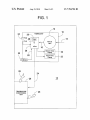
to provide thermostat 10 with other functionality, micropro
the Zone’s actual temperature simultaneously or in an alter
nating manner. Thermostat 10 might also include a selector
more of the following rules:
cessor 36 can be ?rmware programmed to execute one or
switch 34 for manually switching between a cooling mode for
Rule- liUpon receiving a manually entered setpoint tem
cooling Zone 18 and a heating mode for heating Zone 18.
perature, microprocessor assigns an Qi andY) timestamp 48
Items such as display 30, selector switch 34, manual input 12,
to the manually entered setpoint temperature, wherein the
timestamp indicates when the setpoint temperature was
entered relative to other timestamps. The manually entered
setpoint temperature and its timestamp 48 are stored in
and output 24 are well known to those of ordinary skill in the
art. One or more of such items, for example, can be found in
a model CT8775C manual thermostat provided by Honey
well Inc. of Golden Valley, Minn.
memory for later reference.
Rule-2iMicroprocessor 36 looks for patterns of manual
setpoints, wherein each manual setpoint has a manually
entered setpoint temperature and a timestamp 48.
Although thermostat 10 can operate as a regular manual
thermostat by controlling unit 26 as a function of a differential
between the actual Zone temperature and the most recently
A daily pattern, for example, can be de?ned as three con
entered manual setpoint temperature, thermostat 10 includes
a microprocessor 36 (e.g., computer, CPU, ?rmware pro
grammed chip, etc.) that enables thermostat 10 to observe the
secutive days in which a series of three similar manually
entered setpoint temperatures (e.g., within a predetermined
deviation of perhaps 20 F. or 5° F. of each other) have similar
daily timestamps 48 (e. g., eachY-value being within a prede
termined deviation of perhaps 90 minutes of each other).
temperature setting habits of the user (e.g., person that manu
ally enters setpoint temperatures into the thermostat). After
several manual settings, microprocessor 36 may learn the
user’s preferred setpoint temperatures and timestamps them
20
daily setpoint temperature could be, for example, an average
of the three similar manually entered setpoints temperatures
with the aide of a timer 38. With one or more learned setpoint
temperatures and timestamps 48, microprocessor 36 can
begin anticipating the user’ s desires and automatically adjust
the thermo stat’s setpoint temperatures accordingly. Thus,
or the most recent of the three. The learned daily time could
25
thermostat 10 can begin operating as a programmed thermo
stat, rather than just a manual one.
Since a user’ s desired temperature setpoints and time pref
erences might change for various reasons, any manually
entered setpoint temperature 16 overrides the currently active
setpoint temperature regardless of whether the current set
point temperature was manually entered or was automatically
at a learned time to return thermostat 10 back to its pro
35
grammed mode. Thus, thermostat 10 is somewhat of a hybrid
manual/pro grammable thermostat in that it can shift auto
manually entered setpoints temperatures spaced 7 days apart
40
peratures, timer 38 can actually comprise one or more timers
and/ or counters. In some embodiments, for example, timer 38
45
38 is a continuously operating weekly or l68-hour timer that
resets itself every seven days. The increments can be in days,
learned daily setpoint temperature becomes activated at its
learned daily time, or c) a learned weekly setpoint tempera
50
timer. Timer 38, however, is not necessarily synchroniZed
Y values), whereby thermostat 10 controls unit 26 based on
the learned weekly setpoint temperature and continues to do
55
a learned daily setpoint temperature becomes activated at its
learned daily time (but see Rule-5), or c) another learned
weekly setpoint temperature becomes activated at its learned
number such as (X and Y) wherein X cycles from 1 to 7 as a
60
weekly time.
Rule-54A weekly pattern overrides or supersedes a daily
pattern if their assigned timestamps 48 are within a predeter
mined period of each other such as, for example, within three
hours of each other based on theY-values of their timestamps.
day) as a daily timer. In this case, a timestamp 48 might be (3
and 700) to indicate 700 minutes elapsed during day-3.
Whether day-3 represents Monday, Tuesday or some other
day is immaterial, and whether the 700-minute represents
2:00 AM, 7:30 PM or some other time of day is also imma
terial. As one way to provide a programmable thermostat that
can operate independently of an actual time of day clock and
so until interrupted by one of the following: a) the user enters
a manually entered setpoint temperature (adjusts the temp), b)
cycle of a daily timer, timestamp 48 might a be a two-part
weekly timer, andY cycles from 0 to 1,439 (1,440 minutes per
ture becomes activated at its learned weekly time.
Rule-4iAutomatically activate a learned weekly setpoint
temperature at its learned weekly time (at its assigned X and
with the actual time of day or day of the week. Such synchro
niZation preferably is not required; otherwise the user might
have to manually enter or set the correct time and day of the
week.
In the case where timer 36 comprises a weekly timer in the
form of a 7-increment counter triggered by each 24-hour
whereby thermostat 10 controls unit 26 based on the learned
daily setpoint temperature and continues to do so until inter
rupted by one of the following: a) the user enters a manually
entered setpoint temperature (adjusts the temp), b) another
hours, minutes, seconds, or any preferred unit. The weekly
timer could also be a seven-increment counter that indexes
one increment every 24 hours in response to a daily or 24-hour
or the most recent of the three. The learned time could be, for
example, 20 minutes before the three similar timestamps.
Rule-3iAutomatically activate a learned daily setpoint
temperature at its learned daily time (at its assigned Y-value),
includes a continuously running daily or 24-hour timer that
resets itself every 24 hours. The time increments can be in
minutes, seconds, or any preferred unit. In some cases, timer
A weekly pattern, for example, can be de?ned as three
manual setpoints spaced 7 days apart (e. g., same X-value
after one complete 7-day cycle) in which three similar manu
ally entered setpoint temperatures (e.g., within 20 F. or 5° F. of
each other) have similar timestamps 48 (e.g., each Y-value
being within 90 minutes of each other). Such a weekly pattern
can then be assigned a learned weekly setpoint temperature
and a learned weekly time. The learned weekly setpoint tem
perature could be, for example, an average of the three similar
matically between manual and programmed operation.
To assign timestamps 48 to manually entered setpoint tem
be, for example, 20 minutes before the three similar times
tamps. For future automatic settings, the 20 minutes might
allow microprocessor 36 to activate the learned daily setpoint
temperature before the user would normally want to adjust the
setpoint.
30
activated as a learned setpoint temperature. Once overridden,
another learned setpoint temperature might later be activated
Such a daily pattern can then be assigned a learned daily
setpoint temperature and a learned daily time. The learned
65
Rule-6iIf a user enters a manually entered setpoint tem
perature, thermostat 10 controls unit 26 in response to the
manually entered setpoint temperature and continues to do so