1
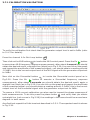
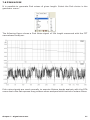
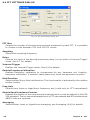
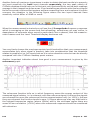
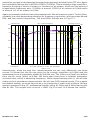
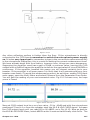
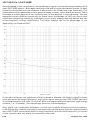
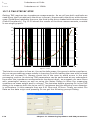
a bi-logarithmic graph. Selecting dB will plot distortion in dB below fundamental/s.
When Linearity is selected dBV or Volts will be used as Y Unit. If the compute linearity
button is pressed dB or V/V are used.
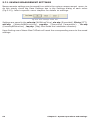
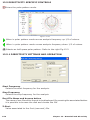
Sweep Settings
These are all settings affecting the next measure to be performed. Must be therefore
handled with care.
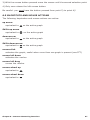
Start and Stop
set the voltage sweep range supplied to the DUT input. Start should be lower in value
than Stop. While these values can be chosen in an iterative way, having a rough idea
of the DUT gain is a good practice. Notice however that keeping the DistLim
parameter to or lower than 10% would prevent hard overload of the DUT. Sweep
range stops anyway when the maximum allowed distortion is reached, whatever
Stop value is chosen. Stop value cannot be grater than 3V, being this the CLIO’s
limit.
Step
set sweep resolution in logarithmic equal step.
DistLim
set, in percentage, the maximum allowed distortion before the sweep stop anyway.
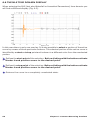
Imp,
in Ohm, set the impedance used by the system to calculate power. Should obviously
be set to the real impedance that loads the DUT. Changing this value after the
measurement has no effect on an already done measure; the value should be correct
before the measure is taken.
Att
set the value of an eventually used passive attenuator placed on CLIO’s input. CLIO’s
input accept up to 100VRMS, that is 1250W/8Ohm. Should you need more, use a
resistors divider on the input and set the Att value accordingly. Advised value are
90-10 Ohm to divide by 10.
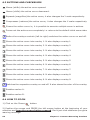
Analysis
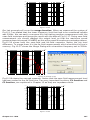
Through this radio button control the analysis type is selected.
Linearity
measure the output Voltage Vs input Voltage. Output level is measured through FFT
looking only at the amplitude of the generated tone. That is harmonics noise or other
is not considered in the output level.
THD
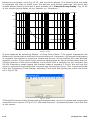
measures Total Harmonic Distortion. Again distortion level is calculated via FFT and
therefore noise is not taken in account. These, in some limited cases, at lower level,
yields to slightly different results than those obtained via traditional THD+noise
measurements. This approach is, however, more accurate. For setting the
measurement frequency please see below.
SMPTE
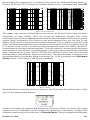
measures Intermodulation distortion using SMPTE standard. Two tones are generated
in a 4:1 ratio at 60Hz and 7000Hz. Intermodulation components up to the 5th order
are considered for distortion.
Chapter 14 - Linearity & Distortion
175