1
Chapter
10
Implinks and Endpoints
Link Concepts and Overview
The SDL suite supports creating and maintaining links between different objects in a system. Such links are used to show relations between
objects in different documents. Objects that may be linked are:
•
Text fragments in text documents
•
Graphical objects and symbols in OM, SC, HMSC, SDL and MSC
diagrams (but not text fragments in such diagrams)
•
Documents in the Organizer structure.
Implinks
The link concept in the SDL suite is designed to support the SOMT
method, further described in the SOMT Methodology Guidelines starting in chapter 69 in the User’s Manual. In SOMT, an important relation
is that one object can be seen as an implementation of another object.
For this reason, links between objects are often referred to as implementation links, or implinks. For instance, a textual object in the requirement analysis may be implemented as an object class in the system analysis, and later as a process type in the design model.
Implinks are the result of a design decision taken during the development of a system. Using implinks enables traceability between the different models and phases, so that the usage of a particular object or concept can be followed from requirements all the way down to code. Another important aspect of implinks is that they facilitate consistency
checks between the different models.
Links and Endpoints
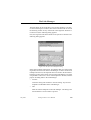
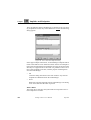
A link has two endpoints, one at each of the objects that are linked together. Endpoints can be created for objects without creating a link, i.e.
endpoints are entities separate from links. When a link is created, endpoints are created automatically, if they do not already exist. It is possible to have any number of links connected to an endpoint. Endpoints
and links can be created from the Organizer and the editors.
Links are bidirectional, i.e. they can be traversed (followed) in both directions. Even so, a link has a “default” direction, defined when the link
is created, to indicate the intended direction. This means that an endpoint is either a logical “from” endpoint, or a logical “to” endpoint.
428
,um-st1
Telelogic Tau 4.5 User’s Manual
July 2003