1
Chapter 2. Pulse Sequence Programming
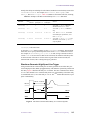
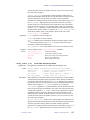
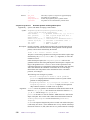
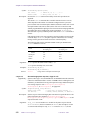
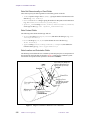
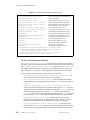
On UNITYplus, the time overhead for the AP bus is 5.75 µs. The offset delay is an
additional 0.45 µs, for a total delay of 6.20 µs.
Note that if the shaped pulse is followed by a delay, say d3, then the end of the delay is at
1.7+pshape+0.5+d3. Similarly, on UNITYplus, the end of the delay is at
6.20+pshape+d3. On UNITY, it shifts 1.5 µs, so the offset delay depends on the type
of system. To obtain the proper offset delay, available in apdelay.h. are macros
WFG_OFFSET_DELAY, WFG2_OFFSET_DELAY, and WFG3_OFFSET_DELAY.
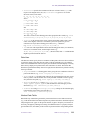
Another delay is incurred between transients on systems other than UNITYINOVA. At the end
of data collection, 3.5 ms is inserted to give the acquisition computer time to check lock,
temperature, spin, etc. If the solids ADC is used so that sw is greater than 100000, this delay
is extended to 15.5 ms on UNITYplus systems or extended by 10 ms per kilobyte points on
UNITY and VXR-S systems. The UNITYINOVA has a 0.004-ms delay at the start of a
transient to initialize the data collection hardware, and a 2.006-ms delay at the end of a
transient for data collection error detection. For systems with gradients, the end of scan
delays do not include the times to turn off gradients, which is done at the end of every scan.
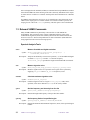
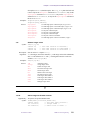
2.13 Indirect Detection on Fixed-Frequency Channel
Indirect detection experiments, in which the observe nucleus is 1H and the decouple
nucleus is a low-frequency nucleus, usually 13C, are easily done on systems with two
broadband channels (not available on GEMINI 2000 systems). Systems with a fixedfrequency decoupler depend on the type of system.
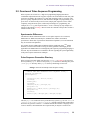
Fixed-Frequency Decoupler
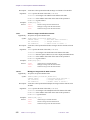
For systems with a fixed-frequency 1H decoupler, the implementation depends on whether
the system is a UNITYINOVA, MERCURY-VX, MERCURY, UNITYplus, or GEMINI 2000, or
instead, is a UNITY or VXR-S.
UNITY
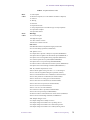
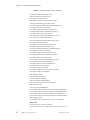
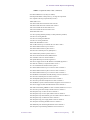
INOVA, MERCURY, UNITYplus, GEMINI 2000 Systems
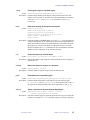
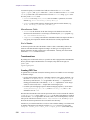
A UNITYINOVA or UNITYplus system with the label Type of RF set to U+ H1 Only in the
CONFIG window, or any MERCURY-VX, MERCURY, or GEMINI 2000 broadband system,
can use the same parameter sets and pulse sequences as a dual-broadband system (e.g.,
HMQC) as long as the pulse statements in a sequence do not use the channel identifiers
TODEV, DODEV, DO2DEV, and DO3DEV. This restriction is negligible because statements
obspower, decpower, dec2power, and dec3power are available that specify an rf
channel without requiring the these channel identifiers. Each of these statements require
only the power level and can be remapped to different rf channels. The rfchannel
parameter enables remapping rf channel selection. Refer to the description of rfchannel
in the VNMR Command and Parameter Reference for details.
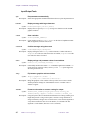
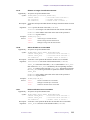
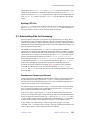
Internal logic on this system checks if the first decoupler is U+ H1 Only, or the system is a
GEMINI 2000, tn is set to 'H1', and dn is not set to 'H1'. If this is the case, the parameters
and pulse statements for rf channels 1 and 2 are exchanged automatically.
MERCURY-VX, MERCURY, and GEMINI 2000 support automatic channel swapping as
well.
146
VNMR 6.1C User Programming
01-999165-00 A0800