1
6.1 XPOLAR—Cross-Polarization, UNITY
to the rare spins by applying an rf field at the Larmor frequency of the rare spins that is of
such magnitude as to make the energy levels of the abundant and rare spins the same in the
rotating frame, the Hartmann-Hahn match condition. Following a transfer of energy from
the polarized spins to the rare spins, the rare-spin field is turned off and resulting signal
observed under conditions of high-power proton decoupling. The recycle time is then set
according to the proton T1, usually much shorter than the rare-spin T1.
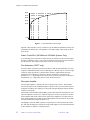
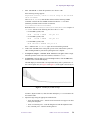
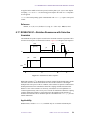
For samples that use cross-polarization, the “contact” time (the time during which crosspolarization occurs) should be optimized with the parameter p2. This is necessary because
two processes happen simultaneously, the magnetization buildup from cross-polarization
and the magnetization loss from rotating-frame relaxation. A time exists for which an
optimum in the magnetization occurs. The rising and falling exponential intensities can be
analyzed with the contact_time macro, which calculates both TCH and 1H T1ρ.
Applicability
XPOLAR is available on all systems.
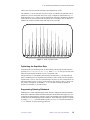
Suppressing Spinning Sidebands
NMR spectra at high magnetic fields often have significant spinning sidebands. While these
spinning sidebands contain information about the chemical shift anisotropy, they can
complicate the interpretation of complex spectra. The sidebands can be eliminated using
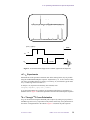
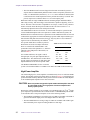
the TOSS (TOtal Sideband Suppression) technique. The TOSS pulse sequence is selected
by setting toss='y'. Note that the parameter srate should be set to the spinning speed
in Hz. TOSS uses 180° pulses based on the parameter pw. It may be necessary to adjust pw
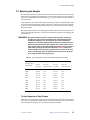
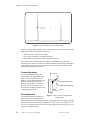
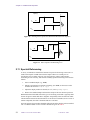
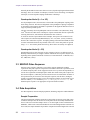
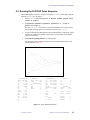
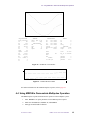
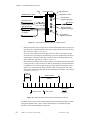
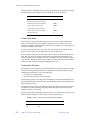
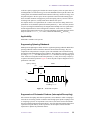
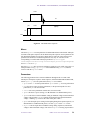
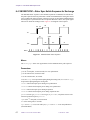
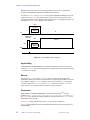
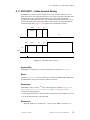
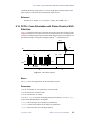
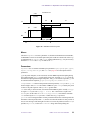
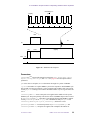
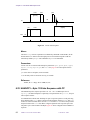
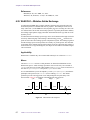
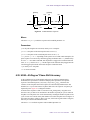
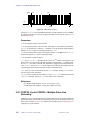
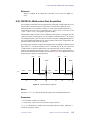
to optimize the TOSS experiment. Figure 21 shows the pulse sequence diagram for crosspolarization with TOSS.
xpol='y' toss='y'
pw
1
H
level2
level1
d1
p2
13
C
Delay recipe
including srate
Figure 21. TOSS Pulse Sequence
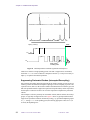
Suppression of Protonated Carbons (Interrupted Decoupling)
Off-resonance decoupling and related experiments, such as DEPT, in which J-coupling is
involved are not usually possible in solids because through-space dipolar coupling as well
as J-coupling is present. An experiment exists, however, that can be used to discriminate
between protonated and nonprotonated carbons—this is the protonated carbon suppression
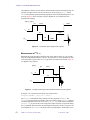
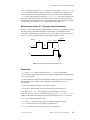
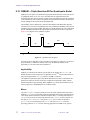
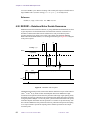
experiment of Opella and Fry. In this experiment, the decoupler is turned off before
acquisition to dephase the protonated carbons.
01-999162-00 A0800
VNMR 6.1C User Guide: Solid-State NMR
60