1
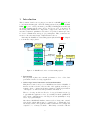
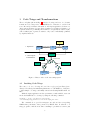
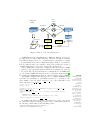
outlined routine, collects performance metrics for the call. Optionally,
a checkpointing/restarting library can be used to shorten the execution
by stopping (checkpointing) and restarting immediately before calling the
outlined function.
3. Empirical tuning
The final phase does the actual empirical tuning. First of all, the potentially beneficial optimizations and their corresponding configurations are
represented as points within an integral search space which can be handled by a search engine. The search engine adopts some search policy to
evaluate points in the search space and search for a point corresponding
a transformation strategy leading to the best performance.
During this phase, multiple versions of the target kernel are generated
by a parameterized translatorfrom the searched points and compiled into
dynamically loadable library routines. The performance of the kernel variants are measured one by one as the checkpointed binary is restarted multiple times and calls multiple versions of the dynamically loadable library
routine.
We give some details about the system design and the current implementation status in the following sections.
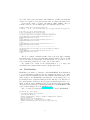
A list of our current hardware/software configurations is given below:
• A Dell Precision T5400 workstation with two sockets, each a 3.16 GHz
quad-core Intel Xeon X5460 processor, and total 8 GB memory;
• Red Hat Enterprise Linux release 5.3 (Tikanga) Linux x86 kernel 2.6.1892.el5.perfctr SMP PREEMPT;
• PAPI 3.6.2;
• the Rice HPCToolkit version TRUNK-4.9.0=1280 (the latest release does
not support the 32-bit machine we use, so we use an older version);
• ROSE compiler version 0.9.4a, revision 6701 (providing a tool interface,
outliner, loop translator, etc.);
• Berkeley Lab Checkpointing and Restarting library V. 0.8.2;
• POET from Univ. Texas San Antonio (We use its latest CVS version
actually, not sure the exact release version number);
• the GCO search engine from Univ. of Tennessee (UTK) (We got a package
from UTK directly, not sure the release number);
• a C version jacobi iteration program, used as a simple example input code
for autotuning.
• the SMG2000 [5] (Semicoarsening Multigrid Solver) benchmark from the
ASCI Purple, used as an example real application.
4