1
The CogniPlus training programs
CODING
The CogniPlus training programs
Working memory: Spatial coding
Working memory: Updating – visual
Dieter Schellig, Uwe Schuri, Walter Sturm © SCHUHFRIED GmbH
Theory
Both monitoring and coding are base mechanisms of
working memory. They are used for (metacognitive)
control and coordination of cognitive processes and
form the basis for more complex cognitive activities.
Monitoring in working memory involves the controlled
supervision of storage processes and stored representations. Storage in spatial working memory requires the
coding of incoming information according to its spatial
features: the location at which the stimuli were perceived and/or their spatial arrangement is stored. Spatial coding links the individual items to representations
(binding) and gives them a structure. There is no “pure”
representation of a visually perceived stimulus; each
stimulus also has a spatial “code”.
For example, the information that a driver obtains by
looking in his rear-view mirror is incorporated into the
stored image of the driving environment. More complex
examples include following assembly instructions or
wiring diagrams, creating mind maps, or working with
multiple open windows on a computer.
Setting and task
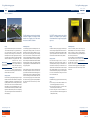
The client observes vehicles driving onto a bridge (memorizing phase). While driving over the bridge the vehicles disappear from the client's view (rehearsal phase).
When they reappear at the end of the bridge, one of the
vehicles may have changed its position in the spatial ar-
Corresponding test in the
NBACK
Markus Sommer, Rudolf Debelak, Christine Heidinger © SCHUHFRIED GmbH
CODING is a program for training monitoring
processes and spatial coding in visuospatial
working memory.
The NBACK training program trains the monitoring function of working memory – the ability to
retain information and continuously update it.
rangement. This vehicle must be identified (recall phase)
– this involves comparing the new arrangement of the
vehicles as they leave the bridge with the stored layout
of their previous arrangement and scanning the new arrangement for differences.
Theory
Difficulty structure
CODING has 21 difficulty levels. At the different difficulty levels different storage and retrieval strategies
are required, ranging from the identification of errors to
reconstruction of the original sequence and the correction of errors. The demands on monitoring processes
increase throughout the program.
The lower difficulty levels train the monitoring skills required to identify errors: the client must decide whether
or not the arrangement of the vehicles shows changes/
errors (yes/no answers). Later the client must click on
the vehicle that has changed its position within the spatial arrangement. Finally at the highest level the difficulty is increased by the disappearance at the recall
stage of the spatial structures between the vehicles;
the scene must be reconstructed from memory. At this
level the client must dissolve his binding of the entire
spatial structure.
The program is adaptive: because the client is constantly working at the limit of his individual ability, there
is little scope for automated processing – controlled
monitoring must therefore be continuously applied.
Working memory is of key importance in dealing with
the demands of everyday life, especially when information that has been briefly presented must be retained
and cognitively processed, or when a task needs to be
performed or a goal achieved. Many diseases such as
Alzheimer’s disease, Huntington's chorea, Parkinson's
disease or attention deficit hyperactivity disorder are associated with impairments of working memory and consequent difficulties in coping with everyday tasks.
Recent scientific findings indicate that the capacity of
working memory can be improved through regular training. As the work of various researchers has shown, the
effect of such training is enhanced if the training tasks
adapt to the client’s ability level. This is the case in
NBACK. The training material consists of n-back tasks
which require the client to react to stimuli that recur at
a particular interval. These tasks place demands on the
client’s ability to retain task-related information and continuously update it in his mind.
Setting and task
In the NBACK training program the client sees a representation of a digital picture frame on his screen. A succession of photographs appears in the frame; the photos have different subject matter (animals, landscapes,
colors etc.). The client’s task is to decide whether the
current photograph matches the one that was shown
one, two or three places back (the number of places
varies with the level). If it matches, he should press the
green button. If it does not match, the red button must
be pressed.
The client receives feedback on his performance at
regular intervals (approx. every 5 minutes). The aim of
this feedback is to maintain the client’s motivation at an
optimal level.
Difficulty structure
NBACK has 15 difficulty levels and adapts to the client’s
ability in four ways.
1.The difficulty is varied by changing the number of
stimuli that the client must remember. At the lower levels
the current stimulus needs only to be compared with the
immediately preceding one. At the highest levels the current stimulus must be compared with the one that was
displayed three places back.
2.The semantic similarity of the pictures represents an
additional difficulty parameter. At higher levels the pictures become more similar.
3.The picture content becomes more abstract and hence
more difficult to verbalise.
4.The picture presentation time becomes shorter as the
difficulty increases.
Corresponding test in the
Vienna Test system
Vienna Test system
CORSI
NBN 14 . COGNIPLUS
COGNIPLUS
. 15