1
and complicated logic. To some extent, VoiceXML encourages this because its form
interpretation algorithm requires multiple passes through a form. The consequences
of certain VoiceXML constructs may not be immediately obvious, e.g. they may
cause an indefinite loop.
VoiceXML adopts a pragmatic and programmatic approach to development. There
is no way to formally check or analyse a VoiceXML script. Instead, VoiceXML
must be debugged using traditional software engineering methods.
VoiceXML applications are essentially single scripts, though these can be made up
from a number of individual documents (i.e. files). VoiceXML supports unconditional transfers (goto) and subroutine-like calls (subdialog) to other documents.
However there is no equivalent of a feature. In fact, VoiceXML does not even use
the term service.
In telephony, services are often composed from self-contained features. A feature
is an additional function that is triggered automatically (e.g. call diversion or call
blocking). From the developer’s point of view, a feature is triggered by certain conditions and is not explicitly called at some point in the call processing code. Features can therefore easily add supplementary capabilities to basic call processing.
The value of features has been amply demonstrated in the IN (Intelligent Network).
C RESS (Chisel Representation Employing Systematic Specification) is a front-end
for defining and formalising services. C RESS was initially based on the industrial
notation Chisel developed by BellCore [1]. However, C RESS has been considerably extended since its beginnings. In particular, it supports the notion of plug-in
domains: the vocabulary and concepts required for each application area are defined separately. C RESS has been demonstrated on services from the IN (Intelligent
Network [24]), Internet telephony [25,27], and IVR (Interactive Voice Response
[27,28]).
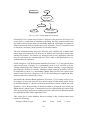
C RESS aims to combine the advantages of an accessible graphical notation, analysis via translation to formal languages, and realisation via translation to implementation languages. That is, the same service diagrams can be used for multiple
purposes. C RESS is neutral with respect to the target language. For formal analysis,
C RESS diagrams are automatically translated to L OTOS (Language Of Temporal
Ordering Specification [11]) or to SDL (Specification and Description Language
[13]); see [28] and [26] respectively. For implementation, C RESS diagrams are automatically translated to Perl (for SIP services) or to VoiceXML (for IVR services);
see [25] and [27,28] respectively.
For IVR services, C RESS is intended to complement existing VoiceXML platforms.
In particular, C RESS offers the following:
• C RESS is a platform-independent graphical notation for a substantial (but not
complete) proportion of IVR applications. A C RESS service is represented at
3