1
3
The grenade timer
This simple construction adds a “poor man’s protected mode” to the processor: as long as the grenade
is fizzing, the system is in real mode and the executing
process can’t escape the fact that it will have to relinquish control when the grenade goes off3 . When the
grenade is not fizzing, the running process is by definition in protected mode, because it has the power to
set the delay and pull the pin to start the countdown
if and when it wishes.
It may be instructive to compare the relationship between the watchdog timer and the grenade
timer with that between the CRC (cyclic redundancy check) and the cryptographically strong oneway hash.
Both the CRC and the hash are functions that take
as input a bit string of arbitrary length and return
as output a short bit string of fixed length. In both
cases, the purpose of the output is to act as errordetecting redundancy: if the input string is changed,
the precomputed redundancy will no longer match,
and a verifier will be able to detect the change. The
difference between the two is that the CRC only resists to random errors, while the hash (which is more
expensive to compute) also resists to malicious attacks. The CRC is designed to detect random bit
errors such as those due to telecommunication noise;
but an attacker may flip unimportant bits in a forged
message until it yields the desired CRC, therefore
making the forgery undetectable. The hash, however,
is designed to stop just that, and makes it computationally infeasible to generate a message with a given
hash output.
The situation is somewhat similar with our timers.
The watchdog timer is designed to interrupt programs that might accidentally lock up, but is insufficient to stop programs that actively try to circumvent
it. The grenade timer, instead, explicitly addresses
the case of malicious attacks. Informally,
The watchdog timer, however, despite its usefulness
for controlling a program that might accidentally run
astray, cannot protect the system against a malicious
program that purposefully tries to keep the processor to itself. The operating system could tell the
guest program “I am about to execute you, and I
will grant you up to 20 million clock cycles; if you
have not returned control to me by then, you will be
terminated”. But if by hypothesis we use a processor where all code runs in real mode, the above is
pointless: without the distinction between real mode
and protected mode, if the operating system can load
the counter with the value “20 million cycles”, then
so can the guest program, which is therefore free to
extend its own lifetime indefinitely.
We were thinking about this problem in the context of providing a restricted execution facility for
mobile code that might run on the hardware node
developed at AT&T Laboratories Cambridge for the
Prototype Embedded Network (previously known as
Piconet) project [2]; this portable short-range wireless system uses the TMP93PS40 16-bit microcontroller from Toshiba (based on the TLCS-900/L processor) which, like most other microcontrollers, does
not offer a protected mode.
Inspired by the watchdog timer concept, we came
up with a construction that solves the above problem. We call it the grenade timer. It allows a system
without protected mode to limit the execution time
of a guest program.
The novel idea is to build a counter that can not be
reloaded once it is running. An egg-timer set to count
downwards for five minutes can easily be stopped or
wound back at any time during its countdown; however a hand grenade whose fuse has been lit will definitely explode after the set number of seconds, regardless of any attempt to put the pin back in. We
want our counter to be like a grenade: once the operating system has pulled out the pin and tossed the
fizzing grenade to the guest process, no authority in
the world (not even the operating system itself) must
be able to postpone the scheduled explosion.
We may however provide an escape mechanism
that makes the explosion happen immediately: this is
equivalent to firing a bullet into the fizzing grenade to
make it blow up prematurely. This is a useful thing
to do when a well-behaved guest program wants to
return control to the operating system before having
consumed its entire quota of allocated cycles.
We complete the metaphor by explicitly saying
that the operating system wears a thick armour that
protects it from explosions: when the grenade goes
off (which corresponds to the processor been reset),
the guest process dies, but the operating system is
unharmed.
watchdog : grenade = CRC : hash.
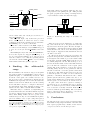
At the circuit diagram level (see figure 1), the
external interface of the grenade coprocessor as described so far (which contains little more than a
counter) is as follows:
The RESET input brings the device in a known initial state: it is a necessary system-level facility outside the control of the main processor and we shall
not consider it any further here.
The device4 is in real mode when IS FIZZING is
1 and in protected mode otherwise. The LOAD input
and the COUNT VALUE data bus may be used to load
3 The position to which the processor jumps on reset will
always run in protected mode and therefore needs to be safeguarded from unauthorised changes, otherwise the guest program could substitute itself to the operating system code and
bypass any protection. See section 4.
4 Or, more precisely, the system that incorporates it.
3