1
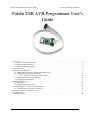
Pololu USB AVR Programmer User's Guide
© 2001–2010 Pololu Corporation
1. Overview
The Pololu USB AVR programmer [http://www.pololu.com/catalog/product/1300] is a programmer for Atmel’s AVR
microcontrollers and controller boards based on these MCUs, such as Pololu Orangutan robot
controllers [http://www.pololu.com/catalog/category/8] and the 3pi robot [http://www.pololu.com/catalog/product/975]. The
programmer emulates an AVRISP v2 on a virtual serial port, making it compatible with standard AVR programming
software. Two additional features help with building and debugging projects: a TTL-level serial port for general-purpose
communication and a SLO-scope for monitoring signals and voltage levels.
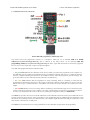
Please note that this guide applies to Pololu’s second-generation AVR programmer (pictured to the left below), not the
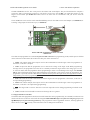
original, similar-looking Orangutan USB programmer [http://www.pololu.com/catalog/product/740] (pictured to the right).
USB AVR programmer PGM03A.
Orangutan USB programmer PGM02A/B.
If you have the original Orangutan USB programmer, you can find it’s user’s guide here [http://www.pololu.com/docs/0J6].
Important Safety Warning and Handling Procedures
The USB AVR programmer is not intended for young children! Younger users should use this product only under adult
supervision. By using this product, you agree not to hold Pololu liable for any injury or damage related to the use or
to the performance of this product. This product is not designed for, and should not be used in, applications where the
malfunction of the product could cause injury or damage. Please take note of these additional precautions:
• The USB AVR programmer contains lead, so follow appropriate handling procedures, such as washing hands after
handling.
• Since the PCB and its components are exposed, take standard precautions to protect your programmer from ESD
(electrostatic discharge), such as first touching the surface the programmer is resting on before picking it up. When
handing the programmer to another person, first touch their hand with your hand to equalize any charge imbalance
between you so that you don’t discharge through the programmer as the exchange is made.
1. Overview
Page 2 of 40