1
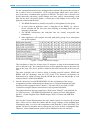
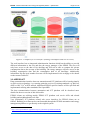
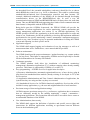
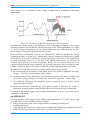
EEPOS ● EEPOS automation and energy management platform - Specification Page 15 of 34 For the communication based on a trading model in SmartCoDe project the concept of the so called “Least Cost Function” (LCF) was developed which can be also used as part of the basic communication approach in EEPOS. The basic idea is that the cost profile inherently represents a power budget over time, and by incorporating a load plan into the next cost-profile update, a certain part of this budget is reserved for the appliance which made the plan: 1. The BEMS broadcasts a (initial) cost-profile to all appliances in the group. 2. At some point an appliance issues a load-plan to the BEMS, e.g. when a freezer switches off the first time after finishing its learning phase and now computes a load-plan. 3. The BEMS incorporates the load-plan into the current cost-profile and broadcasts it. 4. Other appliances will compute and send load-plans, giving rise to subsequent cost-profile updates. Figure 7. Profile calculation example This calculation is done for all time slots (15 minutes) as long as the maximum delay time is allowed to do. The connected devices are then planned to start at the least cost time in the array. The device profile is added to the total load profile at the least cost time. The same principle can be used to define a trading protocol between NEMS and BEMS with the advantage, that the LCP (Least Cost Protocol) incorporates an abstraction level which prevents, that the NEMS has to have the knowledge of each connected device within each BEMS. Interface between User and BEMS/NEMS: For the visualisation of the energy consumption and the communication with the user in German Demonstrator each dwelling will be equipped with a Tablet PC. The data will be provided via WiFi Connection using the internet connection of each separate household. The technical data of the user terminal are: Widescreen Tablet PC with Android 4.0, 1,2 GHz Processor / 1GB DDR III RAM, Built-In Camera on Front, Microphone, Speaker, 3,5 mm Earphone Jack, HDMI Output, WIFI, G-Sensor and USB Host Function. Also for the German Demonstrator the same internet portal, as tested in the German pilot, will be used to show the tenants and the energy manager of the building their consumption data, as well as the temperatures and humidity of their dwellings. The tenants will need a username and a password to get access to their consumption data. Therefore, a data administration system will be installed for the web interface. 2013-05-17