1
A Look at the ZMD 900-MHz IEEE 802.15.4/ZigBee-Ready Radio
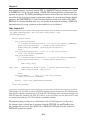
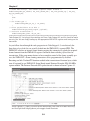
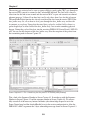
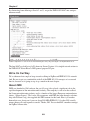
Let’s analyze the contents of Screen Capture 4.1. The actual frame-length calculation, which is
gathered from the PPDU (PHY Protocol Data Unit) header area, is correct. Including the pair
of CRC bytes that are shown as dots at the end of the hex dump, I count 14 octets in the hex
dump area of Screen Capture 4.1.
The Frame Control Word resides inside of the MAC protocol data unit (MPDU) header, which
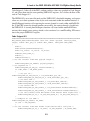
is identified by MHR (MAC header) in the IEEE 802.15.4 specification. I added the FT_INTRA_PAN bit to the low byte of the Frame Control Header in Code Snippet 4.5 as there will be
no intra-PAN communications in our simple little IEEE 802.15.4 network. My code change is
reflected by the Intra PAN bit value shown in Capture 4.1. Turning on the intra-PAN bit in the
Frame Control word eliminates two bytes (Source PAN Identifier) from the addressing fields.
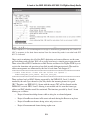
The broken-down Frame Control word tells us that the Destination Addressing and Source
Addressing Modes are 16 bits in length, which means that 16-bit short addresses will be used
instead of the 64-bit IEEE addresses. Most every IEEE 802.15.4 and ZigBee implementation
uses the 16-bit addressing modes rather than the IEEE 64-bit addressing modes as the less stuff
you’re sending, the more power you’re saving. Do the Destination PAN Identifier and the Destination Address values look familiar? How about the Source Address value? According to Code
Snippet 4.2, the source Address should be 0xFFFF as macPIB.macShortAddress = 0xFFFF is
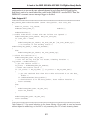
defined. Well, before I compiled the UnslottedTx application, I changed the macPIB.macShortAddress value in the MAC PIB to read ASCII “SA” for Source Address. The MAC PIB (PAN
Information Base) is kept inside the mlmeResetRequest function in the BCS code. If you follow the IEEE 802.15.4 rule book, which the BCS is doing in its own way, the logical location
of the MAC PIB should be inside of the MLME (MAC Sublayer Management Entity), which is
part of the MAC sublayer.
It looks like it took me fourteen tries at sending and capturing this frame (it did), as the Sequence Number is greater than one. Even though we asked for an acknowledgment to be sent
upon reception of this frame, there was no End Device to receive our data and, thus, an acknowledgment from a nonexistent End Device cannot be generated or transmitted.
The frame captured in Capture 4.1 is about as raw and basic as it gets. There is absolutely
nothing ZigBee in this gaggle of bits at all. Everything you see in Screen Capture 4.1 is IEEE
802.15.4 PHY and MAC related. All we did here was stuff the Frame Control bits, make up
some addressing words, stick a text message behind it all and cram it into the ZMD44102’s
registers and transmit FIFO. The ZMD44102 added the necessary frame encapsulation pieces
(preamble, SFD (Start of Frame Delimiter), CRC), formed up the IEEE 802.15.4 frame and
pushed the whole mess out the ZMD44102 Starter Board’s antenna.
No rules were broken and there is absolutely nothing wrong with the frame we just aired. As
long as the receiver and the receiving application know what to do with the incoming frame,
who cares about its format? For instance, the receiver could have simply parsed or counted
through the Frame Control and addressing fields of the IEEE 802.15.4 frame we sent and
picked out what it wanted to use of the text message. Or, if there were more than one receiver,
the address information could have also been parsed and logically analyzed to determine who
55