1
Under Development
There are three ongoing major software
developments. Please contact us if you wish to
receive additional information on any of these
developments.
FLAC++ — A native Windows 95 / NT version of FLAC is
presently under development. FLAC++, written in C++, will
overcome many of the restrictions of FORTRAN-based FLAC,
including the following:
1. FLAC++ will have double-precision variables in all
important calculation modules. This will provide more
accurate solutions for problems involving small
incremental changes over long time periods, such as
transient groundwater and creep simulations.
FLAC Version 3.4 — Several new features will
be available in our next release of FLAC:
• an option for high resolution graphics,
• user’s manual on CD-ROM,
• generalized ATTACH logic for grids of
•
•
•
•
•
•
2. FLAC++ will include a general x,y-grid specification as
well as the existing i,j-grid specification. This will give
users more flexibility in developing grids.
different zone sizes,
visco-plastic-brittle constitutive model,
multistepping to speed dynamic analysis,
incompressible fluid flow to speed transient
groundwater analysis,
double-precision coordinates, so that small
increments are not lost in large-strain mode,
direct file access from FISH, and
FISH intrinsics to perform matrix operations.
3. It will be possible to define different element types for
different regions of a model. For example,
stiffness-matrix elements may be defined for regions in
which only an elastic response is anticipated and
mixed-discretization elements for regions in which
plastic yielding is expected. This can potentially result
in a significant saving in computer time.
FLAC 3.4 is scheduled for release in the Fall of
1997.
Parallel-Processing PFC — The original versions
of PFC (both 2D and 3D) contained logic for
splitting up a problem domain, and executing
each sub-domain on a separate processor, with
communication of forces and ball information
between processors. We plan to extend this logic to
develop a parallel version of PFC (2D and 3D) to
run on two or more Pentium PCs connected by
Ethernet links. This version of PFC will operate as a
native Windows 95 / NT application with MPI
(“Message Passing Interface”) software interface,
used for communication between processors. We
anticipate a significant increase in calculational
efficiency with parallel processing.
4. FLAC++ will utilize the graphics interface developed
for our other C++ codes, FLAC3D, PFC2D and PFC3D.
This will include plotting-while-cycling so that users
can view the analysis as the solution progresses.
We hope to have a preliminary test-version of FLAC++ in
early 1998.
Parallel PFC is scheduled for release in December
1997.
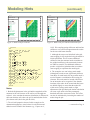
Shown at the Itasca International Tunneling Association
exhibition in Vienna are (left to right): Heinz Konietzky,
Charles Fairhurst, Lars Rosengren and Alfred Zettler.
2