1
1.1
Font design with CI Using Naturalness Learning
Thee naturalness learning for font design employs the echo state recurent neural
networks to learn personal style of writing and synthetize from it font characters.
Human-like behaviour has recently become important in various fields of research
and engineering. The naturalness contributes with added value to the final result,
not only in the handwriting, but also in other fields. For example by comparing the
motion trajectories of industrial robots and motion trajectories of AIBO robots;
motions in technical simulations and motions of computer generated humans in
movies and games; understandable synthesized speech and emotional speech;
technically correct musical performances that follow the score and those
performed with the musician’s expressivity.[3]
We can say that all the above examples are cases where naturalness contributes to
the basic system. In the system for synthetizing the handwriting, the basic system
is provided by the strokes of a font character and the naturalness by the differences
between handwritten strokes and the original font strokes. The possibility to
generate the appropriate differences (naturalness) for the strokes in the font
characters and simple addition of the differences to the font strokes yield in
synthetized handwritten characters.[3]
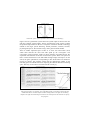
The naturalness is expressed by an arbitrary mechanism: namely as a 2-D
displacement vector field between evenly spaced points along the strokes of the
font and its corresponding handwritten version (Figure 4).
Figure 4
2D displacement vector field, font characters shown in black, handwritten in blue taken from [3]
In several letters, the relationship between the input data and naturalness by this
system was found to be nearly linear. There is amount of the variability in
naturalness, so suggesting that a nonlinear modelling technique should be
employed is on the right place. The temporal nature of the input data (font
characters) implied we need a system that uses short-term memory. An echo-state
network (ESN) meets both temporal and variability requirements. An ESN is able
to model (nonlinear) dynamical systems and is capable of short term memory
modeling, without the need to convert time series into static input by using the
sliding window technique.[3]