1
5.2
5.2
RCN2 program
6
RCN2 program
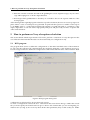
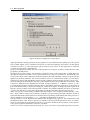
The program RCN2 computes the average energies, the radial integrals and the spin-orbit parameters
of the electornic configurations defined in RCN. To call the program use the Add RCN2 call command
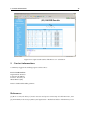
from the Application menu bar, or the 2 button (see Fig. 7). In this program you can set some parameters
Figure 7: RCN2 program main panel.
that influence the calculation performe in the subsequent steps: this is done through the The program
RCN allows to define the configurations of the initial and final states of the transition. To call it use the
Configure... button.
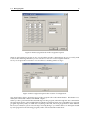
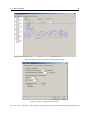
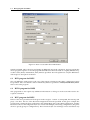
The General tab (Fig. 8) defines whether the radial integrals are multiplied by the overlap integrals and
whether the inetgrals needed for the computation of an electric quadrupole transition should be calculated.
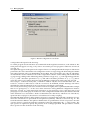
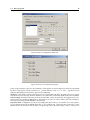
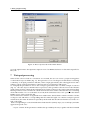
The Numeric Parameters tab (Fig. 9)is particularly important. It defines the factor for rescaling the
Slater integral values with respect to their atomic value in order to simulate the effect of the intraatomic correlation not accounted for in the HartreeFock approximation. F k (li , lj ), F k (li , li ), Gk (li , lj )
and Rk (li , lj , li0 , lj0 ) are the Slater integrals involving different shells. ζi is the spin-orbit parameter. The
”normally” used values of the rescaling factors are 0.8 for the Slater integrals and 1 for the spin-orbit
factor.
Note that the order in which these parameters are listed is used to identify them as they appear in the
input of RCG (see following section).
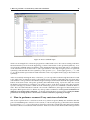
The Output tab (Fig. 10) does not require to be modified.
5.3 RCG program
The program RCG receives as input the output from program RCN2 and computes the eigenvectors and
eigenvalues of the specified configurations. If the calculation is performed in spherical symmetry (we
explain later how to defien the symmetry) then it will also compute the absorption spectrum. Otherwise