1
Exclusive Technology Feature
wiring of the wattmeter from being incorrectly included in the power measurement. That, in turn, can lead to
lower efficiency calculations. By setting the meter to average over 32 (or 64) samples you can generate more
stable results.
You will need two multimeters to measure output power; one to measure output voltage and the other to
measure current. Use the higher-resolution meter to measure current. Since output power is purely dc, it is
calculated by multiplying output voltage times output current.
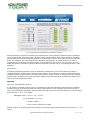
To simplify the task of determining whether the specifications of your power supply comply with worldwide
regulations, Power Integrations has developed a helpful Energy Compliance Calculator. The targets for no-load
and active-mode efficiency are derived from the nameplate rating of each power supply. That rating is simply
the rated output marked on the power supply case and represents the minimum rated output power of the
supply at room temperature and nominal line. As an example: a constant-voltage, constant-current charger
with a nameplate rating of 5 V, 350 mA will deliver 5 V, 350 mA minimum.
Once you enter the nameplate output power rating for your power supply, the calculator will automatically tell
you the target values for compliance to the energy standards relevant to your design. Designs that accept
universal input voltages require measurements made at both 115 Vac, 60 Hz and 230 Vac, 50 Hz.
Measurements for single-input designs should be made at the nominal line voltage of either 115 Vac or 230
Vac.
To demonstrate this process let’s look at the test procedure for a 5-V, 350-mA cell phone charger rated for
universal input. We begin with a series of tests to measure active-mode efficiency at 115 Vac, 60 Hz. Activemode efficiency is the average of efficiencies measured at 25%, 50%, 75% and 100% of the nameplate rating
at a nominal line-input voltage and nominal line frequency. Since the nameplate load rating of this charger is
350 mA, efficiency must be measured at the following currents: full load (350 mA), 75% load (262 mA), 50%
load (175 mA) and 25% load (88 mA.)
Begin the test process by warming up the power supply for 30 minutes. To make the first measurement at
100% load, connect the power supply to an ac source and apply a 60-Hz, 115-Vac input. Gradually increase the
load on the power supply to 100% and allow at least 30 minutes for the circuit to reach thermal equilibrium and
the input power reading to stabilize. Before recording any measurements, make sure no oscilloscope probe or
other meter is connected to the circuit. In some cases you may need to manually set the voltage and/or current
range of the wattmeter to prevent it from auto-ranging and giving fluctuating results. The same measuring
instrument, in two different ranges, will typically have different levels of accuracy. Typically, the operator’s
manual will indicate the range that will generate the highest accuracy.
Once the circuit has reached thermal equilibrium, take the initial power reading from the wattmeter. Wait five
minutes and then take a second reading. If you find less than 5% difference between the two readings, record
the second reading. If the difference is larger than 5%, you should wait another five minutes and continue to do
so until two successive readings are within 5% of one another. Alternatively, you can use the “integration
mode,” available on most wattmeters and described in the following section.
Calculating Integral Input Power
To measure the input power of a design where the input power varies over time, take the following steps:
1. Set your wattmeter to integration mode.
2. Set the interval of integration for your wattmeter to capture approximately one full cycle of variable
input power. (The longer the duration, the higher the accuracy of results. We recommend integrating
over a period of 1 minute for most applications.)
3. Read the input energy from your wattmeter as W-hr.
4. Divide this number by the interval of integration. Make sure to adjust the time units so they cancel. For
example:
Input Energy (W-hr)/Measurement Interval (min) * 60 mins/1 hr = Input Power (W).
© 2012 How2Power. All rights reserved.
Page 3 of 6