1
THE ESSENTIAL
FACTOR
One of the biggest impacts that hydropower plants
have on the local environment is reduced dissolved
oxygen levels downstream. This consequence is one
of concern, as dissolved oxygen (DO) is vital to the survival of aquatic organisms. Most freshwater organisms
need levels above 5 mg/L for optimum growth, and
species like salmon require even higher concentrations. When DO levels decrease, fish and other aquatic
life may abandon the area or die.
While dissolved oxygen concentrations fluctuate
naturally due to wind effects, underwater photosynthesis and organism respiration, hydropower dams
may cause a far more sudden and steep change. As
reservoirs are usually deep enough to stratify, the drop
in DO levels is often due to released water from the
bottom of the reservoir (low DO), as opposed to the
top (higher DO). This low dissolved oxygen content
can also be caused by an overgrowth of algae that
consume the oxygen in the impoundment. To minimize any environmental risk from the dam, dissolved
oxygen levels should be continuously monitored for
atypical changes.
Why is Dissolved Oxygen Important?
The Effects of Stratification
Oxygen Depletion
Dissolved oxygen is necessary to survive for many forms of aquatic life
including fish, invertebrates, bacteria and plants. These organisms use
oxygen in respiration, similar to organisms on land. Fish and crustaceans
obtain oxygen for respiration through their gills, while plant life and phytoplankton require dissolved oxygen for respiration when there is no light
for photosynthesis. The amount of dissolved oxygen needed varies from
creature to creature. Bottom feeders, crabs, oysters and worms need minimal
amounts of oxygen (1-6 mg/L), while riverine fish need higher levels (4-15
mg/L). Even microbes such as bacteria and fungi require dissolved oxygen
to decompose organic material at the bottom of a body of water.
Stratification separates a body of water into layers. This layering can be based
on temperature or dissolved substances (like oxygen) with both factors
often playing a role. The stratification of water has been commonly studied
in lakes, and frequently occurs in reservoirs and deep impoundments.
Oxygen depletion can come from two causes. First, oxygen is used by fish,
bacteria and plants (at night) in a process called respiration. When respiration (oxygen consumption) is greater than the amount of oxygen received
from the air or from photosynthesis, dissolved oxygen levels will decrease.
Second, microbes at the bottom of a lake bed use oxygen to decompose
the organic material. If there is an excess of decaying organic material (from
dying algae and other organisms), the oxygen use increases. As there is no
aeration and little photosynthesis in the lower layer of the water, this oxygen
is not replenished. That means that in a stratified body of water, the oxygen
at lower water levels will get used up, leaving an anoxic (no-oxygen) zone at
the bottom of the water body. When the dam intake is below the stratified
boundary, the released water will also be depleted of oxygen. This in turn
can negatively affect water quality downstream.
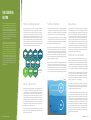
BLUEGILL
BASS
SALMON
TROUT
5
5
6
7
WALLEYE
CARP
PERCH
5
5
5
BACTERIA
PIKE
MUSKIE
1
2
4
OXYGEN
REQUIREMENTS
(mg/L)
Where does DO Come From?
Dissolved oxygen enters water through the air or as a plant byproduct. From
the air, oxygen can slowly diffuse across the water’s surface from the surrounding atmosphere, or be mixed in quickly through aeration. Dissolved
oxygen is also produced as a waste product of photosynthesis from phytoplankton, algae, seaweed and other aquatic plants. As such, dissolved
oxygen concentrations are constantly affected by diffusion and aeration,
photosynthesis, respiration and decomposition. They are even affected
by water temperature, salinity and pressure changes. That means that dissolved oxygen levels can range from less than 1 mg/L to more than 20 mg/L
depending on how all of these factors interact.
For most healthy freshwater rivers and streams, DO levels seasonally range
from 6 mg/L to 15 mg/L. Freshwater lakes may have slightly lower ranges
due to the effects of stratification.
2
MONI TO RING OX YGEN
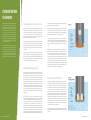
In a stratified impoundment, the top and bottom of a reservoir is divided by
a boundary called the thermocline. This boundary keeps the layers of water
from mixing, and there will often be a noticeable difference in temperature
and dissolved oxygen levels between the two layers.
The uppermost layer of the impoundment is exposed to solar radiation and
contact with the atmosphere, keeping it warmer and air-saturated. Due to
the contact with the air, potential for aeration (wind) and the byproducts of
photosynthesis, dissolved oxygen in the top layer usually remains near 100%
saturation. The exact levels of DO vary depending on the temperature of the
water, the amount of photosynthesis occurring and the quantity of dissolved
oxygen used for respiration by aquatic life.
At the bottom of the impoundment, bacteria and fungi use dissolved oxygen
to decompose organic material. This organic material comes from dead
algae and other organisms that sink to the bottom. The dissolved oxygen
used in decomposition is not replaced – there is no atmospheric contact,
aeration or photosynthesis to restore DO levels in the lower strata. Thus
the process of decomposition consumes all of the oxygen within this layer.
DO Units and Percent Air Saturation
Dissolved oxygen is usually reported in milligrams per liter (mg/L) or as a
percent of air saturation (%). However, some studies will report DO in parts
per million (ppm). 1 mg/L is equal to 1 ppm, while the relationship between
% air saturation and other units will fluctuate based on environmental factors
such as water temperature, pressure and salinity. This is due to the definition of air saturation as a partial pressure, rather than a measured quantity.
In a stable body of water with no stratification, dissolved oxygen will be at
100% air saturation. 100% air saturation means that the water is holding as
many dissolved gas molecules as it can in equilibrium. At equilibrium, the
percentage of each gas in the water would be equivalent to the percentage
of that gas in the atmosphere – i.e. its partial pressure.
It is important to note that while two bodies of water may both be at 100%
air saturation, they do not necessarily have the same concentration of dissolved oxygen. The actual amount of dissolved oxygen (in mg/L) will vary
depending on temperature, pressure and salinity.
How do environmental factors affect oxygen solubility? First, the solubility of oxygen decreases as temperature increases. This means that warmer
surface water requires less dissolved oxygen to reach 100% air saturation
than deeper, cooler water. For example, at sea level (1 atm or 760 mmHg)
and 4°C (39°F), 100% air-saturated water would hold 10.92 mg/L of dissolved
oxygen. But if the temperature were raised to room temperature, 21°C (70°F),
there would only be 8.68 mg/L DO at 100% air saturation. Second, dissolved
oxygen decreases exponentially as salinity increases. Third, dissolved oxygen
will increase as pressure increases. This is true of both atmospheric and
hydrostatic pressures. Water at lower altitudes can hold more dissolved
oxygen than water at higher altitudes.
F ON DR IE ST.COM
3