1
toolie
sender
sender
receiver
receiver
ADT
event(args)
receiver
event(args)
event(args)
event(args)
broadcast
(1-way send)
receiver
request
(send event, receive data)
listener
listen_before
(take action before event
received by receiver)
listener
listen_after
(take action after event
received by receiver)
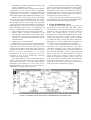
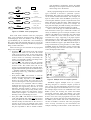
Figure 3. ViTABaL event propagations.
Both event names and data values are propagated
along event connections between toolies, unlike most
visual languages which use dataflow, such as Prograph
[3] and Fabrik [12], or control flow, such as PICT [5].
The event names and argument data types in a view can
be hidden if desired, just showing the kind of propagation
along a toolie connection.
There are four types of events that can be propagated
along event connections:
• broadcast ( event(args) ). The named event and optional
argument data values are sent from the sender
toolie to the receiver toolie. As the sender needs
no information from the receiver, if the sender and
receiver toolies are executing concurrently, the
sender can potentially continue executing before
the receiver responds to the event.
• request (
). The named event and argument
data value(s) are sent from the sender toolie to the
receiver toolie. The sender must wait for the
receiver to respond and return any requested values.
Supplied and returned arguments are indicated by a
‘-’ meaning supplied by sender and a ‘+’ meaning
returned by receiver (e.g. read(+line) and insert(line) in Figure 2).
• listen_before (
). The listener is sent the
named event and argument data values before the
receiver actually responds to the event. The
listener can even modify the event sent to the
receiver, allowing the event response behaviour of
the receiver to be modified without actually
modifying the receiver code. This is a powerful
technique, not supported by other TA or visual
languages, allowing toolies to “listen” to events
sent to other toolies and possibly modify them.
Other language support for such notions, such as
CLOS-style wrappers, are limited to simply
listening to but not modifying the event.
• listen_after (
). The listener is sent the named
event and argument data values after the receiver
has responded to the event. In this case the listener
will not modify the behaviour of the receiver’s
response to the event, but will take some action
based on what event and data values the receiver
has just responded to. This is similar to MVC-
style dependency mechanisms, but has the added
advantage of the complete named event and data
values being sent to the listener.
Event propagation diagrams show instances of toolie
types connected to describe a particular system’s
functionality. The toolie types and their event responses
can be reused in different situations. For example, the
input or shifter toolies from the KWIC system may be
reused in quite different systems to input data into a line
buffer ADS and to shift these lines. ADSs will often be
reused in many different systems. For example, the
input_file and output_file ADSs from Fig 2 are instances
of the same character_file Abstract Data Type (ADT).
Reuse of the toolie type in a different situation may
mean an instance of this type is connected to toolies of a
variety of different types. For example, instances of the
character_file ADT may be connected to any toolie which
sends it read/write events. The input toolie is more
restricted in its usage, supporting a do_input response
and requiring two other toolies responding to read(+line)
and insert(-line) events. The KWIC design in Figure 2
could be modified to support quite different line input or
storage mechanisms by using instances of other ADTs.
ViTABaL checks the send/receive events of each toolie
before generating code to ensure each toolie is sent valid
events and argument data values.
event(args)
event(args)
event(args)
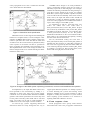
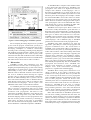
Figure 4. Multiple views of complex systems.
ViTABaL supports multiple views of a system,
allowing designers to construct complex systems in
parts. Views can share information and can be used to
provide both high-level and detailed views of a system.
For example, Figure 4 shows two additional views of the
KWIC system, one showing the toolies and ADSs
associated with line input and shifting, the other
showing toolies associated with line sorting and output.
In these views the event propagation icons have been
hidden, thus showing only the basic interconnections of
the KWIC system toolies. The event connection names
can also be hidden, if desired. All event propagation
views are kept consistent by the environment. For
example, renaming a toolie instance, event connection or