1
Concurrency requires broadcasts and requests to be
sent along communication channels. Broadcasts can be
non-blocking if the receiver and toolies it is connected to
don’t send requests to the sender. We have run the KWIC
system on two Macintosh computers, splitting up the
input and shifter toolies. After removing concurrency
annotations, ViTABaL regenerates code which runs
efficiently on one machine.
ViTABaL generates code to “register” each toolie and
toolie connection, allowing programmers to choose
toolie objects and events they want visualised or traced.
At present ViTABaL regenerates all toolie classes and
methods whenever a view is modified. This could be
changed to incremental regeneration for efficiency.
ViTABaL performs consistency checks before
generating code, to ensure a specification is correct. This
includes checking event propagations are supported by
appropriate event responses in receiving toolies, ensuring
the correct number and type of event arguments are sent,
and ensuring event propagations enacted by event
responses have suitable receiver instantiations specified
in event propagation views.
All views are kept consistent using the MViews
view consistency mechanisms. These allow some view
updates to be automatically applied to graphical and
textual views by the environment. Other changes which
can not be automatically carried out are presented to
programmers as change descriptions. Users manually
implement these changes to restore view consistency [8].
For efficiency, ViTABaL adopts a compilation
approach and translates ViTABaL programs into Snart
programs. These can be efficiently executed, with
generated code being almost as efficient as hand-generated
Snart programs. The process of translating a ViTABaL
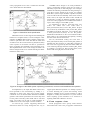
program into a Snart program is illustrated in Figure 8.
Toolie classes, their attributes and methods, and code
to create instances of toolie classes and link instances
with variables used by event response ports are generated.
Event responses are translated into Snart code with
appropriate kinds of method calls between toolie objects.
Broadcast/requests with no listeners on the receivers and
no concurrency between sender/receiver are translated into
Snart method calls. Listened events must be sent to
listen_before/after methods of listeners, which may then
call the real receiver method for the event response.
Base ViTABaL Program Representation
toolie
...
1. Calculate all
toolies to generate
classes for
2. Calculate all
event responses used
(= class methods)
class(input,
inherits(...),
features(
input_file:file,
line_buffer:lines,
shifter:shifter,
do_input,
...
)).
toolie
connection
+ events
toolie_type
...
...
event response
4. Generate code
to create instances
of toolie classes and
to link up instances via
port name attributes
3. Calculate all
toolie connections
(= class attributes)
kwic::init :input@create(Toolie1),
shifter@create(Toolie2),
line_buffer@create(Toolie3),
...
Toolie1@shifter:=Toolie2,
Toolie1@line_buffer:=Toolie3,
Toolie2@line_buffer:=Toolie3,
...
5. Generate event response
code for each event response needed.
Must translate broadcasts/requests into
a suitable form e.g. if listen_before
on call, if concurrent execution, etc.
input::do_input :self@line_buffer(Var1),
self@input_file(Var2),
self@shifter(Var3),
while(Var2@read(Line),
Var1@listen_before(line_buffer@insert(Line)),
Var3@input_finished.
Figure 8. Compilation of ViTABaL programs to Snart class implementations.
6. Program visualisation
Executing compiled ViTABaL systems can be
visualised in a variety of ways. The low-level state of
toolies and ADSs can be displayed in windows which
show attribute values of objects associated with toolie
instances. Event response code can be traced and stepped
through to check the implementation of event responses.
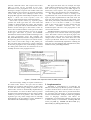
Event propagation views can be animated. As a
system executes, the flow of events along toolie
connections is shown and the “active” toolies are
highlighted. Spy points placed on toolies, toolie events
and event connections allow programmers to examine
toolie event flow and data values. Profilers attached to
toolie events show a list of the event names and data
values passing through connections and onto event
responses. Toolie state, event propagation animation and
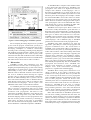
profiling is illustrated in Figure 9, where shifter is about
to respond to listen_after(line_buffer@insert(-line)).