1
[ GB ]
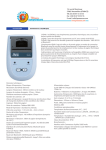
Three channel vibration analyzer
HD2070 is a portable vibration analyzer performing spectral and statistical
analysis on three channels simultaneously. The instrument measures all parameters required by current regulations concerning workers protection from
vibration related risks and is able to measure vibrations transmitted to both
hand-arm and whole body. It has been designed combining simplicity of use
with maximum flexibility and the possibility of updating the instrument according to the evolution of the regulations relating to vibration measurement. The
firmware can be updated directly by the user by means of the Noise Studio
program supplied with the instrument.
Main features
•Octave and third octave filters, available as option (HD2070.O1), satisfy
class 1 specifications of IEC 61260 standard.
•The HD2070 detects accelerations on three axes with integrated amplifying
electronics (IEPE or equivalent type); it is possible to connect three singleaxes or one tri-axial accelerometer to the instrument. Accelerometers with
integrate electronics allow to achieve low impedance and low noise connections between the accelerometer and the instrument, decreasing the probability to get wrong or altered measurements because of interferences or
electromagnetic disturbances.
•The HD2070 analyzes the signals coming from the accelerometer and makes
calculations simultaneously on three axes; it calculates the weighted acceleration values as well as the octave or third octave spectra (with option
HD2070.O1). Acceleration, velocity or displacement values can be shown
for each frequency band. Frequency weightings can be freely chosen according to the specific application.
•Together with values of instantaneous and mean acceleration, the analyzer
calculates in addition peak levels, vibration dose (VDV), crest factors and
performs statistical analysis (option HD2070.O2).
•As statistical analyzer, the HD2070 calculates, with option HD2070.O2, the
probability distribution of a measurement parameter in 1dB classes. Both
the probability distribution and the percentile levels from L1 to L99 are available as graphs.
•A versatile data logging function stores multiple profiles and spectra using
either the internal memory of 8MB or memory card (MMC or SD cards up to
2GB). Each record can be documented with a voice comment. In addition,
the HD2070 can be used as an audio recorder, as a further opportunity to
document the measures.
•With the option HD2070.O3 you can add to the profiles also the signals
provided by accelerometers, recording the digital samples directly. When the
stored data are analyzed, it is useful to examine the accelerometer signals to
verify the absence of artefacts such as, for example, those associated with
the phenomenon of DC-shift.
•The “Navigator” program available in the analyzer allows to examine logged
measurements and to hear vocal comments.
•For a quick setup of the instrument it is possible to store up to nine setup,
user-customized according to specific applications. The desired setup is
easily identified by the associated title.
•The calibration can be performed using either the calibration data of the accelerometers with a vibration generator. The last 120 calibrations performed
are recorded in a file and stored in a protected and reserved area of the
permanent memory of the instrument. The program interface Noise Studio
automatically adds the file supplied with the calibration measurements during the downloading of data into the PC memory.
•HD2070 can be completely controlled by a PC, via RS232 and USB serial
interfaces, using a special communication protocol.
Applications
The HD2070 analyzer is able to perform all the measures required by the European regulations 2002/44/EC concerning workers protection from mechanical vibration at the work place. The choice of hand-arm measurements (HA)
or whole body (WB and BV) changes the frequency range of the spectral
analysis available with the option HD2070.O1. For hand-arm measures the
range extends from 3.15Hz up to 3.15kHz (from 4Hz to 2kHz for octave band
spectrum), while for whole body measures the range of central frequencies
is shifted towards low frequencies, from 0.5Hz up to 315Hz (from 0.5Hz to
250Hz for octave band spectrum).
The HD2070 is suitable for the evaluation of worker exposure to vibration and
the risk of injury in the following cases:
•vibrations transmitted to the hand-arm system by vibrating tools or objects
subject to vibration or impact,
•whole-body vibration transmitted through the driver’s seat of vehicles,
•whole-body vibration in workstations,
•Whole-body vibration of buildings subject to vibration or impact.
Technical standards
HD2070 vibration analyzer conforms to the following standards:
•ISO 8041:2005 “Human response to vibration – Measuring instrumentation”
•ISO 5349-1:2001 “Mechanical vibration – Measurement and evaluation of
human exposure to hand-transmitted vibration – General requirements”
•ISO 5349-2:2001 “Mechanical vibration – Measurement and evaluation
of human exposure to hand-transmitted vibration – Practical guidance for
measurement at the workplace”
•ISO 2631-1:1997 “Mechanical vibration and shock – Evaluation of human
exposure to whole body vibration – General requirements”
•ISO 2631-2:1989 “Evaluation of human exposure to whole body vibration –
Continuous and shock-induced vibrations in buildings (1 to 80 Hz)”
•IEC 61260:1995 “Electro- acoustics – Octave band and fractional-octave
band filters” (option HD2070.O1)
Technical specifications
Technical standards
•ISO 8041:2005
•ISO 5349-1:2001 (hand-arm transmitted vibrations)
•ISO 2631-1,2,4 and 5 1997 (whole body vibration)
•IEC 61260 :1995 class 1 (option HD2070.O1)
Measurement mode:
•HA: Vibrations transmitted to the hand-arm system
•WB: Vibrations transmitted to the whole body
•BV: Vibrations in buildings.