1
Table of Contents
Model Description
Supplied Equipment
Features
Specifications
Setup Location and Procedure
Front Panel Controls
Operation
Rotor Removal and Installation
Programming Functions
Tube Holder Configurations
Care and Maintenance
Troubleshooting
Safety, Emergency Lid Removal
Calibration and Ground Testing
Replacement Parts
Available Accessories
pg. 2
pg. 2
pg. 3
pg. 3
pg. 4
pg. 5
pg. 6
pg. 7
pg. 7
pg. 7,8
pg. 9
pg. 10
pg. 11
pg. 11
pg. 12
pg. 12
WARNING: Care should be
taken when handling substances
that are known to be toxic,
radioactive or contaminated
with pathogenic microorganisms
when using this centrifuge for
the safety of both the operator
and service personnel. When
Risk Group II materials are
used, (as identified in the World
Health Organization “Laboratory
Bio–Safety Manual”), a Bio–Seal
should be employed. More than
one level of protection must be
provided in the case of materials
of a higher group. The use of
flammable or explosive materials
as well as those materials which
chemically react vigorously is
prohibited.
Model Description:
The Horizon Easy-Spin 12, model 653ES, is a continuous-duty,
electronically-controlled horizontal centrifuge with a lid safety interlock system.
The unit is controlled through a push-button interface with a digital time display
for precise spin times and ease of use. Samples can be safely viewed through
the transparent lid. Entry into the machine is restricted during operation by the
safety interlock system.
Supplied Equipment*:
The following items come standard with each Horizon centrifuge:
1. One (1) horizontal rotor
p/n
7786048
2. Operator’s manual
3. Six (6) 2-Place 100mm tube carriers
p/n
7713030
1.
Operator’s
Manual
2.
3.
*
x6
Safety:
The Horizon models 653ES complies with all requirements of
UL standard 3101–2–20.
Horizon Lid Safety Switch: The Horizon lid is secured to the top of the
cabinet by a latching knob and pawl system. When the knob is rotated
clockwise, the pawl grips the underside of the cabinet opening and prevents
the lid from opening. A mechanical stop positions the pawl and prevents it from
rotating completely. When rotated to the stop position, the pawl makes contact
with a micro–switch mounted underneath the cabinet top. The lid safety switch
prevents the centrifuge from operating while the lid is open. An indicator light
on the front of the machine will light up when the lid has been latched properly.
Horizon Lid Safety Interlock System: In addition to the Lid Safety Switch, the
Horizon has a true “0 RPM” lid locking system. The lid safety interlock system
keeps the lid locked at all times, (even during power failure), and requires that
the rotor be at rest in order to unlock the lid. The centrifuge will not allow entry
into the rotor chamber unless the centrifuge has power and the rotor is stopped.
To open the lid, make sure that the centrifuge is plugged in and, with the rotor
stopped, press the ‘OPEN / EMERGENCY STOP’ button.
Note: After the centrifuge has started spinning, it may be possible to rotate
the lid knob enough to cause the pawl to lose contact with the lid safety
switch. If this happens, the centrifuge motor may lose power, but the lid
will still remain locked. If the knob is accidentally moved and this situation
should occur, rotate the knob fully clockwise to its stop position and the
centrifuge will resume operation.
Circuit Breaker: The Horizon is protected with a 4 Amp circuit breaker located
at the rear of the machine mounted to the base. Any electrical short circuit will
cause the breaker to cut power to the machine.
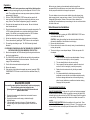
Emergency Lid Removal:
In the event of power failure, it may be impossible to unlock the lid by
conventional means. In this case, the lid must
be removed to gain entry into the rotor chamber
and remove samples. To remove the lid, first take
out the four (4) screws holding the hinge assembly
to the cabinet. Slide the lid to the right or left
until it is clear to remove it. The centrifuge must
be serviced before it can be safely used again.
Contact The Drucker Company for further assistance. Remove these screws on
Calibration and Earth Ground Testing:
It is recommended that the top speed, ground continuity and line leakage be tested
every two years for continued safe operation.
Contact The Drucker Company for further information or testing availability.
The rotor and rotor accessories are rated for a rotation frequency of 4,000 RPM.
Page 2
both hinges
Page 11