1
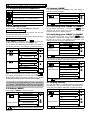
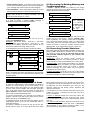
G. With fresh battery cells and correct insertion, the
TROUBLE indicator should extinguish. Put the battery
holder back in, re-mount the battery compartment lid
and re-attach it with the screw.
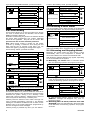
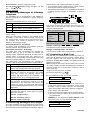
H. Put back the battery area cover - insert the angled legs
at the left edge into their holes and then press the right
edge of the cover against the cabinet surface until the
catches click into place.
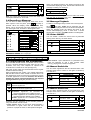
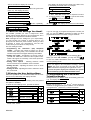
I. The “MEMORY” message will now blink in the display
(caused by the “tamper” alarm you triggered). Clear it
by arming the system and immediately disarming.
ample time (about 30 days) to obtain a new battery and
replace the old one, and the detector or keyfob unit will be
fully operational throughout this period. However, to be on
the safe side, it is advisable not to wait that long.
Use the battery specified in the detector’s own installation
instructions. If you do not have the instructions, seek the
advice of your installer or ask him to replace the battery in
the specific device that sent the low battery message.
After battery replacement, the detector unit will send a
“battery restored” signal to the control panel, and the “low
battery” message will be cleared.
8.2 Replacing Batteries in Wireless
Devices
8.3 Periodic Testing
The wireless sensors supplied with your system are
powered by high-capacity 3.6-Volt lithium batteries (Tadiran
TL-5902) that last several years, depending on the number
of times the sensor is triggered into transmission.
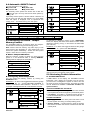
However, if and when a battery becomes weak, the sensor
itself sends a “low battery” message to the control panel,
and a low battery trouble message is displayed together
with the zone information (see Para. 5.2).
The keyfob transmitters used to control the system are
powered by a 12 V alkaline battery (type A27) that lasts
about one year if you do not press a button more than 10
times a day. Battery exhaustion is clearly evident by
flashing of the transmitter’s red indicator while the button
is pressed (instead of lighting steadily).
When a low battery indication appears for the first time, it
may be considered as a pre-warning. It normally gives you
The components of your security system are designed to
be maintenance-free as much as possible. Nevertheless, it
is mandatory to perform a “walk test” at least once a week
and after an alarm event to verify that all system detectors
function properly. Proceed as described in Para. 6.5, and
If there is any problem, notify your installer at once.
8.4 Cleaning the Control Panel
The control panel may occasionally get stained if touched
with greasy fingers, and may accumulate dust after a long
period of use. Clean it only with a soft cloth or sponge
moistened lightly with a mixture of water and mild
detergent, and then wipe it dry.
The use of abrasives of any kind is strictly forbidden.
Also never use solvents such as kerosene, acetone
or thinner. These will certainly ruin the external finish
and damage the transparency of the window at the
top of the unit.
9. PERFORMANCE LIMITS
Although the alarm control system you purchased is highly
reliable, it does not guarantee protection from burglary and
fire hazards. Even the most advanced systems can be
defeated or might occasionally fail to warn. Some of the
reasons for this are:
Sloppy maintenance: If the system is used over a long
period of time without testing, a key element such as a
detector or a siren might go wrong without any visible or
audible signs of failure. If a low battery warning is
neglected, there will be no backup power to keep the
system operational during a power outage.
Power failures: In case of prolonged absence from the
protected site, the mains supply may suddenly fail (an
earth leakage protection relay may trip, disconnecting the
mains supply). After such an event, the alarm system will
draw power from the backup battery, until all reserve
power is exhausted, leaving the premises without
protection.
Telephone line trouble: Telephone lines may be
disconnected or short circuited. With the telephone line
"down", your alarm system will not be able to report events
to the central station.
18
Sirens do not always wake up sound sleepers: Sirens
and bells installed outside or far from bedrooms are not
likely to awaken people who are sound asleep behind
closed doors inside the protected area or in adjacent
buildings.
The system is sometimes defeated: With sufficient
technical know-how, intruders may find a way to defeat
various types of sensor or disconnect warning devices.
Intruders may also take advantage of unprotected
openings and skylights, or even enter forcibly at
unpredictable spots.
Smoke detectors have their limits: In many cases,
smoke detectors fail to warn on time because the fire
started at a different level of the house, or too far away
from the detector.
All this gives sufficient proof that even with a good
alarm system installed, there is still need for life and
property insurance. In addition, users should test their
alarm systems at regular intervals, to make sure that
malfunctions are detected before a true alarm event
occurs.
DE5450U