1
1
Tunneled TLS for Multi-Factor Authentication
Darko Kirovski and Christopher A. Meek
Microsoft Research, One Microsoft Way, Redmond, WA 98052
Abstract—When logging onto a remote server from a distrusted
terminal, one can leak secrets such as passwords and account data
to various forms of malware. To address this problem, we take
an existing approach of using a trusted personal device as the
interface available to users for entering their login credentials. In
our proposal, such a device would send the credentials to a server
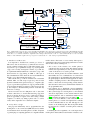
using a tunneled TLS session routed via a distrusted terminal.
The tunneling would be done within an existing TLS session
established between the terminal’s browser and the server. Upon
validating the credentials, the server would enable the terminal
to access the user account. Consequently, the terminal would
never see in plain-text the login credentials. We show that the
proposed protocol resists arbitrary key-loggers, phishing agents,
cross-site scripting, and invasive virtual machines. As a powerful
and surprising application, if the distrusted terminal is at a pointof-sale, the trusted device could use our protocol to execute a
payment with it. The user experience for this payment engine is
similar to a payment with a traditional credit card.
I. I NTRODUCTION
According to a market research report, a surprising 9%
of US online consumers have experienced identity theft [1].
Those who fall prey are not online novices: 52% purchased
goods online in the past three months; they have an above
average online tenure of 5.6 years; and 69% are technology
optimists [1]. Another report estimates that roughly half of
the US consumers online are extremely concerned (5, on a
1-5 scale) about computer malware, online identity theft, and
interception of personal data; as a consequence more than 75%
of all US consumers chose to deploy free, 24% paid, and 1%
no software for malware protection [2]. This does not resolve
fear as, for example, roughly one third of US online consumers
chose not to use online banking from fear of identity theft;
security as a top competitive differentiator is used by 43% of
banks to attract the remainder of the online population [3].
The consequences are:
• direct – identity theft results in billions of dollars worth
of damage to the world economy [4], and
• indirect – the threat of identity theft limits consumers’
engagement in the online economy, thus, hurting the IT
industry as well as numerous businesses that have found
a more efficient way to conduct business by going online,
e.g., banking, insurance, financial services, etc.
Phishing and key-loggers are simple and popular identity
theft methods. Most tools that aim at addressing this problem
by detecting such malware, do suffer from being detected
themselves and then, circumvented. In addition, some of the
available software for protection from malware, is malware
itself. The core of the problem lies in the ease of collapsing
the circle of trust between the user, the remote server that
offers service of interest to the user at cost, and the IT
infrastructure that connects them. In this paper, we look at
multi-factor authentication as one way to address this problem
and opportunistically seek for novel applications – mostly
aiming at points-of-sale.
A. The Problem
Informally, the problem statement is simple. A remote
server hosting a user account wants to authenticate that a client
who is logging under the user’s name, is indeed controlled
exclusively by the user herself/himself. It is rather difficult to
formalize this simple problem description within the existing
computing milieux.
The research community has tried to resolve the problem
of user authentication from a fully distrusted computer using
a broad set of methodologies based upon multi-factor authentication (MFA). MFA1 approaches rely upon at least two of
the following three authentication paradigms:
• “what I know” – the most commonly deployed mechanism, a password, suffers from the following issues: it is
easy to intercept, thus, opens doors to a range of attacks
from key-logging to shoulder-surfing, and even modest
entropy implies a memorization challenge, i.e., passwords
are prone to directory attacks [5].
• “what I have” – the user proves to the remote server during authentication that he/she is in possession of a trusted
device, i.e., its secrets. This method is used predominantly
as an amplifier of trust during authentication. Apart from
inadequate security protocols, the only problem related
to this authentication paradigm, is the fact that it cannot
be used exclusively, i.e., anyone who has access to the
device, could impersonate the users whose secrets are
stored on it.
• “what I am” – scan of user’s biometric traits is used as
a discriminator during authentication [6]. This method
is plagued by many issues: human assistance during
verification is necessary because it is rather easy to fool
the measurement equipment [7], poor practical error rates
[6], cost, privacy, and inconvenience at use.
Considering the strengths of individual authentication
paradigms, most proposals rely upon passwords and authentication hardware. The body of research work that introduces
protocols that leverage upon these two approaches is fairly
diverse and we review it in Section V. We recognize several
crucial objectives:
(i) secure login – the initiative for migrating the input of
user credentials from the distrusted terminal, c, onto a
personal trusted device, p, with an objective that c never
observes these credentials in plain-text, [8] and
1 A solid informal survey of standard MFA techniques can be found on
Wikipedia: http://en.wikipedia.org/wiki/Two-factor authentication.