1
7
pared to a general purpose computer, however at additional
design costs. Certainly the design strategy for a mobile phone
used for MFA should emphasize intrusion prevention as a
premier design criterion. Historically, the critical entry points
for malware on mobile devices have been Bluetooth, SMS
messaging, and e-mail [23].
Finally, the option to use a dedicated hardware device that
offers tamper-resistance and custom-built intrusion prevention
is certainly real. However, due to the strong recent trend
for convergence of most mobile applications (portable MP3
player, digital camera, GPS, WiFi, etc.) onto a single device,
our objective to fit the functionality of the proposed protocol
onto a mobile phone is appealing.
III. T HE T HREAT M ODEL
In this section, we consider several threats and address them
informally in our security analysis.
Case 1. Loss of p and the account password. Since the
authentication system is based upon the “What I have?” (p)
and “What I know?” (password) authentication principles, it is
just to acknowledge that if the user loses p to a malicious party
m who knows her password, then m will have full access to
user’s account A in a classic case of identity theft. Typically,
m will be able to impersonate the user until she notifies s of
her loss of p. All two-factor authentication systems are prone
to this attack (see Section V).
Case 2. Intrusion into p. This is a special case of the previous
attack, where the adversary penetrates p with an arbitrary
program that enables full visibility of its internal storage. To
prevent this attack, the construction of p must be such that
software resident on p should not be able to read id(p) into p’s
general purpose registers – reads and writes of id(p) requested
by s should be done using a hardware-only mechanism. That
way, intrusion into p via a Trojan virus would equal to
password leakage.
In a more complicated version of this attack, if the malicious
code installed on p takes control over its user interface, i.e., it
could both read from and write to the variables that constitute
the user interface, this code could launch arbitrary malicious
actions from p on behalf of the user. Such an attack should
demand great sophistication of the malicious party and is
unlikely on most modern mobile phones as their operating
systems are custom built and difficult to reverse engineer.
Case 3. Phishing p. A traditional phishing attack onto p via
the c ./ p connection is not possible by construction. When p
is registered with s, our protocol establishes a device identifier,
id(p), and stores it at p along with the id(p) ↔ s association.
At a later time, only a TLS protocol with s and no other entity
is allowed to access id(p), thus, any phishing attempt from c
will be outward rejected by p.
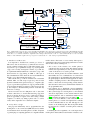
Case 4. Ghost display would probably be the most realistic
and unnerving attack to the user. Here, the adversary m would
have a virtual display resolution twice as large as c’s display.
One half of the virtual display would be connected to c’s
screen, the other half to another machine cm controlled by m;
cm would also have a parallel user input augmented into c’s
I/O. This attack is relatively easy to do by running a malicious
virtual machine on c.
When the user logs onto s via c, m would open another
browser window in the part of the virtual display that’s visible
only to cm and use the parallel I/O to browse the data from
A at will. Since every write generated by m would need to be
confirmed by the user via p, it is unlikely that m could perform
any writes into A’s state. By realizing that such an attack
is a possibility, s could offer viewing only part of the data
related to A over a tunneled TLS connection that minimizes
the damage that a “ghost display” attack could cause.
Case 5. cm ./ p. The case when the user mistakenly connects
p to a malicious computer cm instead of a desired physical
unit c, is equivalent in the worst-case to the consequences
of the “ghost display” attack. Still, the user is more likely to
detect the cm ./ p attack as the expected Web pages from
s will not appear on c although p would show a successful
tunneled TLS connection with s. The user would prevent m
from browsing her data by instantly disconnecting p from s.
Finally, note that all realistic threats in this system pose
substantially less danger to the user identity compared to stateof-the-art in modern detection-based anti-virus, anti-phishing,
and anti-key-logger technologies. Compared to authentication technologies such as SecurID, we point the Reader to
the fact that our system addresses a novel problem where
we do not focus on providing token-based one-time strong
passwords; instead, we focus on fulfilling a small set of
security requirements to enable a personal mobile device as
an enabling technology to making an https://... or some
other type of a login session secure on a fully distrusted client
computer/terminal. Due to the wireless nature of the c ./ p
connectivity, our protocol is designed to be robust to man-inthe-middle attacks as opposed to SecurID [24]. Compared to
the most related work by Mannan and van Oorschot [11], we
do extend their threat model to handle “ghost” displays and
we offer a significantly simpler protocol that can be handled
by traditional TLS handshakes only. We also introduce several
additional functionalities that aim at limiting a malicious party
who is in control of c to read user’s account state only at times
when p and s are connected, i.e., p responds to s’s pings over
the tunneled TLS channel.
IV. R EDUCTION TO P RACTICE
A. Formal Verification via AVISPA
In order to formally verify the security of the proposed
protocol, we first described it using the High Level Protocol
Specification Language [25] which included a description of
TLS and SRP adopted from [26]. Descriptions of the adversarial scenarios were more demanding compared to standard
two-party protocols because our protocol encompassed four
entities including the intruder – this additional complexity contributed to uncharacteristically long and resource consuming
verification efforts. Next, we verified the protocol specification
using the Automated Validation of Internet Security Protocols
and Applications analysis tool (AVISPA) [15], [26]. AVISPA is
positioned as an industrial-strength technology for the analysis
of large-scale Internet security-sensitive protocols and applications. The ofmc theorem prover attached to AVISPA [27]
reported a search time of 36.7 seconds, 18207 visited nodes