1
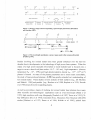
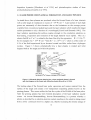
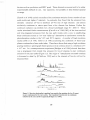
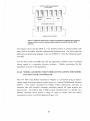
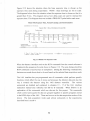
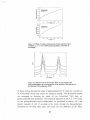
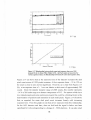
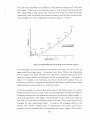
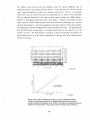
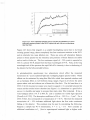
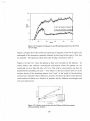
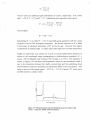
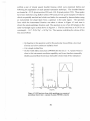
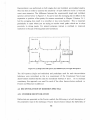
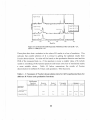
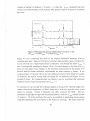
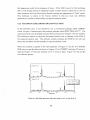
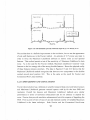
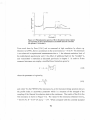
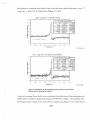
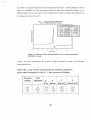
F ig u r e 2 .2 6 A b so lu te c ro s s -s e c tio n d a ta f o r H e liu m a t d iffe r e n t e n e rg ie s
w ith an d w ith o u t A1 filte rs .
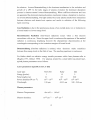
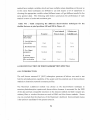
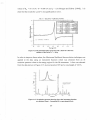
The data in Figure 2.25 indicates that as w e increase the pressure, while keeping al
remains constant the relative cross section increases, as expected from expression Ln
(Iq^I)
= crnl. For comparison purposes the calculated data are also plotted for
selected wavelengths and pressures o f He gas. W e know 1 and can calculate n from
the ideal gas equation, PV=nRT, where P is pressure in mbar, V is volume in litres, n
is the number o f moles, R is the universal gas constant and T is the temperature in
degrees Kelvin and the values for a are tabulated [Kennedy and Manson 1972], The
discrepancy between calculated and experimental data can be explained by previously
discussed effects o f scattered light and order sorting. The use o f XU V filters helps
eliminate this discrepancy and this can be seen in Figure 2.25 where the calculated
and experimental values for the relative cross sections agree.
The filter reduces
scattered light (for X > 800 A) and also can assist on higher order light reduction by
suppressing light below 180 A. Scattered light is the result o f laser-plasma radiation
specularly reflected from shiny surfaces (e.g., optics, slits, bellows etc.) in the
spectrometer and falling on the detector plane. Higher order light is simply explained
by the grating equation mA, = d (sin a + sin (3). For a given angle o f incidence a and
diffraction (3, mA, = const. Hence at the observation angle [3, A appears in first order
(m =l), A/2 in second order (m=2) etc. For example, with the above experimental
system when we measure light at 350 A first order, w e also get second and third
order light at ~ 175 A and ~ 117 A all at the same pixel number. This can add to the
signal on the detector and give a higher incident (and transmitted) intensity than if
just the first order (350 A) were present.
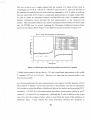
Figure 2.26 above shows the effect o f
scattered light/higher orders splitting as w e see that according to this graph the cross
section varies with pressure, which is an unphysical effect. In order to understand
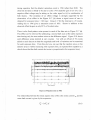
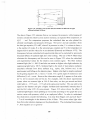
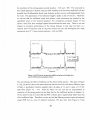
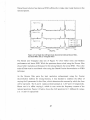
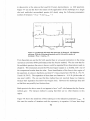
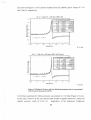
this observation consider the following. It is clear from Figure 2.23 and 2.24 that T
< T at all wavelengths in the absence o f the Al filter. This occurs when light other
than first order radiation impinges on the photodetector. The modulated transmission
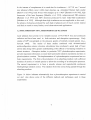
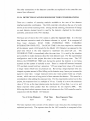
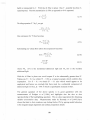
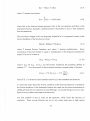
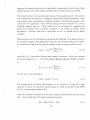
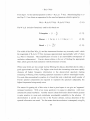
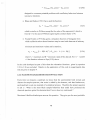
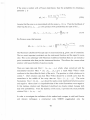
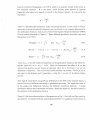
T ', from equation 2.9, is given by
60