1
1.0 INTRODUCTION TO THE PET
PLUS VISCOMETER
1.1GENERAL
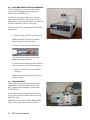
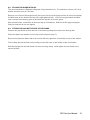
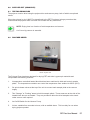
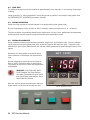
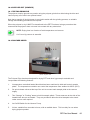
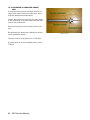
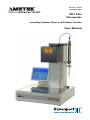
The PET Plus is a microprocessor controlled, capillary Melt Viscometer that is specifically designed
to test the flow properties of PET. The system can
be used to test other polymers and because it does
not require solvents, it can also be used to test
insoluble polymers.
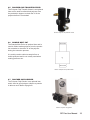
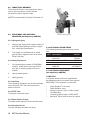
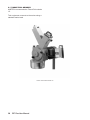
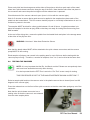
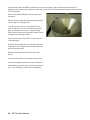
It consists of a heated vertical barrel, a calibrated
die, a small piston called a “follower”, a displacement transducer called a “probe” and control
systems for the nitrogen gas flow and extruder
temperature.
The equipment is based on a system developed
by ICI. It is designed for both research and quality
control of polyethylene terephthalate (PET), which
is hygroscopic and liable to degrade due to
oxidation in the melt phase. The apparatus is
recommended for use in the quality control of polyester polymers to measure the Intrinsic
Viscosity and degradation rates.
The Viscometer extrudes molten PET similar to
an MFI but is specially developed to prevent the
polymer from degrading due to contact with the
atmosphere. The polymer is isolated from moisture
and oxygen because the barrel is sealed and the
polymer is extruded through the die using pure
nitrogen at high pressure.
Therefore, an external supply of Nitrogen gas of 30
Bar pressure is required. This nitrogen gas not only
provides an oxygen and moisture free environment
for the sample but also applies the extrusion force.
The quantity of polymer extruded is calculated
similar to the MFI method B using an LVDT “probe”
to measure the movement of the
“follower”.
The rate of extrusion is accurately measured by
the “probe”, which is designed to operate under the
high-pressure conditions within the barrel during
extrusion.
The system calculates the total thermal and hydrolytic degradation.
Therefore, a “Melt” test can show the degradation
8 PET Plus User Manual
due to the presence of moisture in the polymer
so can be used to check the performance of the
production drying system. A “Melt” test can also
be used to measure the thermal degradation factor
caused by the production extruder.
PET has historically been measured using the
solution method and this indicates the POTENTIAL
Intrinsic Viscosity (IV) of the polymer but does not
show how the polymer will behave or degrade
during extrusion.
The solution technique is being phased out due to
the insoluble nature of highly crystalline polymer
plus high environmental and disposal costs of
solutions. It is also not so suitable for testing
reground or recycled material because the quantity
tested is very small and may not show the “Average
IV” of the mixed granules.
The PET Plus is designed to replace the solution
method so directly reports the Intrinsic Viscosity
(IV) of the polymer and not the Melt Flow Rate.
PET is hygroscopic and any water molecules
present at melt temperatures > 250C will give an
irreversible break in the chain at the ester linkage,
which gives a drop in the IV.
Therefore, the PET Plus can ONLY give the same
IV as the solution method if ALL the moisture is
removed from the polymer before it is tested (less
than 20ppm moisture).
The PET Plus is a semi-automatic system so can
be left unattended after the sample has been
loaded and pre-conditioned. The test takes a total
of 17 minutes after loading the sample.