1
•
•
•
•
•
•
•
•
During transition, the compounding data specified for the original geometry are
passed onto the post-transition geometry.
Compounding factors are saved during crack propagation, and can be plotted in
post-processing via the “select details to plot” window on the “Computations”
screen.
The new compounding features are documented in Appendix C of the v6.1 user’s
manual (Section C10, page C-102).
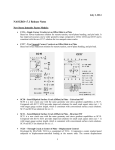
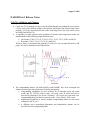
The “Geom Tables” GUI screen show below is an example of how the GUI would
appear for entering 1-D compounding tables for the c-tip for crack case CC02.
A new set of additional (optional) failure criteria were developed for crack cases SC17,
EC02, EC05, CC11, TC11, TC12 and TC15. These new failure criteria include plastic
limit load, a failure assessment diagram (FAD) according to FITNET Option 1 and
FITNET Option 3, and the Newman Two-Parameter Fracture Criterion (TPFC).
Documentation for these new failure criteria is provided in the new Appendix X to the
v6.1 manual.
The shakedown option was added to crack cases TC11, TC12 and SC18.
An option was added (on the Material screen for the NASGRO equation) that allows the
user to change "Threshold Alpha", the constraint factor in the Newman crack opening
function used for fatigue threshold calculations. (The default for the Threshold Alpha is
2.0.)
A label is printed in the output files ("exe" or "dll") to indicate if the results are generated
by running the executable or the DLL.
2