1
Small Vision System Calibration
3
1 Using the Calibration Procedure of SVS
The SVS Calibration Procedure for stereo cameras is an efficient, simple method for finding the
internal (lens distortion and decentering) and external (camera spatial offset) parameters of a two-camera
stereo rig. The output is a set of parameters that can be used with the SVS to warp the stereo images from
the cameras into images that would be produced by ideal pinhole cameras whose imagers are in the same
plane.
The calibration procedure is briefly described in the Calibration section of the SVS User’s Manual.
This document gives an expanded treatment of the calibration procedure, as well as helpful hints to those
experiencing difficulties with the calibration procedure. It also gives technical details of the calibration
and its results.
In an ideal setting, the cameras of a stereo rig are perfect pinhole cameras, with exactly the same focal
length, and parallel optical axes. In practice, cameras are imperfect, suffering from lens distortion and
differing focal lengths, and misaligned optical axes. The goal of calibration is to determine two sets of
parameters, intrinsic and extrinsic, that compensate for the imperfections in the stereo rig. The intrinsic
parameters correct lens distortion and uneven focal length; the extrinsic parameters determine the spatial
offset of the two cameras, including the stereo baseline and any deviation from parallel optical axes. These
parameters can then be used to warp the camera images into standard position, that is, images that would
be seen by pinhole cameras with parallel optical axes.
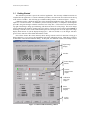
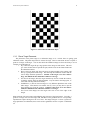
The calibration procedure in SVS uses a simple planar target that can be printed out on a standard PC
printer. When shown the target in 5 different views, the calibration procedure can determine the
calibration parameters using an efficient nonlinear optimization procedure.