1
5.5. VISCOSITY AND STOKE’S LAW
91
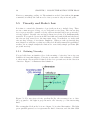
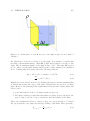
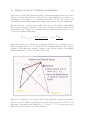
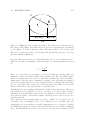
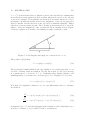
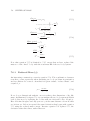
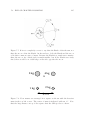
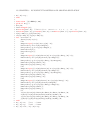
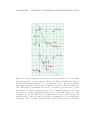
line on top represents another flat plate being driven to the right. It is a good
approximation to assume that the fluid touching the bottom plate is not moving
at all, that the fluid touching the top plate is moving to the right at the same
velocity as the plate, and the fluid in-between moves at a speed proportional
to its distance from the bottom plate. (The lengthening black arrows in the
figure indicate this.) In the situation where the velocity profile is a simple linear
function like that illustrated, ∂u/∂y can be simply interpreted. It is just the
speed u of the top plate divided by the fluid thickness.
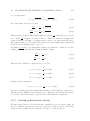
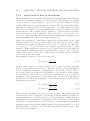
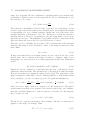
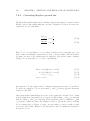
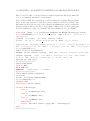
The following three equations describe the situation of figure 5.3, and can be used
to define viscosity.
∂u
(5.6)
F = ηA
∂y
τ =η
∂u
∂y
(5.7)
Equation 5.6 gives the horizontal force you must exert on the top plate in order
to maintain its motion. Not surprisingly, this force is proportional to the area of
the plate. Equation 5.7 is a restatement of 5.6 with different terminology. Here
τ represents “shear stress”, which is shear (horizontal) force per unit plate area2 .
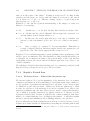
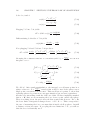
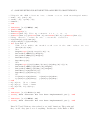
Both 5.6 and 5.7 involve velocity gradients. If we assume a fluid velocity profile
varying linearly with y as indicated in figure 5.3, equation 5.6 simplifies to:
F = ηA
u
y
(5.8)
Here u is just the plate velocity and y the fluid thickness. The SI units for η,
N · s/m2 , can be readily determined from dimensional analysis of equation 5.8.
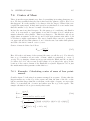
5.5.2
Examples of Viscosity
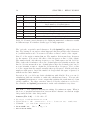
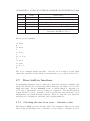
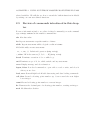
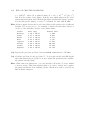
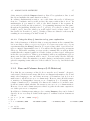
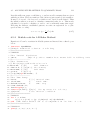
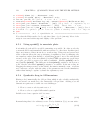
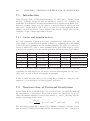
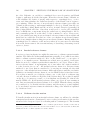
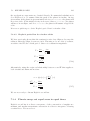
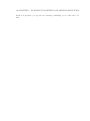
Below is a table of viscosities of some common substances. Note that the viscosity
of honey is much greater than that of oil, which is greater than that of water.
This should fit with your intuitive concept of viscosity.
The SI units for viscosity are N · s/m2 or, equivalently P a · s. (Pa = Pascal,
usually the SI unit of pressure). There is no named unit for viscosity in SI. However in the CGS system, the unit of viscosity is the Poise (pronounced “pwah”),
after the physicist Poiseuille. For this reason you will often find viscosities quoted
in Poise, and particularly in cP, or centiPoise, because water, a very important
fluid, has a viscosity of roughly one cP. The table above quotes viscosities of some
common fluids in cP and also in milliN ewton · s/m2 , which happens to be the
same value. To convert to straight SI units, divide all figures in the table by
1000.
2 “Stress” is everywhere in American culture, but the technical definition of stress is always
and only a Force per unit area. Thus what we call pressure in physics can also be called
compressive stress.