1
120
7.1
CHAPTER 7. NEWTON’S UNIVERSAL LAW OF GRAVITATION
Introduction
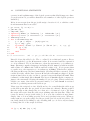
Using Newton’s Law of Universal Gravitation, we will begin to discuss orbital
motions of planets. Along the way, we will have to review a lot of physics. In
particular, we will talk about uniform circular motion, angular momentum, gravitational potential energy, and the division of motions between relative motion
and center of mass motion. All of these concepts are broadly applicable in mechanics, but we’ll use them to better explain orbits, and use orbits to give concrete
examples of each of these important concepts.
7.1.1
Linear and Angular motion
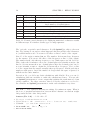
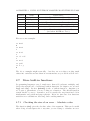
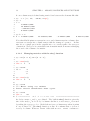
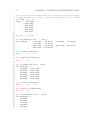
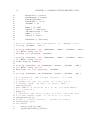
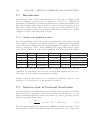
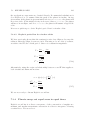
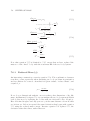
All of the quantities of linear motion have equivalents in rotational motion. An
entire chapter of a physics text is usually dedicated to explaining the relationships
between the linear quantities and the angular quantities. We will not do that here,
but as we will need to refer to these quantities in the rest of this chapter, a table
is provided to remind you of the various quantities and clarify their relationships.
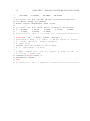
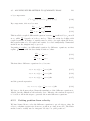
Linear Qty
Unit
Linear Name
Angular Qty
Unit
Angular name
x
v = dx/dt
a = dv/dt
F~
p~
m
m/s
m/s2
N
kg · m/s
position
velocity
acceleration
Force
momentum
θ
ω = dθ/dt
α = dω/dt
~τ = ~r × F~
~ = ~r × p~
L
radians
rad/s
rad/s2
N·m
kg · m2 /s
angle
angular velocity
angular accel.
Torque
angular momentum
Table 7.1: For every linear quantity defined in physics, there is a rotational
equivalent. In this chapter we are most concerned with angular velocity, force,
and torque, as well as linear and angular momentum.
If this is really the first time you are seeing these definitions, bring it to the
attention of your professor for some suggested references.
7.2
Newton’s Law of Universal Gravitation
In 1687 Isaac Newton published the Principia Mathematica in which he included
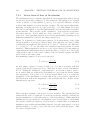
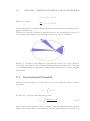
his universal law of gravitation. In modern notation, the law allows one to calculate the mutual attraction between any masses m1 and m2 knowing only the
distance separating them r thus:
F =
Gm1 m2
r2
G = 6.67 × 10⁻¹¹
[SI U nits]
(7.1)
The universal gravitational constant G is a difficult constant to measure. G was
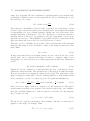
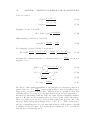
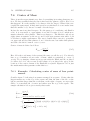
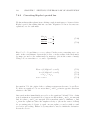
first measured by Henry Cavendish in 1796. He measured the force of attraction