1
• half and loose edges (edge with one or no end);
• edge identifiers.
GrphText imposes that vertex and edge identifiers are positive integers. The
directivity of an edge is described by the use of the character >. Edge identifiers
are optional: if they are not given, Grph will assign them itself using the natural
order 01, 2, 3, etc.
The format for an ID, called id is then [0-9]+. The format for an edge
declaration is then:
(id:)?
id* >?
id*
.
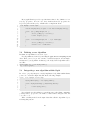
As illustrated in the following examples, the compact syntax of GrphText
enables the representation of any graph topology.
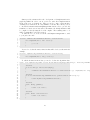
The line
1 2
2 > 3
1: 2 > 3
8
{8}
2: {8}
{8 4 5 7}
{8 4} > {5 7}
# a comment
Describes. . .
an undirected edge connecting vertices 1 and 2
a directed edge from 2 to 3
the same, but the edge ID is set to 1
an isolated vertex with ID 8
an undirected hyper-edge that contains vertex 8
an undirected hyper-edge of ID 2, and that contains vertex 8
an hyper-edge connecting vertices 8, 4, 5 and 7
a directed hyper-edge connecting vertices 8, 4 to 5 and 7
guess what. . .
In GrphText, blank lines are ignored. If a # is found, it is assumed that the
rest of the line is a comment.
7.1.2
GrphBinary: the binary Grph Format
GrphBinary provides a compact encoding for graphs.
The number of bytes used for the storage of IDs is computed from the total
number of elements. If less than 28 elements have to be stored, they one byte
will be used to store the IDs. If less than 21 6 elements have to be stored, they
two bytes will be used to store the IDs. Otherwise 4 bytes are used.
The GrphBinary format is based on the encoding defined by java.io.DataOutputStream
and is organized as follows:
1. the name of the graph class;
2. whether the vertex/edge properties will be written in the file or not
3. whether the cached values for algorithms will be written in the file or not
4. the topology, which is decomposed as follows:
16