1
It is easy to see that this kind of memory access pattern produces (m* n)/4 data cache
misses and m/4 TLB misses.
Other than potentially reusing previously cached elements, little can be done to
avoid these transfers (referred to as the natural cache traffic).
The preceding example demonstrates what happens if memory access follows the
storage order. The following paragraphs discuss what happens if such a favorable
memory access pattern does not exist. The same nested loop is discussed, but with
the order of the loops interchanged:
float x[m][n];
for (j=0; j<n; j++)
for (i=0; i<m; i++)
.......... (2)
sum += x[i][j];
Similar to the previous example, the first reference (to x[0][0]) results in a data cache
and TLB miss.
The next reference is to x[1][0]. This element is still part of the same page (and hence
no TLB miss occurs), but not part of the cache line just brought in. Therefore, this
reference results a data cache miss. Likewise, the references to x[2][0] and x[3][0]
each results in a data cache miss.
On the next reference, to x[4][0], a TLB miss occurs because a page boundary is being
crossed. The references to x[5][0], x[6][0] and x[7][0] cause a data cache line miss
again.
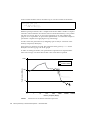
While progressing through the first column of the matrix, the TLB and data cache are
filled up. What happens next depends on the value of m.
If m is sufficiently small, the cache lines and TLB entries are still present when
proceeding to the next column (j=1 in the loop above). If this is the case, all is well.
TLB entries are no longer needed and the values of x[0..m-1][1] are all in the data
cache already. If a cache line spans four elements, references to x[0..m-1][4] again
result in cache misses, but these misses are part of the natural traffic between main
memory and the cache subsystem.
Performance problems arise if m and n are large. To make this more specific, an
imaginary system with the following memory characteristics is introduced7:
A data cache with a capacity of 32 kilobytes, LRU replacement, and a line size of 16
bytes
■
A fully associative TLB with 256 entries
■
One virtual memory page has a size of 4 kilobytes
7. This is not what is used on Sun systems and only chosen for purpose of this example.
UltraSPARC III Cu Memory Hierarchy
19