1
Chapter
1
Introduction
The multichannel analysis of surface waves (MASW) method was first introduced
into geotechnical and geophysical community in early 1999 although earlier development
versions came out several years prior. MASW is a seismic method which generates a shearwave velocity (Vs) profile (i.e., Vs versus depth) by analyzing Rayleigh-type surface waves
on a multichannel record. The method utilizes multichannel recording and processing concepts widely used for several decades in reflection surveying for oil exploration. MASW
utilizes energy commonly considered noise on conventional reflection seismic surveys. The
fundamental mode of ground roll (the Rayleigh-type surface wave event) is without a doubt
one of the most troublesome types of source-generated noise on reflection surveys. Rayleigh
wave energy is defined as signal in MASW analysis, and needs to be enhanced during both
data acquisition and processing steps. Because of this reversed definition of signal and noise
in comparison to seismic reflection, the method requires slightly different considerations and
approaches to data acquisition. Acquisition parameters are optimally determined using the
approach described by Park et al. (1999a). It is suggeted that in most cases parameter design
is favorable to body-wave (e.g., reflection and refraction waves) acquisition as well. This
aspect could be beneficial in some situations when both methods—surface-wave and bodywave—analysis are required.
One of the most significant differences in data acquisition procedures with MASW
when compared with the conventional body-wave survey is the enhancement of low
frequency energy.
A sledgehammer is a common seismic source used for a MASW survey although
many different types of seismic source can be used (see Miller et al., 1986; Keiswetter and
Steeples, 1995). At most of the soil sites a sledgehammer with 10-kg mass usually assures
optimum spectral characteristics for a target depth less than 10 m. A heavier (or lighter) one
may need to be used to meet the required spectral characteristics as the primary target depth
increases (or decreases). It is also important to use a low natural frequency geophone for
most studies. A 4.5-Hz geophone is most often recommended.
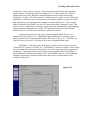
SurfSeis is designed to generate a Vs profile using a simple 3-step procedure:
preparation of a multichannel record (sometimes called a shot gather or a field file),
dispersion-curve analysis, and inversion. The term “multichannel record” indicates a seismic
data set acquired by using a recording instrument with more than one channel and, for most
cases involving modern seismographs, at least 12 channels would be necessary. However, a
multichannel record for use with the MASW method can be recorded in several different
ways, with its assimilation not limited to the number of channels available on the recording
device. For example, a 24-trace record can be obtained with a single-channel device by
stepping the shot and/or receiver away from each other using a uniform increment. By