1
GENOTYPE/GENODIVE manual
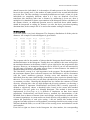
threshold, the number of genotypes that are distinguished using that threshold, the
average diversity within the genotypes and the number of pairwise distances that are
found within the class. The latter is depicted both numerically and graphically; note that
the number of genotypes reaches one at a certain threshold. The diversity index can be
seen as an indicator for the number of different multilocus genotypes (those which
would be recognised under threshold = 0) that are grouped under one genotype for the
current threshold. The calculations for the diversity, and also for the number of
genotypes, can be slow for large datasets. Therefore, for datasets containing more than
500 individuals, the programs asks whether you want to speed up the drawing of the
histogram; in that case the program does not calculate the number of genotypes and the
diversity.
AMOVA
In version 1.2 GENOTYPE can perform a very simple AMOVA (Excoffier et al. 1992),
which calculates the amount of differentiation among populations, without any higherlevel grouping or within individual level. The AMOVA uses the distance matrix that
was calculated in the previous step. For a correct inference of Phist, the distance matrix
should contain squared Euclidean distances (so use any of the IAM distances or the
squared SMM distance-option). The AMOVA also performs a permutation test by
randomising individuals over populations; simply give the number of permutations
when asked for it. For big datasets this test can take a while and there is no progress
indication, so be patient.
Output
Following the drawing of the histogram, the program asks whether to try it again,
meaning recalculating the distances and the histogram, or whether to proceed to the
output-menu. GENOTYPE can save the output in five different formats: an input file for
the GENODIVE program for one particular threshold, a file with genotypes for one
particular threshold, a file with genotypes for all thresholds, a file with the distance
matrix and a file with the histogram. If you specify a name for an outfile, the program
will automatically overwrite any other file with the same name in that directory, so
choose a unique name unless you want the file to be overwritten.
GENODIVE input file:
This output option saves a file in the format that is used as an input file by the
GENODIVE program. You will be asked a threshold-value, which is used to assign
genotypes to individuals, and you will be asked to give a name for the outfile.
Genotypes file:
This is simply a file with for every individual its name and the genotype, according to a
certain, user-specified, threshold-value.
Genotypes for all thresholds:
This outfile makes the previous one completely redundant. It gives for every individual
the genotype it belongs to under all relevant threshold-values (those that give more than
one genotype in total).
Distance matrix:
This output option writes the distance matrix that is used for assigning the genotypes to
a file. You can choose between two different formats: a square matrix and an unfolded
9