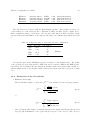
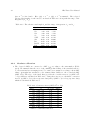
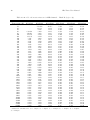
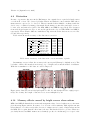
1
Version 1.3 (September 13, 2007)
87
reference point by examining the observed spectroscopy images, it is strongly recommended to
check the zero-th order light images for better wavelength calibration accuracy.
The chance of detecting zero-th order light image at significant level for SG1, SG2, and LG2
is not so large. Therefore the drift of the wavelength zero reference point is calculated by using
the drift measured in NP or NG for MIR-S/L grisms, after correcting the pixel scale difference.
Another issue related to measuring the wavelength zero reference point is the finite pixel
resolution. Although the source positions can be measured with an accuracy of less than one
pixel size unit on the reference image, extraction of the 2D spectroscopy images can only be
made on integer pixel number to avoid erroneous image interpolation. This means that as large
as ±0.5 pixel error could be introduced in the wavelength calibration process if not corrected,
and is not so small comparing with the full length of the dispersed spectroscopy images (∼ 50
pixel). As a first-order correction, we shift both the wavelength array and spectral response
curve, both of which should show rather smooth change along Y (or wavelength) axis, and not
perform sub-pixel shifting of the images. As a result, since object positions change slightly
among different pointing observations, wavelength at the same Y pixel of the extracted 2D
spectra (or the wavelength array) also changes with different pointing observations.
6.1.12
Flat color-term correction
The presence of significant color variation in the flat images can be found in the ratio images of
the broad-band flats (e.g., S7 flat / S15 flat). Therefore, although monochromatic flat-fielding
can flat the background, the object spectrum is affected by the color term of the sensitivity. The
correction for this could be done after extracting the 2D spectra for each target and applying the
wavelength calibration. However, since we have only two broad-band filters for MIR-S/MIR-L
(S7 and S15 for MIR-S, and L15 and L24 for MIR-L) and three for NIR (N2, N3, and N4), we
can derive only global trends of wavelength-dependence of the flats. (Note that the wide-band
filters, S9W and L18W, are not suitable for deriving the color dependence of the flat within the
spectral coverage of the channel). Two broad-band flat images are interpolated to estimate the
flats for a given wavelength in the following way:
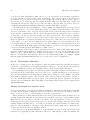
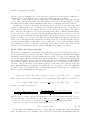
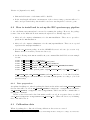
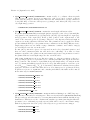
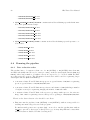
F2 (x, y, λ) = [F (x, y, λ2 ) − F (x, y, λ1 )]/(λ2 − λ1 ) × (λ − λ1 ) + F (x, y, λ1 )
(6.1.4)
where λ2 and λ1 are effective wavelength for broad-band filters. The equation 6.1.3 leads to:
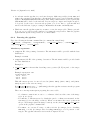
obs = obj(λ) × R(λ) × F2 (x, y, λ)/[spectral f eature(x, y) × F1 (x, y, λ)]
(6.1.5)
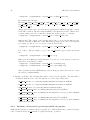
and, the color term is expressed as
F2 (x, y, λ)
=
spectral f eature(x, y) × F1 (x, y)
F (x,y,λ2 )−F (x,y,λ1 )
λ2 −λ1
× (λ − λ1 ) + F (x, y, λ1 )
spectral f eature(x, y) × F1 (x, y)
(6.1.6)
Therefore the color-term correction is calculated by two broad-band super-flats and one spectroscopy super-flat. Note that the product F1 (x, y) × spectral f eature(x, y) always appears
together, i.e., we do not have to separate spectral f eature term from the ’super-flat’.
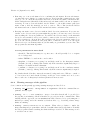
After the color-term correction the image is as follows:
obs = obj(λ) × R(λ)
(6.1.7)
For the NG spectra with the point source aperture (Np), flat-fielding will be made in a similar
way to the slit spectroscopy of diffuse sources, since the aperture size is much smaller than the