1
Chapter 6
Spectroscopy pipeline cookbook
The spectroscopy pipeline is being developed and maintained by the IRC spectroscopy data
reduction team. It is mostly written in IDL, and uses IDL ASTRO library (maintained at the
GSFC) among others. Although it is developed under Linux environment, it may be portable
to other platform after some modifications (though we have no plan to increase the exportable
platforms by ourselves). The toolkit also uses the ds9 FITS viewer for reviewing the images,
and the xpa package for communication between the ds9 and the IDL main program.
The spectroscopy data reduction requires calibration database (FITS images and ascii tables)
distributed and updated also by the IRC spectroscopy data reduction team. The database is
based on observations of calibration objects and calibration frames taken during PV/DT phase
observations, as well as pre-launch calibration experiments in our laboratory. Therefore observers
do not have to make their own calibration observations.
6.1
General overview of the pipeline processing
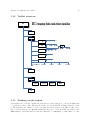
The main pipeline processing consists of several well defined steps, which are explained in the
following sections.
6.1.1
Dark subtraction
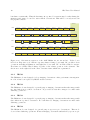
Scaled super-dark images are subtracted from the raw data. For the scaling, dark count offset
is calculated within the pipeline, by comparing average counts at the slit-mask-covered portion
of the pre-dark image, and the corresponding area on the super-dark image.
Additionally the average dark counts of the mask-covered portion of each observed sub-frame
is measured, except for LG2 for which there is no good dark area on the spectroscopy images for
measuring the dark level. The averaged offset is added to (or subtracted from) the super-dark
to make the scaled super-dark.
6.1.2
Linearity correction
Linearity correction is made following the method adopted for imaging data reduction.
6.1.3
(monochromatic) Flat-fielding
In the case of the slit-less spectroscopy, the entire FOV is the aperture for the background
sky, but the object image itself is the aperture for the object. This aperture size difference
makes difficulties in flat-fielding the slit-less spectroscopy images since, unlike a conventional
long-slit spectrograph, a given pixel can be illuminated by background photons with a range
of wavelengths within the disperser’s passband, and the mixing fraction of photons of different
83